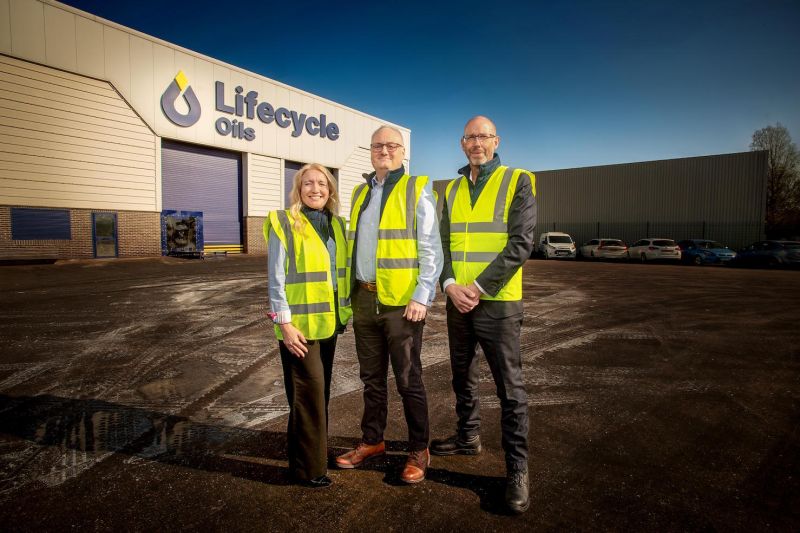
Aviation is one of the hardest industries to decarbonise, writes Suzanne McKenzie, Sales Director at Lifecycle Oils. Aircraft require energy-dense liquid fuels to deliver range and performance, and unlike cars or buses, large-scale electrification or hydrogen propulsion isn’t currently possible, and is still many years away. This leaves Sustainable Aviation Fuel (SAF) as the only commercially viable route to reducing aviation emissions at scale in the near to mid-term.
Among the feedstocks being explored, waste oils – particularly used cooking oil (UCO) – stand out as one of the most effective and sustainable solutions. At Lifecycle Oils, our focus is on transforming this waste into high-quality biofuel feedstocks and advanced fuels that meet both performance and sustainability demands.
The Carbon Case for UCO
First-generation biofuels, produced from virgin crops like soy, palm or rapeseed, face well-documented issues: land-use change, deforestation, biodiversity loss and competition with food crops.
In contrast, UCO is a true waste stream, avoiding the need for additional agricultural production and its associated carbon impacts.
Lifecycle analysis (LCA) studies show that UCO-based biodiesel delivers 80-90% lower greenhouse gas (GHG) emissions compared to fossil diesel across the fuel’s life cycle. When converted to SAF via hydroprocessing technologies, UCO-derived fuels can cut aviation emissions by 70–80% on a lifecycle basis, depending on the refining pathway and blending ratio.
To put this into perspective:
- Burning one litre of fossil jet fuel emits around 5kg of CO₂e.
- SAF from UCO typically reduces by two-thirds, according to National Renewable Energy Laboratory reports.
When scaled across millions of litres of fuel used by airlines daily, these reductions add up to meaningful climate impact.
Mandates Driving SAF Adoption
The policy environment is accelerating the shift toward SAF. In the UK, the Sustainable Aviation Fuel Mandate will require airlines to use at least 2% SAF by 2025, rising to 10% by 2030. The EU’s ReFuelEU Aviation Regulation is even more ambitious, mandating a 6% SAF blend by 2030 and increasing to 70% by 2050.
Globally, the International Civil Aviation Organisation (ICAO) has set a long-term aspirational goal of Net Zero aviation emissions by 2050. SAF from UCO will play a central role in meeting these targets, particularly as it is already approved under international standards (ASTM D7566) for blending up to 50% with conventional jet fuel.
Converting Fryer Oil to Flight Fuel
The technical pathway from UCO to SAF involves several stages:
- Collection – Our ISCC and REDcert-accredited team collect UCO from food manufacturers, caterers, and restaurants.
- Filtration, Settling & Pre-treatment – The UCO is filtered to remove contaminants & processed using a multi-stage filtration and settling process into a specification suitable for pre-treatment and biofuel feedstock.
- Hydroprocessing – The pre-treated UCO undergoes hydrotreating using hydrogen to remove the oxygen from the free fatty acids, converting the carbon bonds into long chain hydrocarbons.
- Hydroxygenation – The process continues hydrocracking these hydrocarbons to break them down into shorter molecules through isomerisation. This is critical for creating a fuel with the correct freezing point and combustion properties for jet engines.
- Blending – The resulting SAF is blended with conventional jet fuel to meet aviation fuel standards (2% 2025 growing to 10% by 2030).
From 1,000 litres of UCO, it is possible to produce around 500-850 litres of SAF through hydroprocessing, depending on process efficiency.
Our processing plant can also create feedstocks for other fuels like HVO and other Biofuels.
Lifecycle Oils: Scaling Circular Innovation
In May 2025, we opened a new UCO processing facility in Wednesbury, West Midlands, capable of producing over a million litres of biofuel feedstocks each week. The site integrates collection, filtration, settling, pre-treatment, and production, and can be powered entirely by our own LF100 biofuel, creating a circular, low-carbon production model.
The facility can handle diverse UCO inputs, from 60L barrels and 120L bins to 1,000L IBCs and bulk tankers, collected from across the UK food industry. Once processed, the UCO becomes LF100 and a high-quality feedstock for advanced fuels, including SAF.

Meeting Aviation’s Decarbonisation Needs
Airlines face a steep decarbonisation curve. With global passenger demand forecast to more than double by 2050, cutting emissions while growing capacity will require rapid scaling of SAF. Current global SAF production stands at just over 1,000 million litres per year – less than 0.1% of aviation fuel demand. To meet 2030 mandates, this must rise to tens of billions of litres annually.
Waste oils like UCO cannot meet all of this demand alone, but they represent one of the most immediately scalable and sustainable options. Importantly, UCO-derived SAF provides an essential “bridge fuel” that can be deployed today, while longer-term solutions such as hydrogen and electric aviation mature.
Closing the Loop in Aviation
The transformation of UCO into SAF is more than just a technical achievement – it is a powerful example of the circular economy in action. Waste from the food industry becomes the energy source for another: aviation.
At Lifecycle Oils, our mission is to expand this model, maximising the value of waste streams while driving down emissions across industries. By ensuring that every litre of UCO collected can be converted into sustainable energy, we are helping to deliver the low-carbon fuels the aviation industry urgently needs.
From Kitchen to Cockpit
The journey of UCO from fryer to flight is a compelling example of how circular thinking can tackle complex decarbonisation challenges. For aviation, where the clock is ticking on Net Zero commitments, UCO-derived SAF is not just an option – it’s a must.
At Lifecycle Oils, we are proud to be enabling this transition, scaling up production, and proving that the fuels of the future are already here. Yesterday’s cooking oil is helping to power tomorrow’s flights – and in doing so, reshaping the future of sustainable aviation.
Additional information about Lifecycle Oils can be found at https://lifecycleoils.com/
More news can be found here: https://essmag.co.uk/category/news/