Offshore wind is playing a vital role in delivering clean, reliable power at scale. And with the foundations of these mammoth structures being exposed to some of the harshest environments imaginable, protecting them from corrosion is tantamount to protecting our energy security.
Given positive experiences on previous projects in collaboration with EnBW, Steelwind Nordenham steel fabricators turned to Sherwin-Williams when working on He Dreiht, Germany’s largest wind farm and a showcase for modern, sustainable infrastructure.
Our renewable future
The EnBW offshore wind farm “He Dreiht” comprises 64 turbines with a total capacity of 960 megawatts, and is one of the first wind farms in Germany to be built without government subsidies
Covering an area of around 90 kilometres near the island of Borkum in the North Sea, it is one of Europe’s largest energy transition projects. By spring 2026, it will be able to supply 1.1 million households with renewable energy. It plays an integral part in the country’s future energy plans, making its protection from the elements a crucial consideration.
Matthias Winkler, at Sherwin-Williams, said: “Off-shore wind monopiles are exposed to aggressive environmental conditions every day.
“Rising from the seabed, these steel structures encounter saltwater immersion, strong currents, wave impacts, and fluctuating splash zones, all of which leaves them highly vulnerable to corrosion.”
Off-shore wind facilities are expected to run with minimal maintenance for more than 30 years. A small failure in a coating system, then, can often go unnoticed until it is too late, leading to increased repair costs and expensive extended downtimes.
“The monopiles are the backbone of the entire wind farm. If they fail, the turbines fail.”
Coatings and challenges
Protecting monopiles from corrosion, then, is not just a technical necessity. It is a matter of safety, sustainability, and energy reliability.
Corrosion protection coatings act as a barrier between the metal and its environment, preventing corrosive elements like water, oxygen, and salts from reaching the surface. Sherwin-Williams’ Dura-Plate SW-501 Series is a 100% solvent-free and benzyl alcohol-free high-build epoxy coating that forms a dense, impermeable layer over the steel surface. With outstanding structural integrity, these coatings offer long-term protection for turbine investment while delivering safety and reliability well beyond their expected service life.
Choosing the right coating, however, can be challenging. Traditional options are not designed to withstand the decades of light-touch maintenance that is central to the wind farm business model. Rather, they are based on the very different needs of manned oil and gas platforms.
Many contain volatile organic compounds (VOCs) and harmful solvents that can evaporate into the air, threatening applicator safety. VOCs can also contaminate water, necessitating time- and resource-sapping post-application treatment before installation.
Some coatings can be difficult or slow to apply, reducing build efficiency. Others do not meet relevant standards and regulations, such as VGBE-S-021-02-2023, NORSOK M-501 or ISO 12944-9 2018.
Industry leading
Due to their extensive experience working with Sherwin-Williams on a range of projects, Steelwind Nordenham and EnBW were well aware of the coating system that best met their needs.
Dr. Andreas Liessem of Steelwind Nordenham, says: “For Steelwind Nordenham, reliability and quality are non-negotiable. Our reputation depends on delivering foundations that will stand the test of time.
“By choosing the Sherwin-Williams Dura-Plate SW-501 coating system, we’re not only ensuring 25 to 30 years of corrosion resistance in one of the toughest marine environments, but also helping safeguard Germany’s energy security and the end user’s investment.”
“Together with our partners, we pursue sustainable solutions that create long-term value”, he continues.
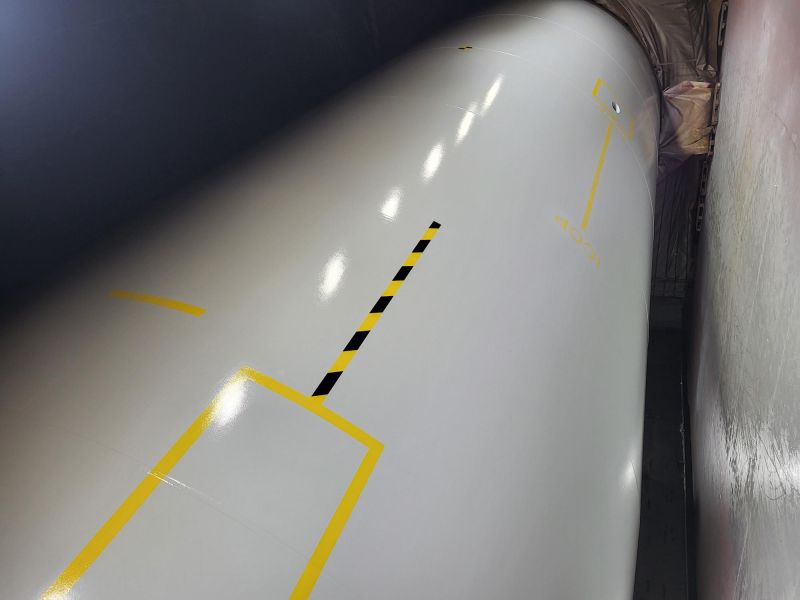
Application of the 100% solvent-free coating system took place at Steelwind Nordenham’s advanced fabrication facility in northern Germany, where the massive steel monopiles, each measuring up to 71 metres in length and weighing approximately 1,350 tons, were produced.
Steelwind’s applicator partner, Robert Krebs GmbH from Hamburg, used manual airless spraying to ensure consistent film build and surface coverage across the vast steel structures.
Matthias Winkler notes: “Despite the scale and complexity of the task, the project was completed smoothly and without any application issues. This is testament to both the product’s ease of use, and the professionalism of the project partners.”
Close collaboration between all three partner companies ensured the system met all regulatory and client requirements. As part of the He Dreiht offshore wind project, Steelwind Nordenham once again relied on the proven protective coating Dura-Plate SW-501 this time on a foundation of exceptional size. The application process went smoothly and impressed with outstanding surface quality.
Dura-Plate SW-501 exceeded expectations in two key areas: excellent handling during application and superior surface finish after curing. This confirmed the coating as a reliable solution for demanding offshore structures and highlighted its role in a long-term corrosion protection strategy.
Secure energy future
Coating technology is fundamental to building a sustainable energy future, helping to ensure steel monopiles will stand strong beneath the waves for decades to come.
By protecting the very structures that anchor our clean energy infrastructure, the industry is helping to secure not just the longevity of wind farms, but the reliability of renewable power for generations to come.
Learn more: https://www.sherwin-williams.com/
For more news: https://essmag.co.uk/category/news/