By Richard Butland, CEO, Highview Power
Richard Butland
The UK is striving for a clean power system where over 90% of demand is met by clean sources by 2030 with gas-fired generation used only rarely to ensure security of supply.
Right now, over 40% of the UK’s power comes from renewables – and a natural part of that and the wider transition to a clean power system is periods of excess electricity. This problem has highlighted the need for storage solutions that offer ways to ensure more clean energy reaches our grids and our homes – the more we can store, the less we waste.
The need for LDES
Currently, we are wasting or curtailing the equivalent of 7 terawatt hours a year, just over 2.5% of our nation’s entire energy consumption. By 2030, we’ll grow our share of renewables by 5 to 8 times – that could turn 7 terawatts into 40 terawatts if we were to build out all the renewables and, even more, if we don’t utilise storage.
Policy is rightly prioritising storage technologies which provide both storage and flexibility to the grid. NESO is clear that we need many storage technologies of long and short duration, including batteries, pumped storage, hydrogen and infrastructure upgrades to deliver this whole system change. Up to 8GW of Long Duration Energy Storage (LDES) have been targeted, defined as storage of longer than 8 hours, by 2030.
In October, the Government announced a cap and floor mechanism for LDES alongside Ofgem’s first allocation round for the technology – which is building further investment and allows for assets to be deployed more quickly.
How Liquid Air Energy Storage works
To deliver grid flexibility we want technology solutions that are fully locatable and adaptable – suitable in locations of high congestion and demand on our network. They must also be modular and specific to the location’s requirements.
In our ever-demanding world where we seek to reduce emissions, deliver more clean power and meet decarbonisation targets, our solutions must be near zero-carbon. Highview Power’s liquid air energy storage (LAES) technology can deliver against these demands.
The LAES technology, which is a form of long duration energy storage, provides storage for days, to weeks, to months, with zero carbon stability solutions. By providing stability, we can maintain the frequency – voltage, inertia and short circuit, which the grid needs for balancing supply and demand.
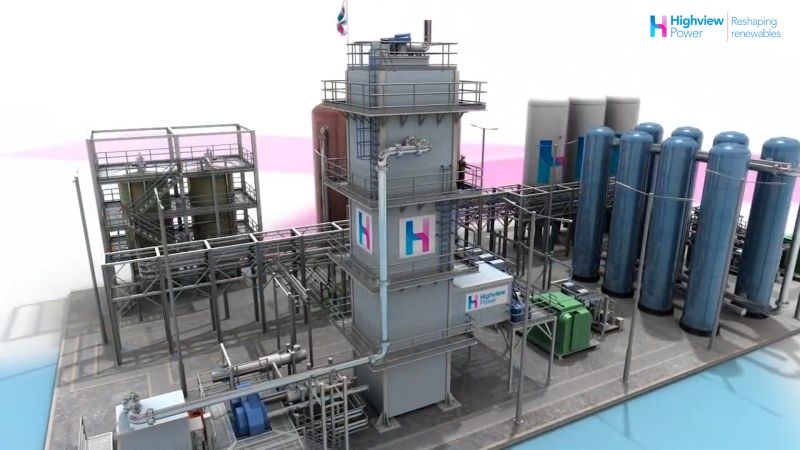
It works by drawing in ambient air, pressurising and compressing it. It uses electricity during periods where it’s abundant and would otherwise be wasted. The air is cleaned, dried and refrigerated until it liquefies. This is a core process that has been established in the industrial gases and LNG industry for decades – the only difference is that we are liquefying ambient air, not natural gas. This takes the air to -160°, converts it to a liquid, and from there we extract heat and store it in insulated tanks which are 46 meters in height and five meters in diameter.
At -160° we open a valve and add heat to the liquid, which accelerates the expansion and powers a standard steam turbine. This closes the loop on the system so electricity is not used to heat up the liquid air. In the process of expansion there’s lots of cold and we store it to use when we next need to freeze and liquefy air.
Highview’s IP has been developed over 15 years. The components and the supply chain have been running for decades, but it’s the integration and the IP that are innovative. As the technology is modular, we adapt it for different locations depending on grid requirements with no geographic constraints and a small build footprint.
The integrated systems can be decoupled and run separately to provide zero carbon stability units, with the equivalence of a nuclear facility or medium-to-large CCGT minus the carbon. The stability island can provide structural inertia being a large rotating mass that acts as a protection to barriers on the system.
There’s no transition without LDES
Highview Power already has a pipeline of four liquid air long duration storage sites in development and there is a significant pumped hydro plant in development – these projects are the closest to delivering against the 2030 targets with the LAES plants being locational to provide enhanced capability to the grid. With the cap and floor mechanism forthcoming, now is the time for LDES to accelerate, offering significant opportunities for this leading UK technology. Put simply, there’s no energy transition without LDES!