With continued energy market volatility, solar technology leader Solivus explains the critical role that lightweight solar is playing in helping large commercial premises speed up the clean energy transition, safeguard against price hikes and lower their energy bills.
The reality is that the energy crisis is still far from over. Though energy prices have fallen since summer 2023, they are still well above pre-‘energy crisis’ levels and are due to increase in autumn 2024. This will bring new cost pressures for many businesses, especially large commercial premises with their enormous size and scale.
But it isn’t just a cost issue – it’s about energy security too. Solar PV enables large commercial building owners to lock-in a portion of their energy supply with low costs, and clean on-site generation for 25 years. Many commercial buildings cannot accommodate the weight of conventional solar PV systems or have roofs that are unsuitable for conventional installation methods.
Fortunately, the market has responded with a plethora of innovative technologies which can balance the need for energy security and sizable carbon reductions while reducing costs for commercial suppliers. One such example is lightweight solar.
Recent years have seen the latest generation of lightweight commercial solar quickly come to the fore as a way for businesses to manage energy costs through self-consumption. And for good reason. Foremost, with their big sweeping rooftops, investing in solar is an obvious solution for commercial premises seeking to generate their own clean, green energy.
A game-changer
Of course though, this approach hasn’t always been possible for many commercial operators. This is because traditionally, solar was once confined to robust permanent structures able to withstand the weight of rigid roof-mounted solar panels and therefore not suitable for hangers, warehouses, stadiums and other commercial builds. But thanks to advances in technology, a new innovative lightweight solar system offers a fraction of the weight of conventional panels and has more universal applications for fixing methods which have opened up new roof space opportunities.
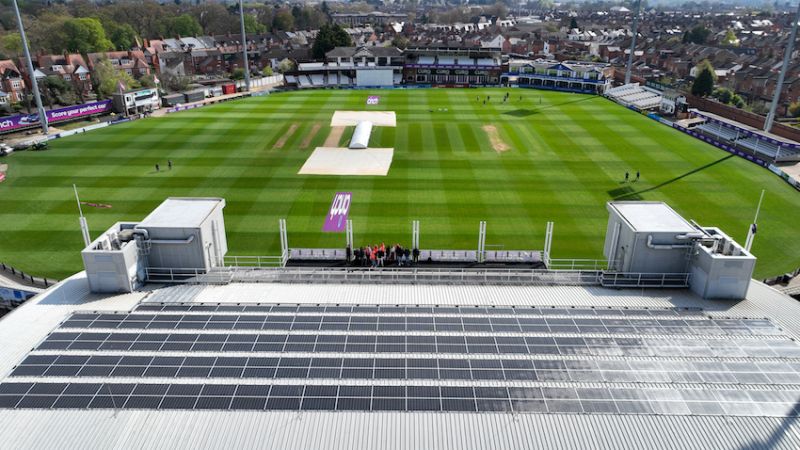
A great example of this opportunity can be found in Solivus’ recent work with Northamptonshire County Cricket Club (NCCC). Hereby, as part of its commitment to sustainability, the club sought to take advantage of the self-generation opportunity afforded by solar. However, the stadium’s extensive roof, like many sports centres and stadiums, wasn’t able to take the weight of traditional glass solar panels.
Cue the game changer: Solivus’ lightweight solar systems. Unlike traditional solar installs, Solivus’ systems use flexible lightweight panels which are up to 70% lighter than traditional panels.
Constituting a step change in solar innovation, the solution comprises a 2x1m fibre-glass board, at a thickness of just 2mm, embedded with photovoltaic cells of less than 1mm depth. Despite a seriously thin form the result is a powerful performance rated at over 19% efficient – which is similar to that of heavier panels.
Commissioned in March 2023, the final system comprised a total of 221 lightweight solar panels. A year later, and the latest operational data has shown that not only has the system decarbonised the stadium by producing cleaner, greener energy, but also enhanced the financial returns for the club. As of August 2024, operational data reveals the installation has seen total estimated savings for NCCC of over £20,000, with an annual ROI of 10.8%. To date, the installation has saved over 15,900 kg of CO2e.
Underscoring this too is a dedicated operations and maintenance (O&M) programme designed to ensure the project continues to reach its full value potential. This is supported with a five-year workmanship warranty, a twelve-year product warranty and a twenty-five-year performance warranty.
Evening the playing field
There is no escaping it; the energy transition is on. While this brings new complexity for commercial businesses, it also provides an opportunity to reimagine their sustainable strategy and take advantage of innovation.
The good news in this is that while traditional solar has often proven problematic for many commercial buildings, the newest generation of lightweight innovation has been designed to provide a flexible, agile alternative and even the playing field. With benefits that include sizable cost savings, power supply reliability, energy independence and improved environmental credentials, surely it’s time to give this important innovation the green light?
For more information please visit www.solivus.com