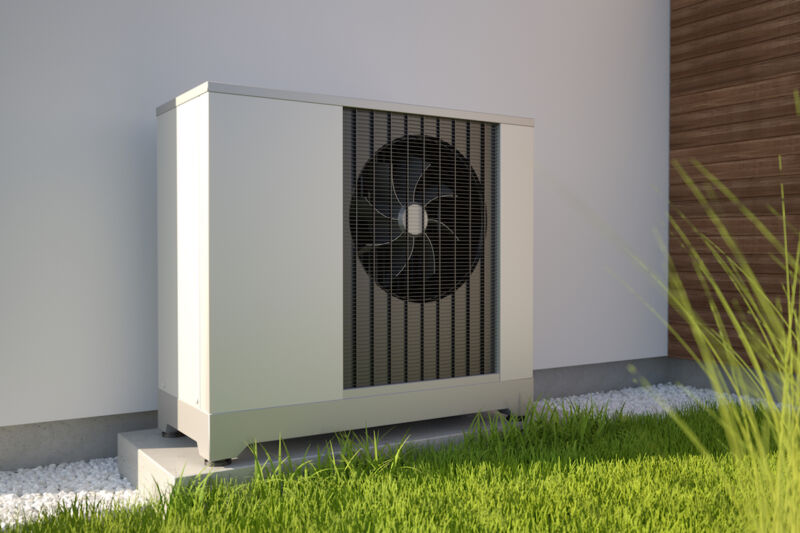
Heat pumps provide an alternative way to heat our homes and businesses without burning fossil fuels. Implemented in combination with renewable electricity supply, heat pump technology provides a low, or even zero carbon heating solution, and plays a prominent role in most projected net-zero scenarios.
Patent filing statistics are a useful lens through which to view technological development. In the case of heat pumps, patent statistics depict a steady increase in inventive activity between 2010 and 2020, with a growth rate of 190% over this ten-year period. This compares with growth of 113% over the same period for climate change mitigation technologies as a whole. With a diverse range of new technologies competing for an established place in our clean energy future, this statistic is an encouraging sign for heat pump technology.
In recent years, patent filings relating to control of heat pump operation dominate. For example, controlling the flow of refrigerant, or operation of the compressor in response to detected conditions. This reflects the general trend of innovators seeking to optimise heat pump energy performance. More generally, we see an increase in innovation integrating heat pumps into whole-building energy systems serving to optimise energy efficiency of the building as a whole.

There are different types of heat pump: air source, ground source and water source, all of which have grown in popularity in recent years. Ground and water source heat pumps are naturally the most efficient because ground and water temperatures are higher and less variable than air. However, the practical implications of laying heat exchange pipes in the ground or in a body of water make air source heat pumps a more practical solution in many cases.
In response, innovators have focussed on improving the energy performance of air source heat pumps, which can be fitted to the side of most buildings, with the result that their energy performance has improved dramatically in recent years.
Recent innovations also focus on compactness, improving the visual appearance of heat pumps on the side of buildings. Another technological trend over recent years is a move towards inverter-driven variable speed compressors. Conventionally, heat pumps operate at 100% output until they achieve a desired temperature, at which point they cycle between a 100% on state and a 0% off state to maintain that temperature.
Inverter driven heat pumps, however, use a variable speed compressor to adjust their output between 0 and 100% in response to internal and external temperatures and other conditions, in order to maximise efficiency and provide a workable solution in colder conditions.
We also see innovation aimed at reducing the global warming potential of refrigerants, which are highly potent greenhouse gasses. In principle, the refrigerant should be fully contained within the heat pump for the lifetime of the product and can be extracted for reuse at the end of this lifetime. However, with large scale deployment of heat pumps, the issue of leakage and ineffective disposal adds up to a big problem for climate change.
Author: Georgina Ainscow, Partner, Reddie & Grose