Nearly half of UK businesses think Net Zero is a high or very high strategic priority. But fear of greenwashing accusations means some companies are greenstalling – slowing down their decarbonisation ambitions. James Hampshire, Business Development Manager at Powerstar looks at some of the latest research, and the incremental steps companies can take to start their climate change journey. He highlights two modern energy management technologies that can provide immediate benefits when embarking on a Net Zero strategy.

James Hampshire
Analysis-paralysis: starting your decarbonisation journey
In a recent report, RepRisk note that last year saw a slight drop in greenwashing incidents in the UK, with a year-on-year decrease of around 4%. However, they also point out that there is a 179% rise from reported levels six years ago. The same report highlights a UK anti-greenwashing rule, requiring firms to demonstrate that products and services properly deliver on their environmental promises. And 79% of respondents to the Breaking Business Barriers to Net Zero report agree that greenwashing presents a major reputational risk. Hardly surprising, then, that companies might be greenstalling – stuck in analysis-paralysis – given the potential for reputational damage.
For many businesses, there are both internal and external elements affecting the feasibility of embarking on a Net Zero strategy. Fear of scrutiny is one factor: but greenstalling is not only driven by fear of accusations of greenwashing. Barriers and challenges to Net Zero progress include regulatory uncertainty; lack of trusted information sources; and – quite simply – not knowing where to start.
The Carbon Trust and Net Zero Intelligence Unit recommend first steps for companies embarking on their decarbonisation journey,
“Your business cannot do everything at once. Focus first on the areas that can drive the greatest impact, based on a rigorous assessment of the risks and opportunities for your business, and take action there…”

Powerstar transformer
First steps towards Net Zero: updating existing energy infrastructure
While businesses may perceive decarbonisation as expensive and potentially risky, a review of current energy infrastructure can be a profitable starting point. This doesn’t necessarily require significant financial investment, and can even have an immediate payback through emission reductions and reduced energy usage – which means lower energy spend.
Transformers: These are a vital aspect of many manufacturers’ energy infrastructure, stepping up or stepping down voltage. And where companies have on-site renewables – whether as a first stage in decarbonisation or as a means to reduce energy costs, or both – transformers are necessary to integrate solar or wind generation.
The UK’s transformer fleet is ageing: many have been working for over 60 years, despite the design life for a transformer being estimated at around 20 years. Not only does this risk transformer failure and concomitant effects on production, but the inefficiencies associated with operating an old unit create unnecessary Scope 2 emissions, which also means excess Scope 3 emissions for customers.
Upgrading to a modern amorphous core transformer can lower core losses by up to 70%: meaning reduced emissions, lower energy consumption, and related reduced energy expenditure. Looking to your own Scope 3 emissions, if new transformers are purchased from a supplier that manufactures in the UK, this can further reduce transportation-related emissions as compared to the more-prevalent imported units.
Voltage Optimisation: As with transformer usage, many businesses may already have Voltage Optimisation (VO) as part of their energy infrastructure and – similarly – upgrading older VO systems can offer significant energy efficiency improvements.
Where the National Grid supplies an operating voltage that averages at around 242V to meet its statutory obligations, most UK electrical equipment operates at 220V. This overvoltage leads to wasted energy, with unnecessary emissions and higher energy bills. It also puts equipment under stress, creating wholly-avoidable wear and tear, and shortening equipment’s lifespan. This leads to additional maintenance and early-replacement costs. VO regulates incoming voltage, to ensure optimum voltage levels, while unnecessary voltage can be returned to the Grid.
For companies upgrading their existing VO or considering investing in VO for the first time, more modern and dynamic VO technology can provide real-time voltage management, for greater performance reliability and longevity. In either circumstance, a full site survey should be undertaken, incorporating voltage profile analysis and evaluation of critical load, to ensure the technology is an appropriate solution. Where VO is recommended, if it incorporates remote monitoring then site consumption can be logged, including harmonics and power factors, providing energy managers with real-time performance data to enhance resource efficiency.
For any site where overvoltage is an issue, VO is an efficient and easy-to-install way to address carbon-related and cost issues, providing a better-conditioned power supply. It is a long-established technology but, where a company looks to VO with modern, dynamic improvements, it is risk-free and transparent – demonstrating gains against initial investment.
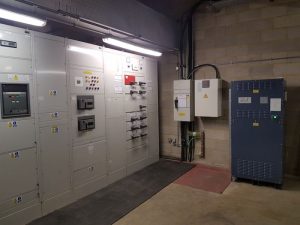
Voltage optimisation installation
Setting a baseline: accelerating progress on a Net Zero strategy
The CDP (previously the Carbon Disclosure Project) is unequivocal,
“To deliver a clear Net Zero transition, businesses must set out how they will pivot assets, operations and ultimately, entire business models towards Net Zero-aligned emissions reductions.”
Businesses are concerned about budgets, costs, and return on investment: to protect the bottom line, and to help ensure stakeholder buy-in for longer-term Net Zero transition plans. For initial, incremental steps towards decarbonisation, pivoting assets – replacing outdated equipment with modern alternatives – represents a clear opportunity to reduce emissions while also lowering energy spend. Where these form the first step towards a longer-term Net Zero strategy, it is important to work with a supplier who provides full site surveys – prior to commissioning – to demonstrate the business benefits of any proposed solution.
Meeting longer-term targets: the need for security and support
Companies may be looking to the longer-term, to possible investment in Battery Energy Storage Systems (BESS) and, potentially, to an even longer-term investment in a resilient microgrid solution. In this instance, a Digital Twin – digital modelling as part of a feasibility study – can be crucial to demonstrate the efficacy of any proposed new energy management solution: ensuring that the project can be delivered on time and within budget.
Ultimately, there is a strong commitment across UK business to decarbonise and achieve sector-specific as well as UK-wide Net Zero targets. But support is crucial: clarity on legislation and regulations; industry body leadership on sharing best practice; and investment to enable the UK-wide energy transition.
Not just a destination: Net Zero is a journey
In the short-term, companies who may be stalling on implementing a Net Zero strategy can benefit from proven technologies: where emission reduction can be bolstered by lower energy spend. A progressive energy management plan can reap financial benefits in the immediate-term. Avoiding greenstalling can be doubly-beneficial: demonstrating emission reductions while reducing energy spend, with the right collaboration – an energy technology specialist who understands that Net Zero is a journey.
To discuss your Net Zero journey, contact Powerstar:
W: www.powerstar.com E: info@powerstar.com T: 0333 230 1327