Across UK manufacturing and processing sectors, the pressure to decarbonise is intensifying. As one of the most emissions-intensive parts of manufacturing, thermal processes are increasingly being scrutinised. Yet, while the ambition to decarbonise is clear, the pathway is rarely straightforward. writes Etienne Fourie, Process Engineering Department Manager, Babcock Wanson UK.
The scale of the industrial heat challenge
While UK greenhouse gas emissions have decreased, government analysis indicates that around half of industrial energy consumption remains fossil-based. There are various reasons behind this, but the move away from fossil fuels is made all the more challenging by the nature of industrial equipment. Many sites rely on long-life assets that remain operationally sound and economically valuable. Boilers, thermal fluid heaters and steam systems are typically designed for operating lives measured in decades. It is not uncommon for well-maintained Babcock Wanson systems to run for 30 years or more. From both financial and sustainability perspectives, prematurely scrapping these assets can be difficult to justify.
In this context, the most pragmatic decarbonisation strategies are those that choose incremental, flexible decarbonisation pathways, adapting and optimising existing plant along the way.
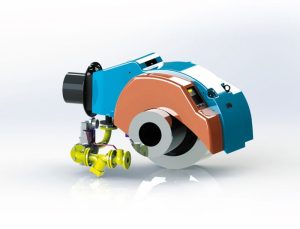
Modulo+ burner
Start with efficiency: the lowest-risk carbon reduction
For many sites, the fastest and most cost-effective carbon savings still come from improving system efficiency before considering fuel switching or electrification.
Measures such as advanced burner tuning, improved insulation, steam trap maintenance, and optimised blowdown control can deliver meaningful gains with relatively modest capital outlay. Certainly, consider investing in a modern energy-efficient burner with a high turndown, such as our Modulo+ gas burners which are designed with digital micro-modulation control and specially developed combustion head for a turndown of 12:1.
The condition of the water feed cannot be underestimated in efficiency and equipment longevity, so it is vital to use the correct water treatment chemicals and additional measures where necessary and suitable.
Digital monitoring is also playing a growing role. Real-time performance data and predictive maintenance tools allow operators to identify inefficiencies early, reduce unplanned downtime, and build a clearer picture of energy use across the plant. Our Navinergy digital platform, for example, provides 24/7 boiler room performance monitoring alerting users to deviations in equipment operation and water quality enabling them to take action where required.
Waste not, want not
Waste heat recovery is particularly valuable. By installing flue gas economisers or condensing heat exchangers, sites can capture exhaust gas energy generated by the combustion process that would otherwise be lost and feed it back into the process, reducing fuel consumption and associated emissions. In the case of our R-Eco, the overall efficiency of a boiler can be increased by up to 98% whilst also reducing NOx emissions.
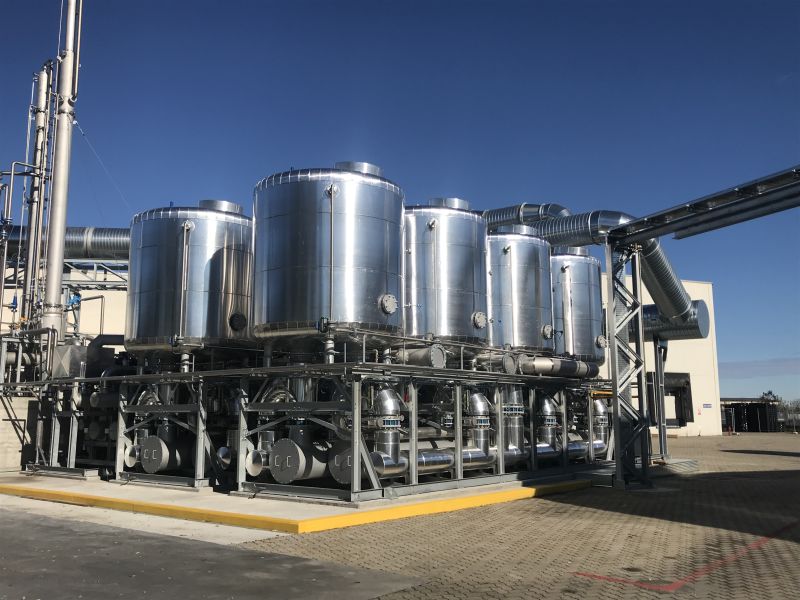
But it’s not just heat that can be recovered. Solvent recovery systems, such as those manufactured by DCT, allow for a very high level of purity for the recovered solvents to then be reused in production.
Electrification and the role of hybrid systems
Electrification is widely recognised as a key route to industrial decarbonisation, particularly for low and medium temperature processes. Technologies such as electric boilers and thermal fluid heaters, resistance heating and heat pumps are already technically capable of meeting a large proportion of industrial heat demand, although the most challenging applications remain at very high temperatures.
However, full electrification is not always immediately feasible. Phased electrification strategies that introduce electric capacity alongside existing combustion plant, often in the form of hybridised systems, can be more practical. Rather than replacing working assets, hybrid systems allow electric and fuel-fired technologies to operate in parallel, giving operators flexibility over how process heat is generated.

Hybrid Add-on boiler 200kW
For example, our Hybrid Add-on electric boiler is designed to integrate quickly and seamlessly with existing gas or oil fired steam boilers, with minimal integration requirements. Developed by Standard Fasel, part of the Babcock Wanson Group, the modular low-voltage Hybrid Add-on boiler connects directly into an existing installation, providing additional steam capacity using electricity. By allowing operators to switch flexibly between fuel and electricity depending on energy prices and availability, the system supports resilience in an increasingly complex energy landscape.
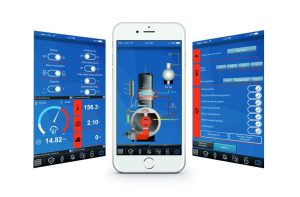
Navinergy digital platform
Building a practical roadmap
In practice, the most successful decarbonisation programmes tend to follow a staged pathway to reduce risk, spread capital expenditure and maintain operational continuity. For operators navigating an uncertain energy landscape, flexibility, system thinking and this careful staging are key.
Babcock Wanson offers a complete range of products and services for boiler houses and other process heating needs.
020 89537111
info@babcock-wanson.com
Click here for more news: https://essmag.co.uk/category/news/