Rolf Bienert, Managing Director and Technical Director at industry body, OpenADR Alliance, looks at what EV corridors are and whether can deliver on their promise of ultra-fast charging.

Rolf Bienert
Despite some challenges in the market, electric vehicle (EV) sales are expected to reach 17 million in 2024. This is according to the International Energy Agency (IEA) that states that more than one in five cars sold worldwide this year is expected to be electric, with growing demand projected over the next decade.
But despite the impressive growth figures, not everyone is buying into the EV revolution. EVs are still around 20-30% more expensive than comparable ICE vehicles, particularly as automotive manufacturers try to fit larger batteries to resolves concerns around so-called range anxiety.
With buyers worried about taking longer journeys because batteries not having enough capacity or more likely, a lack of chargers. If concerns about the absence of accessible and reliable fast charging points is putting people and potentially stalling the EV markets, could the idea of EV corridors be the answer?
Pioneered in the US
This was pioneered by Tesla in the US with its proprietary charging network designed for Tesla owners. Since then, other automotive companies have signed up to access the Tesla EV charging infrastructure across the country. Tesla chargers are known as Superchargers, they have set the standard for EV charging and make up three out of four fast chargers.
The US is one of the biggest EV charging markets and well-funded for future development. The Biden Administration announced more than $7 billion in funding for the country’s charging infrastructure as part of its bi-partisan infrastructure law passed in 2021. Many projects will focus on electrification for heavily trafficked domestic corridors, as well as freight corridors as part of its plans to reduce emissions from these routes.
Europe’s move to charging corridors
In Europe, EV corridors are attracting attention from some of the biggest names in the business. In 2022, bp pulse, the electric charging division of bp, announced plans to invest up to £1bn in the UK’s EV charging infrastructure and up to €100mn in Germany’s EV charging infrastructure by 2030.
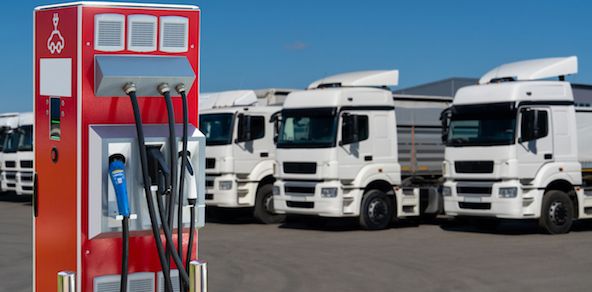
Last year, the company launched a truck charging corridor along a 600km stretch of the Rhine-Alpine corridor across Germany with 21 charging locations with ultra-fast charge points. This is one of busiest road freight routes in Europe, connecting ports in the North Sea with those in the South in Italy, aligning with bp’s mission “to provide accessible and strategically positioned charging infrastructure for our customers along the major truck corridors in Europe”.
Having dedicated e-truck charging stops like this, complete with rest facilities makes sense, providing convenient places for drivers to take mandatory rest breaks. But it’s all part of the bigger picture, giving freight operators confidence that the infrastructure is in place, and accelerating the journey towards decarbonising freight (and passenger) transport.
The ripple effect
With big name companies making significant investments in charging infrastructure, we can expect to see a ripple effect with more dedicated public EV charge stops being developed and the opportunity for more innovation. The potential is to create a series of EV corridors – or perhaps we should call them ‘EV superhighways’ – criss-crossing the whole of Europe and beyond.
Earlier this year, Greenlane announced a major project that features a 280-mile charging corridor that eventually could stretch from Las Vegas to Los Angeles. While Renewable Properties, a California-based renewable energy developer, has launched an EV fleet charging service. A developer and investor in small-scale utility and community solar projects, it plans to leverage its community solar development, and electrical infrastructure expertise to provide a turnkey charging solution for companies electrifying their truck fleets.
Ultra-fast public charging across major routes that work in tandem with millions of charge points at homes, workplaces and other destinations, will create an infrastructure that’s fit for purpose, and which can meet the needs of all EV users, from freight operators to passenger cars.
Potential for growth
This potential for growth offers huge opportunities for many parties.
As a global industry alliance, the OpenADR Alliance has seen a growing number of organisations operating as part of the wider EV ecosystem joining our ecosystem – from automotive manufacturers like Ford Motor Company, to those developing EV charging management systems, software tools and payment systems. Through the promotion and adoption of OpenADR as part of a robust and reliable EV charging infrastructure, I believe we can play an important role as the global market continues to open up.
The rollout of fast-charging EV corridors is a real opportunity and cannot come quickly enough. We are in the early stages where there is no shortage of innovation as companies collaborate to tackle challenges, solve problems and create solutions.