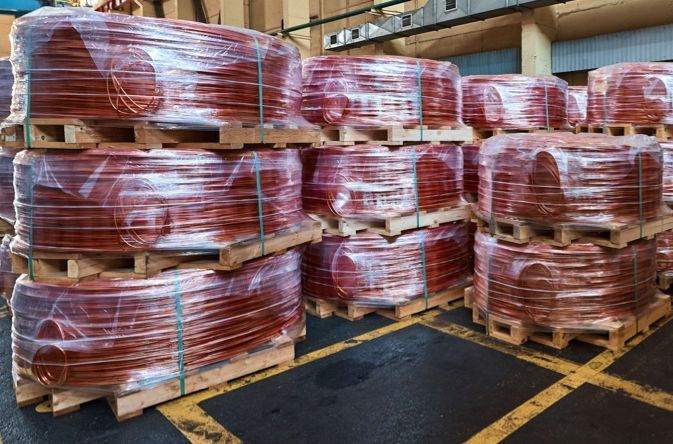
Britain’s grid build-out is mostly discussed in terms of planning consents, supply chains and skilled labour. A fourth constraint is now forcing its way onto the agenda. Copper, the metal that carries almost every electron from a wind farm to a heat pump, has spent much of the autumn trading above $14,000 a tonne on the London Metal Exchange, close to record territory and roughly 30% higher than a year earlier.
For network operators, contractors and the manufacturers, higher copper prices feed straight into the price of cables, transformers, switchgear and busbars as the UK prepares for a major expansion of its electricity network.
Why the Grid Depends on Copper
Copper remains essential to the electricity network because of its excellent conductivity, durability and flexibility. After silver, it is the best conductor available at industrial scale. Transformer windings, underground cables, substation earthing and the conductors inside high-voltage direct current links all depend on this material. Aluminium has long dominated overhead lines, where weight matters more than cross-section, but in high-current and space-constrained applications there is rarely a like-for-like substitute.
Pricing is set globally. The LME copper contract is the benchmark used to index physical supply agreements, and it is quoted in US dollars per tonne. That detail matters for British buyers, because they are exposed to two variables at once: the metal price and the sterling-dollar exchange rate. A copper rally can be partly cushioned by a firmer pound, or amplified by a weaker one. Procurement and treasury teams therefore have good reason to monitor both markets together. Charting platforms such as TradingView can be used in this case to overlay copper against GBP/USD and judge when conditions favour fixing a price or placing a forward order.
What Is Driving the Rally
Several forces are causing the increase in copper prices. Mine supply has been struggling to keep pace with the steadily climbing demand from grid expansion, electric vehicles and the data centres. The International Energy Agency’s most recent Global Critical Minerals Outlook warned that the current pipeline of mining projects points to a potential 30% shortfall in primary copper supply by 2035. Declining ore grades, rising capital costs, and long development timelines are cited behind this claim.
Trade policy adds another layer of risk. Uncertainty over a possible US tariff on refined copper has drawn large volumes of metal into American warehouses, but this tightens availability elsewhere. Disruption at mines in Chile has also added to the pressure.
The Price Control Timing Problem
Ofgem’s RIIO-3 settlement took effect in April 2026. Across gas and electricity, the final determinations approved £28.1bn of upfront investment within a wider pipeline of roughly £90bn over five years. £10.3bn of the initial sum was allocated to electricity transmission, with more expected to follow as projects mature.
However, those allowances were set when copper was considerably cheaper. Regulated companies do have mechanisms that account for inflation and real price effects, but the lag between a cost spike and any adjustment can be long. In the meantime, part of the difference is carried by shareholders and, through incentive sharing, eventually by bill payers.
The next challenge concerns electricity distribution. Network operators are finalising business plans for the ED3 period, which runs from April 2028 to March 2033. Ofgem is expected to reach its decisions during 2027. Those plans must forecast equipment costs years ahead, at a moment when one of their largest material inputs has been unusually volatile.
A Real-World Example
Eastern Green Link 2, a joint venture between SSEN Transmission and National Grid Electricity Transmission, shows the scale of the investment to expand the UK’s electricity network. This is the UK’s biggest electricity transmission project, involving a 436km-long, 2GW, 525kV link that runs beneath the North Sea from Peterhead to the East Yorkshire coast before continuing onshore to Drax. The project carries a reported price tag of around £4.3bn, with operation targeted for 2029.
Flagship schemes of this kind typically secure their main cable supply years before installation, and Prysmian was appointed as EGL2’s cable supplier before construction began. Early commitment offers some protection. However, smaller reinforcements like substation upgrades or connection works are more exposed to price volatility in copper, because they are procured on shorter cycles.
How the Industry Is Responding
Buyers are trying to reduce the risks by leaning more heavily on metal price adjustment clauses. These protect them by tying the final cost of a cable or transformer order to a published copper index rather than a fixed figure. Larger organisations are using exchange-traded forward contracts to lock in part of their exposure.
Engineers, meanwhile, are revisiting specifications. Aluminium conductors are being considered wherever performance allows, and loss ratings are getting closer scrutiny. A transformer may cost more upfront but reduce energy losses throughout its operating life if it is more energy efficient. Recycling is also getting attention since copper can be reused repeatedly without losing its conductive properties. This makes decommissioned network assets a valuable source of secondary supply.

Planning for a Higher Cost Base
Higher copper prices are unlikely to stop the UK’s energy transition, but they add another challenge for the organisations responsible for delivering it. With supply forecasts pointing to a tight market for years to come, network operators, contractors and equipment manufacturers need to watch for both commodity prices and exchange rate movements when planning major projects. Monitoring these markets can help procurement teams anticipate potential cost changes and make informed purchasing decisions. As the UK’s electricity network expands, managing material costs will remain an important part of keeping projects on schedule and within budget.