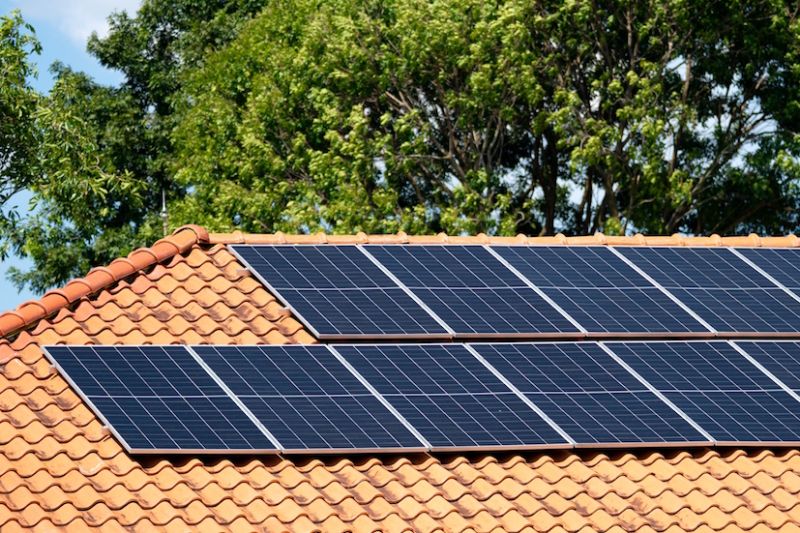
Solar panels on a council house roof do more than cut a bill. For a social housing tenant, they can be the difference between heating a home properly through winter and rationing every kilowatt, as Mohamed Gaafar, CEO and co-founder, Gryd Energy, explains.

Mohamed Gaafar, Gryd Energy
Social housing tenants are among the most vulnerable to fuel poverty, with the least ability to act independently when costs rise. They can’t remortgage to fund an installation, or simply switch tariff their way out of a badly insulated, gas-dependent home.
If the energy transition is going to mean anything for this group, it has to reach the roof over their heads – and increasingly, in parts of the UK, it is.
The benefits go beyond the bill itself. Solar gives tenants a source of electricity that isn’t exposed to the swings of the wholesale market, at a time when volatile prices have been one of the biggest drivers of fuel poverty. And for councils themselves, a decarbonised, higher-EPC-rated housing stock is a direct route to meeting their own net zero and asset management targets.
Local authority performance
We built the Gryd Council Housing Solar Index because there was no clear picture of where the UK stood on solar across council housing. Without that visibility, it’s impossible to measure progress or identify where parts of the country might be getting left behind. Compiled from Freedom of Information requests to local authorities, in the continued absence of any central government dataset, it’s the most comprehensive snapshot we have of how local authorities are actually performing.
The findings surprised us. Nationally, council housing trails the private market: 5.8% of council homes have solar, against 7.8% of private ones. But in Wales, 10% of council homes have it, and in Scotland, 8.6% do, both ahead of the private market. Council housing can outperform, and in these two nations, it already does.
The regional variation underneath those figures is striking. North West Wales leads the UK, with one in three council homes now fitted with solar, followed by North East Wales at 21.7% and Aberdeen and North East Scotland at 13%. Southern Wales delivered the most dramatic single-year shift anywhere in the country, rising from 0.3% of council homes – the lowest in the UK – to 8.1%. Scotland’s Highlands and Islands nearly doubled its rate too, from 4.7% to 9%. In England, the East Midlands stands out, with solar-equipped council homes almost doubling in twelve months and accounting for more than a third of all new council installations nationally.
Local authority benefits
What these leading regions share isn’t better weather. It’s councils willing to commit to solar at scale. In our experience, local authorities are frequently more ambitious than private developers when it comes to installing larger systems, and Wales and Scotland prove that ambition can translate into results.
Part of that comes down to structure. A council is a single decision-maker for thousands of homes, which means it can commission solar street by street or estate by estate, negotiating one contract instead of thousands of individual ones.
Private homeowners don’t have that advantage. Each one has to independently decide to invest, find the capital, and manage the installation themselves. Council housing stock is also more uniform – more semis, terraces and bungalows with straightforward roofs – which makes it easier to standardise and roll out at pace than the UK’s more varied private housing stock.
Funding
For most councils, the barrier is rarely a lack of ambition alone, it is upfront capital, and how best to allocate what is available.
Closing that gap is less about any single fix than a combination of them. The councils making the fastest progress are typically doing three things: treating solar as a rolling, whole-stock programme rather than a series of one-off projects, so they can plan and procure at scale; pairing available grant funding with other finance models – including private investment – to stretch limited budgets further; and prioritising the homes that are easiest and cheapest to retrofit first, to build momentum and evidence before tackling harder stock like high-rise blocks.
Funding is the crux of it. Two of the routes councils have relied on most are closing at exactly the wrong moment: the Warm Homes Social Housing Fund is no longer accepting applications, and ECO4 Flex is nearing the end of its available resource.
It is moving in the right direction, though. If the upcoming tranche of Warm Homes Fund investment is deployed effectively, we could well see more council regions leapfrogging the private market within a year. But relying on public funding cycles alone will always produce stop-start progress. Public funding must remain the foundation, but it needs matching with private capital that can help councils deploy at a scale current budgets simply can’t support alone.
That capital is not hard to find. Private investors have long favoured solar and other renewables, drawn by the maturity of the technology and the certainty of the returns – nearly $1 trillion was invested in solar globally over the last two years alone. The money is there. What’s missing is the policy architecture to let it flow into social housing at pace and at scale.
Wales and Scotland have shown what’s possible when councils commit. The task now is making sure every region – and every tenant, regardless of who owns their roof – gets to share in what the energy transition actually delivers.
Learn more https://gryd.energy/