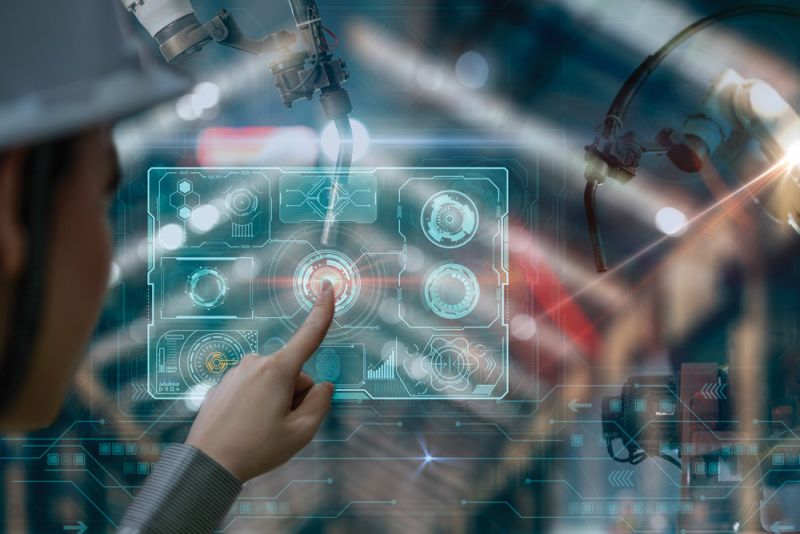
The personal drivers of digital transformation (DX) will vary from business to business, but what is shared across the industrial supply chain is that advanced technologies offer a route to industrial sustainability. The key is that their deployment should be based on climate science.
By Jocelyn Golding, OEM Industrial SI & IAD Channel Marketing Manager, Schneider Electric
Digital transformation and sustainability journeys of industrial companies are intrinsically linked. While each journey will have a unique approach and pace depending on the size and budget of the business, it is a journey that the entire supply chain is on. As we enter 2026, the Net Zero 2050 targets are now less that 25 years away, prompting facilities of all sizes and specialism to review sustainability activities and advance climate strategies in line with digital transformation. UK industry faces additional incentives to decarbonise as the Government continues to tighten emission caps on sectors like aviation, power and manufacturing under the UK Emissions Trading Scheme.
UK industry has already been making strong progress towards its targets, showing a massive emissions reduction of 54% since 1990. As the sector explores digital transformation technologies to further improve efficiency and profitability, using data-driven enhancements to support businesses as they contribute to the collective effort of industrial decarbonisation.
The great climate system
 Understanding the climate science that underpins industrial decarbonisation will help businesses steer their digital transformation journeys for the most benefit, both in terms of sustainability and business goals. Climate science offers the vital metrics that businesses can focus on, like energy efficiency and resource allocation that businesses can apply to their specific processes.
For example, a manufacturer looking to improve sustainability may have already deployed an advanced and efficient production line that operates at a high level of energy efficiency. However, but leveraging a digital twin for product agility also means the operator can take action on effective use of every energy and material resource.
This example is just one improvement in one setting, but industry represents 13% of the UK’s total carbon emissions so by multiplying DX improvements across industry, it’s possible to make a sizeable contribution to decarbonisation of industry.
But this just covers the known, industrial businesses should commit to lifelong learning of climate science to uncover insight that can improve their performance in terms of specific processes. People in roles from purchasing and legal to IT and facilities need specific advice. For example, marketing colleagues can learn about greenwashing legislation to make sure they don’t make incorrect environmental claims.
Developing knowledge around sustainability is not just for end users and business owners. Practically every industrial job role will benefit from climate science understanding, especially for a solutions provider. OEMs and systems integrators already play a vital role in deploying technology that aligns with sustainability objectives, as the experts within the supply chain designing solutions that prioritise energy efficiency and circular economy principles. This level of packaged sustainability works to differentiate OEMs and SIs in a crowded marketplace and help them position themselves as impact makers for industrial sustainability.
Taking action
The first step in a sustainability or DX journey is setting a strategy. Companies that want to align business goals with sustainability objectives must set a benchmark that takes holistic view of operations. They can then outline the actionable steps to achieve that, such as deploying automation, exploring electrification, and leveraging data-driven insights in line with climate science to develop green business practices.
The foundation for these tactics is putting in place a data architecture that allows for interoperability so that businesses can future-proof operations against Net Zero targets, creating a culture of continuous improvement and decarbonisation.
Schneider Electric Sustainability School
 Having been named the World’s Most Sustainable Corporation for a second time by Corporate Knights in 2025, Schneider Electric has opened up its own in-house training to provide sustainability knowledge and skills to the industrial workforce and beyond. With three chapters now available, the Sustainability School is a pathway to bring in-demand expertise and practical tools into a business and elevate a brand’s reputation as an impact maker.
Businesses looking to build sustainability expertise, design for decarbonisation, and advance Net Zero readiness should enrol today.