Over the last two decades, a series of major technological revolutions have fundamentally changed the way companies and their workers across the utilities industry operate on a day-to-day basis, writes Aaron Dosa, Business Development Manager for Utilities sector at Getac.
Between 2006-2010, the launch of services such as Microsoft Azure, Google Cloud Platform and Amazon Web Services (AWS) brought cloud computing into the mainstream for the first time. Their arrival introduced powerful new concepts like massively scalable IT infrastructure, ‘anytime, anywhere’ computing, virtual PCs, and centralised global IT management, enabling organisations to work faster, smarter and more efficiently than ever before.
The rapid adoption of cloud computing soon gave rise to the Internet of Things (IoT), which further transformed utilities operations by allowing companies to connect their physical assets to digital networks for the first time. This turned ideas such as real-time data collection, predictive maintenance and process automation from fantasy into reality, helping to further cut costs, boost productivity, and avoid costly unplanned downtime.
Fast forward to today, and artificial intelligence (AI) is the latest innovation promising to usher in a new wave of productivity and efficiency gains. According to the World Economic Forum, AI is set to contribute up to 14% of global GDP by 2030 – equivalent to about $15.7 trillion – and businesses everywhere are rushing to capitalise on the many benefits on offer. However, for organisations across the utilities industry, realising some of these benefits is proving more difficult than originally anticipated.
The cloud conundrum
The reason for this is simple. A key hallmark of nearly every leading AI model is that they are cloud-based, meaning they require a constant internet connection to function. This is because most digital devices available today lack the powerful hardware needed to run these models at a local level.
While maintaining internet connectivity isn’t an issue for professionals in office environments, it is significantly more challenging for utilities workers who regularly operate in remote facilities and challenging field environments where connectivity is much more limited. Whenever a reliable internet connection isn’t available, they are immediately cut off from cloud-based AI solutions, rendering them useless.
Rugged edge AI solutions offer the missing link
Fortunately, the emergence of powerful new rugged edge AI solutions is changing this by integrating artificial intelligence capabilities directly into the local operating system for the first time, rather than relying on a cloud-based approach.
At the heart of these new devices is an innovative Neural Processing Unit (NPU). Designed to mimic the processing function of the human brain, this unique component is engineered to perform AI-related tasks efficiently, with minimal power consumption. The NPU works alongside the device’s traditional CPUs and GPUs, leaving them free to perform other tasks, which results in a much smoother, more responsive overall experience.
This unique architectural approach enables devices to run powerful AI models locally, without the need for a constant internet connection. As a result, even workers in remote or challenging locations can take advantage of powerful AI features such as voice and content recognition, automatic transcription, image enhancement, intelligent assistance and much more.
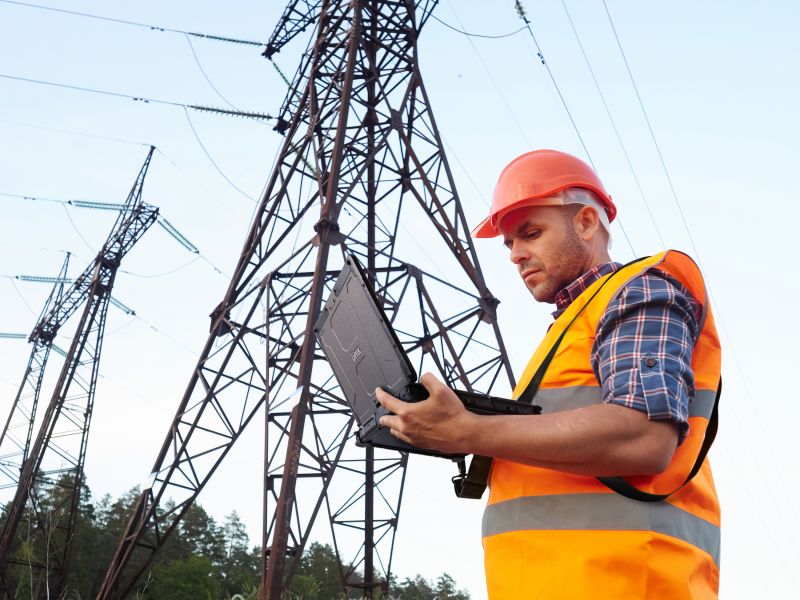
For example, a utility field engineer repairing an asset in a remote substation would traditionally have to run manual diagnostics and spend significant amounts of time searching technical manuals on their device to find a solution to the problem faced. However, using an edge AI device, the same engineer can describe the issue they see to the on-board AI model in natural language, which will automatically search the technical manuals and pinpoint the relevant sections for them in a matter of seconds. The engineer can then choose to read the sections themselves or have the AI model walk them through the repair step-by-step, keeping their hands free to make the repair more quickly and efficiently.
Furthermore, the unique architecture of these devices delivers significant energy savings, as the NPU is designed to consume far less power than traditional CPUs whilst performing AI-related tasks – a key advantage in remote environments where long battery life is often crucial. Data security is also improved because sensitive data remains on the device instead of being sent to the cloud, reducing the risk of data breaches.
Bringing the power of AI to every worker in the critical industries
As the AI goldrush continues to rapidly gather pace, organisations of all shapes and sizes are scrambling to capitalise on the many potential benefits on offer. However, for field professionals across the critical industries, many of these benefits felt out of reach – until now. The emergence of powerful new rugged edge AI solutions is rapidly reshaping the way every worker operates, regardless of what their day-to-day working environment looks like.