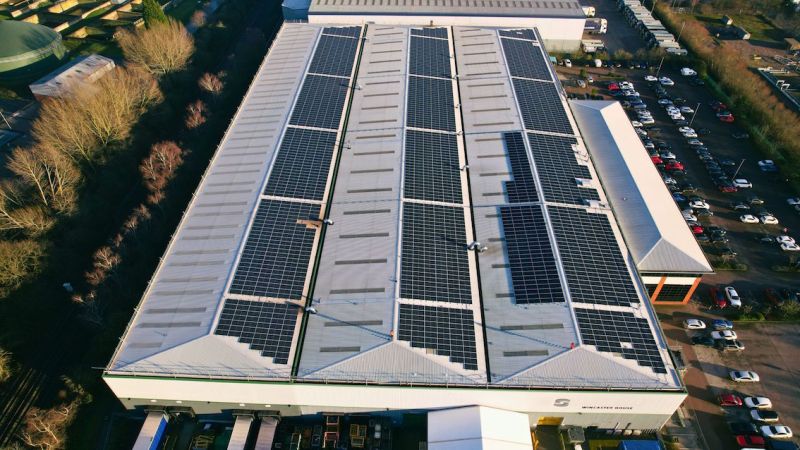
Rooftop solar is one of the fastest growing forms of renewable energy in the commercial and industrial (C&I) sector. As adoption accelerates, questions around fire safety are becoming increasingly common. In this article, Neil Borrill-Carroll, development director at AMPYR Distributed Energy (ADE), looks at the common causes of fires in rooftop solar systems, the importance of robust system design, how collaboration is helping to mitigate risk and the role that best practice plays in increasing confidence in solar power adoption.

Neil Borrill-Carroll
Driven by lower costs and sustainability goals, more businesses are turning to solar. While relatively rare, a fire on a commercial site can be devastating, not only from a safety perspective but also because of the impact on operations, property and insurance coverage.
Understanding the causes
Solar panels are designed to operate safely for decades. However, they are not a fit and forget solution. Like any electrical infrastructure, risks can emerge when product quality or installation is poor or routine maintenance is neglected. RC62, the UK’s joint code of practice on fire safety for solar installations, confirms poor installation practices, inadequate maintenance and product defects as the leading causes of fire incidents[1]. Over time, environmental exposure, physical damage or deterioration of cables and joints can also create points of weakness. These issues can lead to localised heating and, in very rare cases, ignition.
Last year in the UK, fire services recorded 171 fires involving solar systems[2]. While incidents are rare, the potential impact is significant. A rooftop fire can damage not only the panels themselves, but also the building fabric, production areas and electrical systems. It can trigger long insurance claims, disrupt operations and, in some cases, affect business continuity for months. For our customers, these risks are more than theoretical. They are a key consideration when deciding who to trust with a rooftop solar installation.
Designed for safety
Fire prevention must start long before installation. Every system must be designed to meet and, where possible, exceed the highest quality standards, often guided and approved by insurers. Adopting proven design principles that minimise fire risk from the outset is key, including careful cable routing, robust mechanical protection, proper earthing, fully rated isolation and fire protection equipment.
Approved, accredited and certified installation partners with a safety-first approach, proven track record in adherence to design standards and solid experience in C&I rooftop solar delivery are essential to ensuring a quality installation.
Collaborating closely with customers and their building insurers means that installations are designed in line with their specific fire safety requirements. Many insurers have developed detailed guidance on panel placement, access spacing, isolation zones and cable protection. By engaging all stakeholders early in the design process, it means that the approach and outcome are agreed before work begins[3]. Once completed, each installation must undergo a rigorous quality review before commissioning to verify that safety and workmanship are up to standard and fully meet design expectations including the requirements of insurers.
Collaboration and learning in an evolving risk landscape
Fire safety is not a fixed standard, but an area that continues to evolve as technology, regulation and industry knowledge advance. We operate a partner-led model that allows us to collaborate with market-leading installers and technical advisors. Together we review the latest data on incidents, new component types and insurer guidance. We share these insights across our partner network and constantly refine our quality standards. Insights from one project are quickly applied to others, ensuring continuous improvement in both safety and performance. By building a portfolio-wide view, we can spot emerging risks early and take proactive steps to address them.
This approach benefits not just ADE but the wider industry. We actively promote best practice across our partner network and work with suppliers to improve component quality, installation methods and inspection processes. Industry analysis from SolarPower Europe reinforces this view, highlighting that while fire incidents remain rare, consistent quality control and matched components are critical to maintaining safety[4].
The customer perspective
From a customer’s viewpoint, the possibility of fire raises serious questions. Will business operations be interrupted? Can the site continue to be safely insured? What about reputation and the safety of occupants and staff? Our customers are not just looking for a high-quality renewable energy installation; they want a long-term partnership with the asset owner and manager to ensure risks are actively managed and its investment performs optimally for years to come
For them the key issue isn’t just that the system generates power, it is that the system performs safely and reliably over its full life. They expect the highest standards of risk management and transparency and need to know that fire risk is being addressed at each stage, from design to delivery, to operation and maintenance.
As the long-term owner and operator of our distributed energy assets, we take full responsibility for their performance and safety throughout their lifespan. Fire prevention is built into our asset management strategy from day one and when it comes to managing risk this type of rigour is essential.
Advanced digital monitoring systems track output and electrical performance from thousands of data points across the asset portfolio. Any anomaly triggers an alert for investigation. This enables rapid intervention to prevent potential issues from developing further.
Our asset management team conducts regular maintenance and visual inspections to ensure that cabling, connectors and isolators remain in good condition. Preventative maintenance is scheduled in accordance with both manufacturer guidance and insurer expectations. This long-term vigilance is what keeps our systems performing safely and efficiently year after year.
For end users, knowing that their solar installation will be safe and reliable in the long-term can be a game changer when it comes to choosing the right funding and project development partner. They are not simply buying a solar system and hoping for the best, they are working with an organisation that is fully invested in the asset’s ongoing safety and reliability, giving them peace of mind that fire risk is under control for the life of the asset.
Setting the standard
Solar power has so much potential for commercial, industrial and public sector organisations. Done well, it can unlock significant energy cost savings and support long-term energy resilience. Confidence in the technology is key for its long-term adoption as part of the UK’s future low carbon energy mix. To encourage investment, fire safety should never be an afterthought or a compliance exercise. Fire risk mitigation must be integral to how we design, build and operate every asset. This robust approach will build confidence in solar and help more businesses to realise its full potential at a time when UK industry is experiencing some of the highest energy prices in the world.
For more information about AMPYR Distributed Energy, visit www.ampyrde.com.
For more Renewable energy news: https://essmag.co.uk/category/renewable-energy/
ENDS
[1] https://www.thefpa.co.uk/advice-and-guidance/advice-and-guidance-articles/are-solar-panels-a-fire-hazard-
[2] https://qbeeurope.com/news-and-events/press-releases/uk-fire-services-tackle-a-solar-panel-fire-every-two-days/
[3] https://www.towergateinsurance.co.uk/insight/risk-management-considerations-for-solar-panels
[4] https://www.solarpowereurope.org/advocacy/position-papers/rooftop-pv-fire-safety-factsheet