Andy Cornell, CEO of UK advanced biofuels technology solutions provider, ABSL Ltd, looks how the most advanced gasification process can address the challenges of producing sustainable aviation fuel at scale.
There is a perfect storm forming over the aviation industry. The imperative to decarbonize is being hit by limited availability of feedstocks, and the near desperation to produce sustainable aviation fuel (SAF) in sufficient quantities in an ambitious timeframe is seeing companies invest billions in unproven technology and processes. Often with disastrous effect. There is another way, one which is proven, pragmatic and uses technology from established partners that helps mitigate risk to both investment and reputation.
At present, most sustainable aviation fuel (SAF) is being derived from hydroprocessed esters and fatty acids (HEFA); essentially used cooking oil and fats. Last year 150mn gallons (570mn litres) of SAF was produced. To put that in context, the U.S. alone consumed around 23 billion gallons (87 billion litres) of jet fuel. There is a limited availability of HEFA, and there will be competition with other offtakers including marine and road transport, and industrial heat. So, meeting global SAF mandates by 2030 – whether 10% in the UK or 3 billion gallons in the USA – is going to need alternative feedstocks … and at some scale.
This is a view widely held across the aviation industry. In an interview with the Financial Times, Lauren Riley, chief sustainability officer for United Airlines, expressed confidence that new technologies would enable SAF to be made from a wider range of sources, including solid, municipal waste (MSW).
A reliable gasification solution
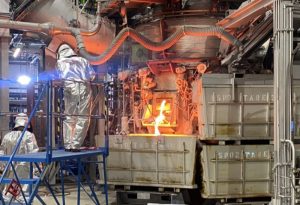
At its facility in Swindon, UK, ABSL is using proprietary technology to transform a mixed waste stream into clean, tar free syngas that can easily be converted into liquid fuels, including SAF. Eighty miles west of London, it is the only plant in the world working in a continuous commercial setting to convert a broad range of solid feedstocks into high quality syngas. ABSL has engaged with world-class engineering partners, including industry specialist Hatch, to produce a syngas that can be integrated into standard process trains for SAF, biomethane, biomethanol and biohydrogen production.
The specialized technology integrates four process steps based on mature technologies and is a key enabler in biohydrogen, biomethanol and SAF production; while simultaneously generating Carbon Dioxide Reduction credits (CDRs) that help airlines fund and meet their net zero obligations.
The RadGas process first converts waste and biomass materials into ‘raw’ gas via a fluidized bed gasifier using oxygen and steam. Then a direct current (DC) electric plasma arc furnace reforms tars, and ash is captured. Next, a heat exchanger that cools the syngas also raises steam that is used in the gasifier at the start of the process. Finally, dry and wet gas scrubbing removes fine ash, acid and alkali contaminants, resulting in a clean syngas free from tar and particulates. Plasma is widely accepted as being highly effective at reforming tars and, because operating temperatures are lower than other approaches, process efficiency is high.
RadGas technology provides higher levels of reliability than other processes by using already proven technologies with established operating and maintenance procedures. This reduces technical risk, which is further mitigated by ABSL’s commercial demonstration plant. This is being used at present to convert a tonne of waste an hour, that’s taking 10,000 tonnes of waste away from landfill and converting it into 27GWh of gas a year.
Running all four RadGas process steps in this environment has provided a huge amount of operational and technical learning, based on over 10 years of experience of waste and biomass gasification – a track record that few alternative syngas producers can match. This contrasts with many businesses in the same sector who have tried, and failed, to produce at industrial scale without fully proving their approach in a pilot or demonstration plant.
In particular, the high-profile collapse of Fulcrum BioEnergy’s Nevada waste-to-fuel plant in June 2024 has not only cost public and private investors over US$ 1 billion in hard cash, but it also leaves multiple project developers in the USA and UK without the model on which they were banking to meet new and challenging SAF mandates. August’s mothballing of the Evero plant in Hull, UK, only adds to this chasm in capacity.
Proven technology for a pragmatic solution
As businesses and investors strive for ways to solve the challenges of hard to abate industries, like aviation, at the scale required and within a highly ambitious timeframe, there must be innovation and experimentation. But these have to be tempered with pragmatism and experience.
By taking an incremental approach, built on a long history, and using established technologies in its demonstration plant, ABSL provides investors and partners with greater confidence that these SAF challenges and targets can be conquered. This will help pave the way not only for sustainable aviation, but also for wider clean energy applications such as heavy transport, industrial heat and manufacturing feedstocks.