
Eaton, the global intelligent power management company, is calling for bidirectional electric vehicle charging between buildings and the grid to be integrated more quickly into Britain’s electricity supply network because it could enable homeowners to offset the costs of charging their EVs significantly.
Analysis conducted for Eaton by management consultancy, Baringa Partners, showed thatusing bidirectional EV chargers, together with renewable energy generated from assets such as rooftop solar panels, could save the typical homeowner in the region of £1,000 per year, which is approximately 90% of the average annual cost of charging a mid-sized family car.
The main barrier to achieving this is that vehicle-to-grid charging is not yet widely possible, either in the UK or much of mainland Europe, which is holding up investment in the technologies that support it. Additionally, only a few EV models are capable of bidirectional charging at present.
Bidirectional chargers enable homeowners to feed energy into the grid as well as receive it, and this provides them with energy flexibility. It allows them to reduce energy costs by storing off-peak energy in an EV battery to use either in their home when energy is more expensive(vehicle-to-home) or sell back to the grid when demand peaks (vehicle-to-grid).
Ryan Thomson, Power & Low Carbons Solutions Partner at Baringa Partners, summarised the findings of the study: “Enabling EV and charge point asset owners to access flexibility services will accelerate the energy transition. Both residential and commercial customers can access significant savings, with most benefit for those who can leverage onsite renewables and storage solutions.”
Siobahn Meikle, Managing Director, Eaton UK & Ireland, explaining the system benefits of bidirectional charging, said: “The grid could handle more renewable energy from assets such as commercial windfarms if it were able to pay homeowners to take energy into EV batteries via bidirectional chargers and dispatch it back to the gird to meet peak energy demand.”
She called on the Government to accelerate the integration of vehicle-to-grid charging into the electricity network by reforming the grid codes that govern the technical requirements for connecting to the electricity grid. “This would encourage electricity suppliers and the vehicle industry to develop and market the products householders and businesses need to accesscost savings, and the grid would be able to handle larger volumes of renewables,” she said.
“Grid codes giving easy access to the distribution network to EV chargers and other flexibleassets, such as solar panels, together with new tariffs and contracts for flexibility, would reflect the real-time value of energy and capacity in the power system, making Britain far more ready for the energy transition away from fossil fuels.”
Businesses, particularly those that run fleets, could benefit similarly from bidirectional charging, and make equally impressive savings on their energy bills.
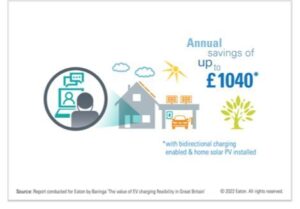
The ‘Smart or Retired Professional’
This archetype is based on a person who works from home or has recently retired from the workplace. This person spends most of each day at home and lives in a house with driveway where they charge a mid-sized EV with their charging station. As their EV is typically at home and connected to the house via the charger, this person can make the highest annual savings by using a bidirectional charger to supply power to the home or grid when electricity is more expensive.
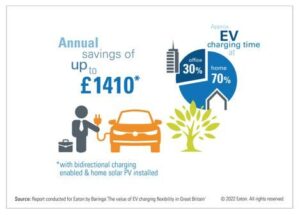
The ‘Weekday Worker’
This archetype is based on a retail manager who works five days per week and drives a return journey to their workplace every day in their mid-sized EV. The Weekday Worker charges their vehicle with their home EV charger in the evenings (approximately 70% of the time) and tops up by charging at work (approximately 30% of the time). More miles mean more savings from charging with cheap night-time electricity, but reduced opportunity to benefit from home-generated solar energy.

The ‘Medium-Sized Office’
This is an archetypal building, rather than an archetypal person. It is a medium-sized office equipped with three EV charging stations and solar panels. This building offers EV charging to employees and visitors. All charging takes place during the daytime (9am – 6pm) and the vehicles charged are cars. Potential savings are lower because the EVs are connected for only the minority of their overall charging (most is at home).
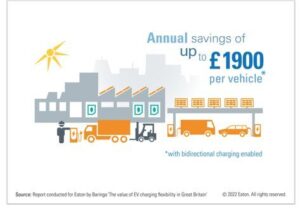
The ‘Delivery Depot’
This archetype is a building equipped with three EV charging stations, three batteries for energy storage, and solar panels. It is a depot that provides charging for a fleet of vans that make deliveries throughout the day and return to the depot to be recharged in the evenings. Delivery depots derive higher value than households per EV, benefiting from vehicles with large batteries that spend a lot of time charging (crucially straddling daytime and night-time so high-price and low-price periods).


