Airports are among the most demanding public environments in the world. With millions of passengers moving through terminals every year, even basic infrastructure is used at an extraordinary scale. That constant activity makes reducing emissions more complex, but it also creates opportunities for meaningful progress when the right decisions are made.
As pressure grows to cut carbon footprints across the aviation sector, airport operators are looking beyond aircraft and energy systems. Interior spaces are receiving new attention, particularly restrooms, which operate continuously and require frequent service. Choices that may seem small in other buildings can have a measurable environmental impact when multiplied across millions of uses.
The full environmental cost of paper towels
Paper towels are deeply embedded in airport restrooms, yet their environmental footprint extends far beyond what travelers see. Towels must be manufactured, transported, stored, replenished, and disposed of. Even when made from 100 percent recycled content, the process consumes energy, water, and fuel at every stage.
A recent third-party Life Cycle Assessment conducted by independent consultant TrueNorth Collective evaluated hand drying methods from cradle to grave. The study examined manufacturing, transportation, use and end-of-life disposal. The results showed that high-efficiency hand dryers can reduce the carbon footprint by up to 94 percent compared with 100 percent recycled paper towels.
The LCA measured a wide range of environmental impact categories, including global warming potential, fossil depletion, water consumption, smog formation and eutrophication. Across nearly every category, high-efficiency hand dryers demonstrated significantly lower environmental impact than paper towel systems.
In airports, where restrooms are in constant use throughout the day, those differences accumulate quickly. Over time, the environmental cost of paper towel systems becomes substantial.
Efficiency that supports passenger flow
Sustainability improvements in airports must never compromise passenger movement or comfort. Restrooms are critical choke points, and slowdowns can ripple through an entire terminal.
Modern high-speed touchless hand dryers are designed for high-traffic environments. Shorter dry times help reduce lines and congestion, while eliminating paper towels reduces restocking and waste removal. For facility teams, this translates into lower labor demands and more predictable operations.
Hygiene remains a top priority in public spaces. Advanced hand dryers equipped with electrostatic HEPA (eHEPA®) filtration are independently proven to remove 99.999 percent of viruses and 99.97 percent of bacteria from the airstream at 0.3 microns. This level of filtration supports a clean restroom experience aligned with public health expectations.
Aligning with sustainability and certification goals
Many airports are pursuing sustainability benchmarks such as LEED and WELL certifications while working toward long-term net-zero targets. Interior infrastructure decisions play a supporting role in meeting these goals.
High-efficiency hand dryers help reduce energy use, water consumption, and waste generation, all of which support green building standards. They also allow airport operators to document measurable emissions reductions, an increasingly important factor in sustainability reporting.
Tools such as Excel Dryer’s cost and carbon calculators help facility teams quantify environmental impact alongside operational savings. Clear data allows decision makers to justify upgrades with confidence and transparency.
A proven approach at a global hub
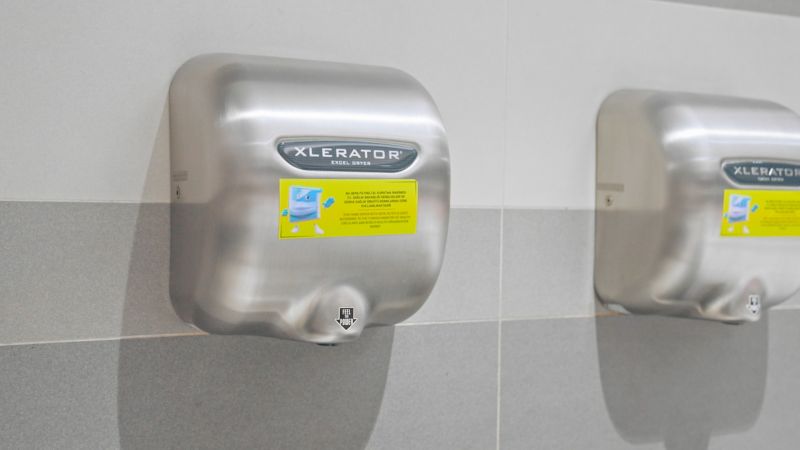
Istanbul Grand Airport offers a real-world example of how restroom infrastructure choices can support sustainability and operational goals. Serving approximately 76 million passengers annually, the airport installed XLERATOR® Hand Dryers with eHEPA filtration throughout its restrooms.
The airport has received multiple accolades, including recognition from Airports Council International as Europe’s Cleanest Airport and a World’s Best Airport ranking from Travel + Leisure readers. Facility leaders point to improved restroom efficiency, enhanced hygiene, and reduced operating costs as key outcomes.
Eliminating paper towel systems removed a significant source of waste while helping streamline restroom traffic in one of Europe’s busiest terminals.
Small decisions with scaled impact
Airports face unique challenges in reducing emissions, but they also have unmatched potential to drive change at scale. Infrastructure decisions inside terminals may seem routine, yet their cumulative impact is significant.
High-efficiency hand dryers offer airport operators a practical way to reduce emissions, improve operational efficiency and maintain positive passenger experience. In high-traffic environments, small choices can deliver meaningful results.
Article by: Kim Lynch, director of marketing at Excel Dryer
For more Sustainability stories: https://essmag.co.uk/category/sustainable-solutions/