Grid connection infrastructure is increasingly becoming a key challenge for Europe’s offshore wind sector. As developers establish large offshore zones further away from land at a multi-gigawatt scale, high-voltage direct current (HVDC) infrastructure is emerging as the preferred solution for many long-distance offshore connections and hybrid interconnectors.
Offshore wind delays in Europe were traditionally linked to permitting, inflation, turbine availability, or contract economics. Those issues remain relevant, but the most important incremental risk is now whether the transmission system can be procured, built, tested, and energised on time. A wind farm can be technically complete and still generate no revenue if its export system is delayed.
We therefore view HVDC availability as a credit-relevant variable. For transmission system operators (TSOs), the main risk is higher capex, political scrutiny, and a larger funding requirement. For developers, the main risk is a delayed commercial operation date (COD) and the loss of expected cash flow during the construction-to-operation transition.
The HVDC Market Is Becoming a Bottleneck for European TSOs
Europe’s offshore wind build-out is driving a rapid increase in demand for HVDC infrastructure. Projects such as LanWin6, NordOstLink, Princess Elisabeth Island, Nautilus, TritonLink, and TenneT’s 2 GW offshore program are competing for the same limited pool of specialised converters, subsea cables, offshore platforms, engineering expertise, and installation capacity. This is creating a more challenging procurement environment for European TSOs and increasing the risk that grid connection schedules constrain offshore wind deployment.
The HVDC supply chain is concentrated across two main specialised segments: converter systems and grid solutions—supplied mainly by companies such as Hitachi Energy, Siemens Energy, GE Vernova, and Mitsubishi Electric—and offshore HVDC cables, where Prysmian, Nexans, and NKT are among the leading manufacturers. Bottlenecks can arise at different points in the value chain, from converter engineering and cable production to offshore platform fabrication and installation vessel availability.
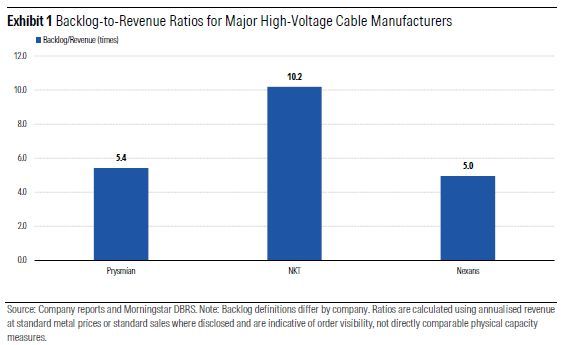
Exhibit 1 illustrates the scale of order-book depth among the main European high-voltage cable manufacturers. The latest disclosed backlog-to-revenue ratios for Prysmian, NKT, and Nexans indicate multiyear revenue visibility, suggesting that a significant portion of specialist cable capacity is already committed over the medium term. Although backlog definitions differ by company and the ratios should not be interpreted as directly comparable measures of physical capacity, they support our view that cable procurement remains a key constraint for offshore grid delivery. This can reduce flexibility for TSOs when procuring new HVDC connections and increase the risk that grid delivery schedules become a constraint for offshore wind developers.
Elia Group SA/NV (Elia; BBB (high), Stable), for example, is currently facing a more challenging procurement and execution environment for major offshore grid investments, particularly around Princess Elisabeth Island and related HVDC infrastructure. In its H1 2026 results, Elia highlighted continued progress across its Belgian and German investment programmes, including Princess Elisabeth Island and the LanWin6 offshore converter system contract in Germany, while also pointing to cost inflation, scarcity of specialised equipment, rising material costs, and supply chain constraints as key factors affecting the timing and economics of HVDC delivery.
In our view, this demonstrates that while major offshore grid projects remain strategically and economically supported, HVDC infrastructure is emerging as the pace-setting factor for offshore wind deployment. Availability and pricing constraints are shaping project timing, capital allocation, and execution risk, affecting TSOs through higher capital expenditure (capex) and longer procurement timelines, and offshore wind developers through potential delays to grid connection availability. As a result, we increasingly view HVDC constraints as a broader credit consideration for the offshore wind value chain.
Grid Availability Is Becoming a Key Execution Risk for Offshore Wind
Although HVDC infrastructure is typically developed, owned, or procured by transmission system operators, offshore wind developers remain economically exposed to its timely delivery. A wind farm can complete turbine installation and still face delayed revenue generation if the required offshore grid connection is not available on schedule. Grid connection timing has therefore become an increasingly important execution variable for offshore wind projects, particularly in markets where multi-gigawatt developments depend on complex HVDC links.
In our view, the main credit risk is a delay in COD. A delayed COD postpones generation of EBITDA and funds from operations, while project-related debt, committed capex, and interest during construction continue to accumulate. This can slow deleveraging and reduce financial flexibility, especially for developers with large offshore pipelines and limited earnings diversification. For instances where multiple offshore assets are expected to contribute materially to medium-term cash flow growth, a delayed COD can affect group-level credit metrics.
TSOs Are Better Positioned to Absorb Cost Inflation Than Developers
The credit impact of HVDC constraints is likely to differ materially between TSOs and offshore wind developers. TSOs are directly exposed to higher procurement costs, longer delivery timelines, and more complex project execution. However, regulated frameworks generally allow efficient investments to be recovered over time through tariffs or regulated asset base growth. This does not eliminate timing, funding, or political risk, but it provides a stronger mechanism for cost recovery.
Offshore wind developers have a different exposure profile and are more at risk from the delay that HVDC assets can create in project commissioning and cash flow generation. If grid connections are delayed, developers may face postponed revenues, higher interest during construction, and slower deleveraging. This creates a more immediate link between transmission delays and credit metrics, particularly for developers whose business plans rely on offshore projects entering operation between 2028 and 2035.
Relative Credit Exposure Varies by Developer Profile
The credit exposure to HVDC-related delays varies significantly by developer profile. Companies with a high reliance on offshore wind for future growth—such as Ørsted A/S and certain private offshore platforms—are more exposed, particularly when expected cash flow generation is concentrated in a small number of large projects. For these issuers, delayed CODs could affect medium-term deleveraging plans and financial flexibility.
By contrast, diversified utilities with large, regulated networks, including RWE AG, Iberdrola S.A., and Equinor ASA, appear better positioned to absorb delays because offshore wind represents only one component of a broader earnings base. This reduces the impact of delayed offshore wind contributions, while stronger access to funding provides greater flexibility to manage construction-period costs.
Potential Beneficiaries Across the Supply Chain
While HVDC constraints create execution risk for TSOs and offshore wind developers, they may support stronger order visibility and pricing power for equipment suppliers. Converter manufacturers, cable producers, offshore platform fabricators, and installation contractors are likely to benefit from sustained demand as European countries accelerate offshore wind, interconnector, and grid reinforcement programmes.
Companies exposed to this part of the value chain may therefore see stronger backlogs and improved revenue visibility. However, the benefit is not risk-free. We note that suppliers must also manage their own execution challenges, including labour availability, manufacturing capacity, working capital needs, and potential penalties if delivery milestones are missed.