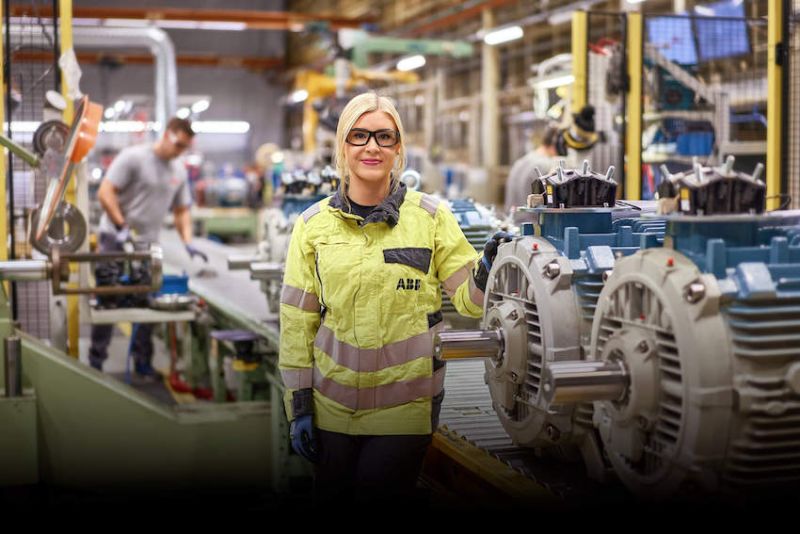
Stefan Floeck, Division President of IEC Low Voltage Motors, ABB , explains how ABB’s ‘Engineered to Outrun’ philosophy is reshaping its own low voltage motor factories, from zero waste to low‑carbon, renewably powered operations.
Every motor that rolls off a production line carries a carbon story with it. At the scale of global industry, those stories quickly add up. According to the International Energy Agency, the manufacturing sector accounted for nearly 40% of global energy demand in 2024. At that scale, how we design and manufacture the machinery that keeps the sector moving is central to whether that demand can ever be met sustainably.
At ABB, we see low‑carbon operations not as a glossy add‑on, but as a core part of our mission to make industry run ‘leaner and cleaner’. Across our IEC Low Voltage Motors sites in India, China and Finland, we are redesigning everything from packaging and pallets to ovens and energy systems. The goal is simple: motors that are more efficient in use, and built in facilities that shrink their own carbon footprint.
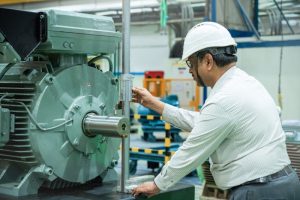
ABB’s IEC LV Motors sites in India
Designing out waste in India
In India, ABB’s IEC LV Motors sites at Bangalore and Faridabad have taken the traditional factory waste model and turned it inside out. Instead of asking “How do we get rid of this?” the teams started asking, “Why does this exist at all, and if it must, what can it become?”
Both factories are now third‑party certified as ‘Zero Waste to Landfill’, achieving a waste diversion rate above 99.99% in 2024 by systematically applying a 5R approach – refuse, reduction, recyclability, reuse and recovery of energy from waste. Single‑use plastics have been eliminated, paper use aggressively cut down in the push toward a paperless factory, and every waste stream – hazardous and non‑hazardous – is redirected to authorized recyclers.
This mindset extends into energy as well as materials. The Bangalore site has achieved Platinum certification as a green factory from the Indian Green Building Council (upgraded from Gold last year).Through targeted energy-efficiency initiatives, such as replacing pneumatic torque tools with electric alternatives, the site has reduced electricity usage by roughly 3.8% year-on-year and eliminated around 40 tons of greenhouse gas emissions from its operations – the equivalent of charging more than 3.2 million smartphones.
And at Faridabad, major energy wins are well underway. By 2024, the site was running on 100% renewable electricity – sourced from a mix of on‑site generation from a 500 kWp solar plant and externally supplied power – fully converted to LED lighting and equipped with higher‑efficiency motors. For 2026, the team is now exploring the replacement of remaining low‑efficiency motors in existing machines with our own IE5 Ultra‑Premium models, squeezing out the next layer of savings from an already high‑performing site.
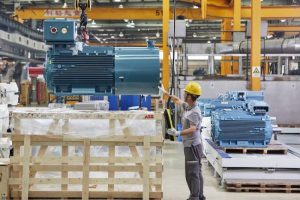
In China, ABB’s Shanghai IEC LV Motors site has taken aim at a critical source of emissions
Smarter packaging and energy systems in Shanghai
In China, ABB’s Shanghai IEC LV Motors site has taken aim at a critical source of emissions: packaging and process energy – and the impact is already visible on the factory floor. On the large motor assembly line, an upgrade to just one drying oven has already avoided 84,000 kWh of electricity use and 209 tonnes of CO₂ between January and November 2025. Together, that’s roughly equal to the annual greenhouse emissions of 62 gasoline‑powered cars. Compared to 2023, the energy efficiency of the drying oven is up 30.9%, saving $10,731 a year.
In addition to this, an Acrel‑5000 energy usage monitoring system has been rolled out with 291 smart meters cross distribution rooms, switch cabinets, power cabinets, and key energy‑using equipment. This gives real‑time visibility of where energy is used and eliminates hundreds of hours of manual meter reading and data entry each year.
This focus extends to how products are packed and shipped. Traditional nail‑assembled wooden motor boxes created waste and safety risks, as panels were destroyed during unpacking and fresh timber was needed each time. Working with suppliers and customers, the team redesigned the crates with self‑tapping screws and an optimized structure for easy reuse. The impact has been substantial: circular use of packaging materials, saving 1,200 m³ of timber and enabling the reuse of more than 25,000 packaging boxes every year, all while eliminating the factory’s biggest packaging‑related safety hazard.
Closing the loop in Vaasa – and reaching carbon neutrality
At the end of 2025, ABB’s IEC LV Motors plant in Vaasa, Finland, officially achieved carbon neutrality in its own operations. In 2025, electricity usage was cut to around 17 GWh from 19 GWh in 2024, even as the plant produced more than 10,000 additional motors.
This step change rests on years of concrete actions. Extensive LED retrofits and HVAC automation delivered hundreds of megawatt hours of savings, while waste heat from processes such as impregnation and casting operations is now captured and reused to heat the facilities, saving thousands of megawatt hours more.
The Vaasa site is now applying the same logic to plastics and packaging, sharpening sorting guidelines and separating plastics from energy recovery streams. Smaller motor packages are being switched from plywood to lighter, more recyclable cardboard, with larger sizes to follow. The aim is clear – minimize disposal and energy recovery, and push more material into genuine reuse and recycling.
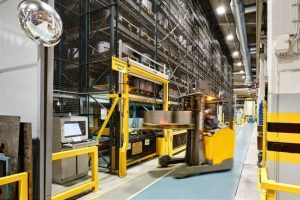
Leading from the factory floor
The story across ABB’s IEC Low Voltage Motor sites is not one of a single breakthrough, but of hundreds of deliberate choices all pointing in the same direction: measure more, waste less, reuse what you can, and redesign what you can’t. Together, these changes start to rewrite what a modern motor factory can be.
For an industry that has historically focused on efficiency only once a product is in use, this is an important shift. From zero waste and circular packaging to carbon‑neutral operations, ABB’s low voltage motor factories are truly ‘Engineered to Outrun’. And as each site takes its next efficiency step, they show how the road to a net‑zero future runs straight through the factory floor – where everyday decisions reshape the impact of industry for decades to come.
Learn more: https://www.abb.com/global/en
For more sustainability news, click here.