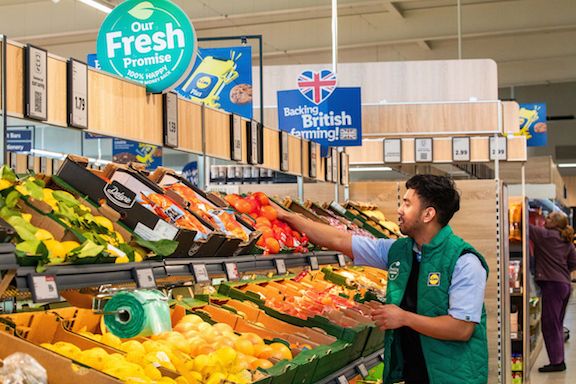
Lidl GB has published its fifth sustainability report, “Beyond the Basket”, showing strong progress across its goals for healthy and sustainable diets, environmental action and community impact. As part of its strategy to embed sustainability into its value model and accelerate the shift towards healthier, more sustainable diets, the discounter also announced it has exceeded multiple sales targets.
As detailed in the 2025 Sustainability Report:
- The retailer has reduced Scope 1 and 2 emissions by 11.4% since 2019.
- Today, 100% of the energy the discounter consumes is renewable. To further invest in the UK renewable infrastructure, Lidl has committed to sourcing 100GWh per year directly from RWE’s Gwynt y Môr windfarm through a five-year contract– equivalent to 37,000 medium sized UK homes and just over 15% of Lidl GB’s national electricity. This will help avoid 17.7 million kg CO2e emissions annually.
- Innovations like vacuum-packed mince have cut plastic use by 63%, saving 250 tonnes annually and halving food waste in-store.
- £100,000 has been invested in water catchment projects to improve water quality and promote sustainable water management.
- Community investment remains central to Lidl’s sustainability journey. In FY2024, Lidl donated 18.5 million meals to over 2,800 good causes via its food surplus and customer donations.
- A £650,000 investment over two years to launch its fruit and veg education programme Lidl Foodies, which to date has reached over 12% of British primary schools and engaged more than 240,000 children.
Lidl has expanded its range of fibre-rich products and introduced monthly discounts of up to 30% on wholegrain items through Lidl Plus. As a result, the retailer has already surpassed its industry-leading target to increase fibre tonnage by 20% by 2026 – achieving nearly 22% growth two years ahead of schedule. Wholegrains now account for 15.3% of all grain sales, up from 12.9% in FY23/24, with a target of 25% by 2030.
In addition, Lidl exceeded its 2025 sales target for own-label meat-free and alternative plant-based milk, reaching a 694% increase against a 400% goal. These milestones support the discounter’s broader commitment to increase plant-based food sales by 20% by 2030, in line with the EAT- Lancet Planetary Health Diet and net-zero ambitions by 2050 – proving that healthier, sustainable diets are positioned for growth.
To drive further action, Lidl, the first British retailer to align with the framework, yesterday convened experts and leaders from across the food system – from farmers to academics – to explore practical solutions, that work across the industry. The event built on the landmark EAT-Lancet Commission report, which underscores the urgent need for a global shift to a healthier, more sustainable and just food system to address climate and health impacts.
Richard Bourns, Chief Commercial Officer at Lidl GB: “Aligning our strategy with the Planetary Health Diet is a long-term commitment to building a healthier, more sustainable food system. It’s delivering measurable impact – beyond the basket – by making healthy and sustainable food more accessible and affordable. The progress outlined in our report shows we’re matching growth with real sustainability progress. From sourcing materials responsibly and reducing emissions, to investing in British farming, we’re proving sustainability and value go hand-in-hand.
“Our customers expect us to lead with purpose, and we’re proud to be doing just that. By embedding sustainability into the heart of our operations, we’re not only protecting the planet – we’re supporting communities, empowering suppliers, and delivering the quality and value our customers rely on every day.”
To deliver products responsibly to customers, Lidl has taken big steps to reduce environmental impact across sourcing, packaging, and transport. Today, 98% of its critical raw materials are sourced from verified sustainable sources, with a target of reaching 100% by the end of 2025. For the seventh consecutive year, Lidl sold the highest volume of own-brand Fairtrade cocoa among UK grocery retailers. The discounter also remains on track to reduce own-label plastic packaging by 40% by next year, with recyclability rates already reaching 95%.
Beyond reducing its impact in sourcing and packaging, Lidl is investing in the future of British food and farming, committing £30 billion over the next five years – after exceeding its original target by more than 40%.
Aligned to a sustainability vision of ‘Better Living, Every Day’, the discounter’s strategy to create impact beyond the basket has delivered a series of milestones, driving progress toward its ambitious goals – not only in promoting healthy and sustainable diets, but also in environmental action and community impact.
For more information about Lidl GB visit corporate.lidl.co.uk
For more Sustainability stories: https://essmag.co.uk/category/sustainable-solutions/