By Dave Palmer, general manager for the UK and Ireland at ICS Cool Energy
McKinsey reports that industry consumes more energy than any other sector: 149 million terajoules in 2017 and fuel consumption for energy accounts for almost 45 percent of that energy consumption. According to the European Heat Pump Association (EHPA), out of the 2,388 TWh of final energy the industry uses for heating and cooling purposes, most of it is for process heating. This puts Heating as one of the prime opportunities for reducing fossil-fuelled energy consumption and related emissions. Many industrial processes do operate at high temperatures and thus require low emission fuels but a change in process design can also lead them towards electrification.
Renewables could produce more than half of the world’s electricity by 2035, at lower prices than fossil-fuel generation, according to the same McKinsey report. Considering zero-carbon electricity is flowing through the grid, by betting on electrification of heating technologies available today, industrial plants same as buildings, can lower their greenhouse-gas emissions significantly – a goal that is on the horizon for the majority of them.
While feasibility of a heat pump in industrial applications depends on the temperature levels required by the manufacturing process, there are applications, which need low to medium temperatures – an area where heat pumps can step in to replace the fossil–fuel based solutions.
Heat pumps – from buildings to process applications
While heat pumps were traditionally known for their residential applications, with rising energy costs and increasingly ambitious environmental goals they have become more and more recognized for their commercial and industrial applications.
Thanks to the technology innovation, many industrial processes like food and beverage, plastics and rubber, chemical and pharmaceutical – just to name a few – have started looking at heat pumps as an efficient heating solution for a wide range of their processes. As they were getting familiarised with the new products and technologies, they started recognizing the economic benefits from a most efficient use of energy while also providing a significant benefit towards emission reduction.
Heating, cooling, heating while cooling, heating or cooling
Heat pumps rely on one of the most energy-efficient methods of heating: the transfer of free thermal energy from outside to inside based on the difference in temperature between the two. What not everybody in the industry does though is looking at cooling and heating at once. There are new opportunities ahead if we stop treating cooling and heating separately – we need to change the paradigm and start looking at heating from the cooling perspective and the opposite.
Heating, cooling, heating while cooling, heating or cooling – choices can be make when it comes to satisfying heating and cooling demands in practically any application. Across the plants and buildings in UK and Europe, we see different heating demand profiles that come with specific efficiency opportunities. All of them allow for significant efficiency improvements by choosing the right heat pump solution – and sometimes even combine it with other technologies.
While pure heating heat pump solutions require external (sustainable) heat sources such as air or (ground) water, simultaneous heating and cooling applications provide the unique opportunity to reclaim or harvest energy which is available within the same plant or building.
Repurpose the heat
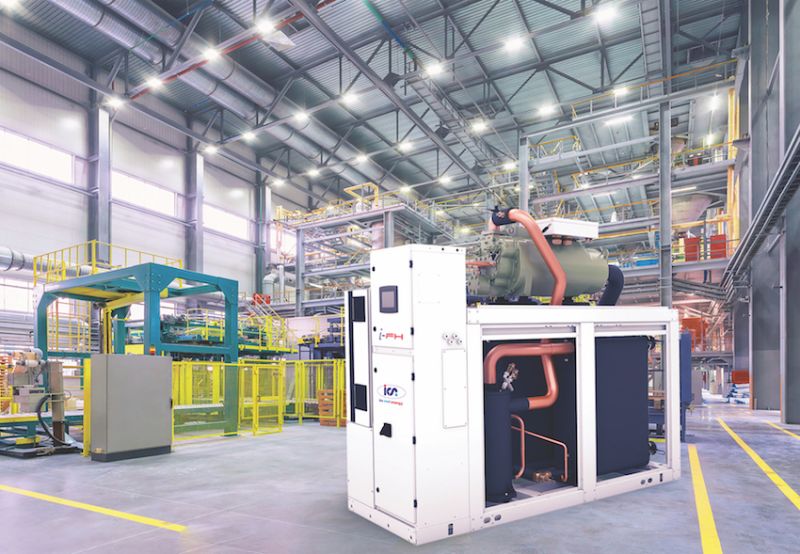
Chillers and cooling plant are used to cool manufacturing processes and facilities, and just by doing so generate waste heat that typically gets lost to atmosphere, this heat does not just have to be wasted and can be harnessed effectively by Industrial Free Heating (i-FH) units.
Repurposing energy by integrating cooling and heating systems is an opportunity often overlooked. An obvious example is a hospital. Hospitals require all-year round cooling in surgery rooms or to keep vital IT equipment such as MRI scanners running. Heating is required to keep patients comfortable and there is always demand for domestic hot water. If we equip the building with a heat recovery chiller, it will generate hot water as a by-product of the chilled water system. The system can provide heating when there is a demand, whilst using, or when not simultaneously required, storing the cooling energy through use of ice banks. This helps connect the heating and cooling demands within a 24-hour span.
Advanced energy efficiency
Heat pumps offer significant energy savings because of their inherently efficient heating technology. Still, not every heat pump offers the same results.
Water-to-water heat pump can reach Seasonal Coefficient of Performance (SCOP) of 5 or more, which means the heating capacity is at least 5 times the electrical power consumption. Since this kind of system provides cooling too, the avoided power consumption of a traditional chiller adds to the overall saving. Considering that cooling and heating is provided by the same power source, a new efficiency metric called Total Energy Efficiency Ratio (TER) has been introduced. A SCOP of 5 leads to a TER of 9, which means 1 unit of power input delivers 4 units of cooling and 5 units of heating.
Heat recovery solution can further increase energy efficiency of heat pumps. Recovering the heat rejected through a condenser we can use it for another purpose. Partial heat recovery, for example, allows the recovery of energy from the compressor’s discharge.
Hybrid solutions and energy gains
With new generation, low global warming potential HFO refrigerants, it’s possible to achieve temperatures up to 120 degrees Celsius with water-sourced heat pump systems. Having said that, the stretch of these temperatures reduces the thermal capacity of these heat pumps, which affects the level of investment.
To optimize first costs and annual energy efficiency, for applications that require low or medium temperature heat, it is possible to go hybrid and partially electrify the heat demand, which allows for flexible switching between consumption of electricity and fossil fuels. Conventional means of heating, when only applied to stretch heating temperatures at the extreme winter days, is very limited compared to the annual energy consumption. Hybrid solutions deliver renewable energy and help reduce the energy intensity tremendously.
Total system approach, customization and reliability
No doubt, in process and critical applications, the ability to rely on the process cooling and heating system working efficiently with limited or no downtime is paramount. A number of factors can be considered when thinking about the reliability of the system. This includes the reputation of the manufacturer, the product testing the manufacturer undertakes on every unit, the quality controls in place during production and the location of their after-sales service departments.
It’s advisable to work with partners that not only offer a wide range of the latest energy-efficient products in stock and ready for delivery, but that can also tailor solutions to meet the exact customers’ requirements. Experience has taught us that every customer is unique. Vertical industry application, geographical location, high or low ambient temperatures or extreme water temperatures can necessitate tailored solutions.
The partner’s expertise to conduct comprehensive technical site surveys will ensure that you get the right solution for your application. Ideally, the partner can also offer to take on the responsibility of delivering, installing and commissioning, and then takes care of all the maintenance and compliance on the customer’s behalf – providing you with a complete end to end, hassle-free solution.
Considering the Total Cost of Ownership
Traditionally, when looking at the total cost of ownership (TCO) it comprises all costs associated with the cooling and heating system. This includes the purchase cost of the system (design, development and installation), running costs (maintenance and repair costs and time) plus recycling costs or resale value at the end of its lifecycle.
Even though the initial purchase price of one system may be higher than another, the better system leads to a lower TCO over the course of its lifecycle because it is more reliable or easier to maintain. For this reason, it is important to look beyond the initial cost to see the bigger picture.
On the other hand, manufacturers looking to upgrade their systems, but trying to avoid capital investments, can benefit from new, enhanced and flexible long-term exchange programmes. This form of subscription offering gives manufacturers access to the latest process heating and cooling equipment with the flexibility of an operating expense. Packages can include a complete process temperature control solution including equipment, preventive and 24/7 emergency maintenance, replacements, and upgrades. Customers receive the right temperature control solutions for their process needs with the flexibility to adapt their capacity according to changing seasonal and operational requirements. The flexibility of this business model can be a significant ingredient to the decision process and making a step into a more sustainable heating.
Conclusion
Over the last few years, innovations in process cooling and heating systems have led to innovative designs that can offer significant benefits compared to the systems that they are designed to replace. Energy efficiency, reliability, sustainability, options for customization and TCO all play a role in finding the right process heating solution that best fits your process needs. With technologies available at our fingertips to massively increase the efficiency of processes or buildings, we should not waste time to second-guess the opportunities we have.
———————
i-FH INDUSTRIAL FREE HEATING: Chiller & Water to Water Heat Pump Applications
There is energy that is lost in most buildings as a result of heat produced by chillers used for cooling manufacturing processes and facilities. This heat can be recovered, harnessed and used to heat other processes.
ICS Cool Energy’s i-FH (industrial free heating) solutions can be used to achieve this. The broad range of energy-efficient ICS Cool Energy heating solutions cover any need, whether it is:
•Heating or cooling (heat pumps)
•Heating while cooling (chillers with heat recovery)
•Heating while cooling or heating (heat pumps with heat recovery)
•Any combination above (multi-pipe units)
———————
CASE STUDY
|
Combining heating and cooling processes bring increased efficiencies and reduce gas and electricity consumption at an animal health products plant in Southern France. An international manufacturer of animal health products was looking for ways to reduce their environmental footprint and increase efficiencies of their plant’s cooling and heating systems. What started with a simple modernization, turned into an innovative project that connected their cooling and heating processes significantly lowering the energy and gas consumption. THE CHALLENGE Located in the south of France, the production site’s cooling demand included cold water temperatures of 6/11°C to support its manufacturing process, storage of finished goods and raw materials, as well as to provide air-conditioning for their laboratory and office space. In the same time their heating needs required 80°C hot water for process and space heating. Their existing system consisted of an aging 450kW air-cooled chiller and two gas boilers with 300kW capacity and 85 % efficiency. Originally, the manufacturer wanted to increase the efficiency and lower the environmental footprint of the system simply by replacing the aging equipment with new, more efficient but equivalent one. The analysis presented by the ICS Cool Energy team showed how to recover the heat from the chiller plant and reuse it for heating needed in the production process. THE SOLUTION Due to the high hot water temperature required, an air-cooled chiller with Heat Recovery was not an option that could meet the demand. To satisfy the cooling needs and recover the heat when there is a demand for simultaneous heating and cooling, ICS Cool Energy team proposed an alternative system based on i-FH water-to-water heat pumps and dry-coolers. Leaving the original heating plant featuring the gas-boilers as back-up and support option, the aging air-cooled chiller was replaced by two i-FH heat pumps. Thanks to its innovative design, the heat pumps can run in cooling mode only like a traditional chiller, and in Heat Recovery mode to fully or partially satisfy the process heating demand at the plant. THE RESULT Combining heating and cooling processes by re-purposing waste heat from the cooling plant resulted with significant reduction in gas consumption. While the original boiler heat plant provides additional capacity when there is insufficient heat recovered to satisfy the demand, the customer experienced60% decrease in gas consumption during the first 6 months of operation from March to September. Their average annual gas consumption is expected to drop by 40-50%. With this they will reduce their CO2 emissions by 100-120 tonnes of per year. Additionally, during the three summer months from June to August, with the customer experienced 47% lower electricity consumption from its cooling operations*. Annually, thanks to the system ugrade they expect a drop in energy cost between 7-15%, and an increase in the plant’s average Energy Efficiency Ratio (EER) from 1.19 to 2.1. * Energy consumption taking into account the cooling system modification as well as variable cooling demand and weather conditions.
|
|
WATER SOURCE HEAT PUMP PROVIDES 40% ENERGY SAVING AND “FREE HEATING” FOR SWEET MANUFACTURER THE CHALLENGE The customer, a leading manufacturer of chocolate & confectionery products, was looking for ways to lower the environmental footprint of his operations. One of the options he was looking at was reusing the heat generated when cooling one of their jacketed mixing vessels in other parts of his plant. The existing cooling and heating system in this part of the factory included several process chillers as well as a boiler used to provide process hot water, ensuring the sweet mixture remains in a transferable liquid form that can be pumped. The specific process in question, which was being cooled by a chiller sited alongside it, involved mixing several ingredients in a 1000L stainless steel jacketed vessel to achieve the desired gelatinous product consistency, before being transferred via temperature control jacketed pipework to a holding tank further downstream of the process line. THE SOLUTION Following a comprehensive site survey, the ICS Cool Energy team determined that the customer’s annual energy costs, based on this process operating 16 hours a day/365 days a year with a 600kW chiller & high temperature hot water were approximately £225,000 and had a TER (Total Efficiency Ratio) of 1.7. To harness the heat generated during the cooling of the 1000L jacketed vessel application and send it directly to the customer’s heating circuit as “free heating”, ICS Cool Energy team installed the i-FH (Industrial Free Heating/water source heat pump) unit. THE RESULT The i-FH is capable of recovering up to 80degC energy and in this specific case, by providing 75degC hot water direct to the boiler, the load was lessened substantially. As a result, the customer reduced their energy by 40%, which meant their annual energy costs would drop from £225,000 to £125,000 and a far improved TER of 4.0. Additionally, the customer benefited from the compact design of the i-FH unit as it fitted in a restricted space next to their process. The modularity and scalability of the unit also allows the customer to use this technology on new and evolving processes elsewhere in their works.
|