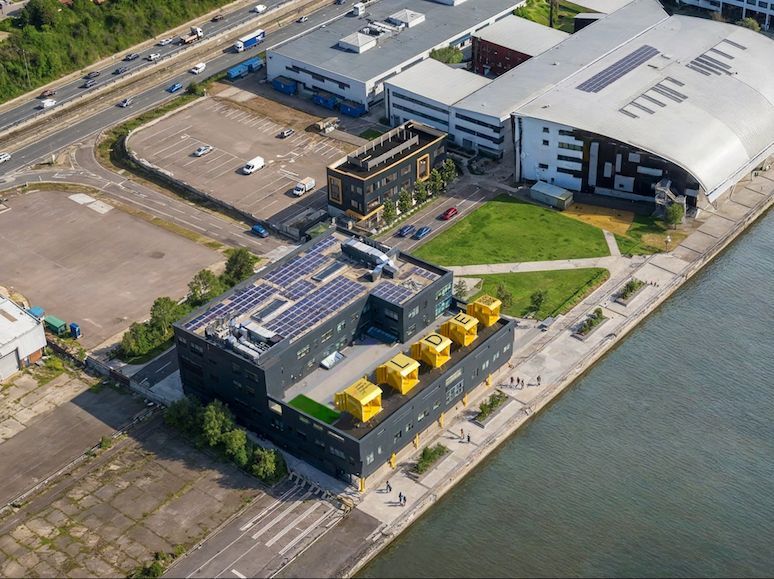
The London Borough of Newham has granted full planning permission for a landmark energy resilience project at London Design and Engineering UTC (LDE UTC) in the Royal Docks.
It will be the first urban building in London to generate, manage and optimise a significant majority share of its own energy through an intelligent microgrid. The scheme combines five Hover Energy vertical-axis wind turbines with the college’s existing solar array, and a planned battery storage system with an intelligent control layer – the Hover Microgrid Management System – which generates, stores and balances energy as one decentralised system, and is expected to supply 81 per cent of the building’s electricity.
The turbines are fully enclosed, with no exposed blades, and were designed for constrained urban rooftops. They will sit at roughly parapet level, broadly in line with the existing roof, keeping them discreet from the street.
The Microgrid Management System provides the intelligent control layer which will monitor and optimise the system in real time, balancing generation, storage and demand across the building. By generating and managing its own power on site, the college strengthens its energy resilience and cuts its reliance on the national grid. As a microgrid, the system can be linked with neighbouring sites in future to share clean energy and build resilience from price and supply shocks across the Royal Docks. Hover’s patented Agentic Microgrid Management System continuously analyses demand, generation and storage data to optimise performance in real time.
Geoffrey Fowler, Principal & CEO of London Design and Engineering UTC, said: “This is an exciting milestone for the College and for sustainable education. Our students will not simply study engineering, design and renewable energy, they will learn in a building that actively generates, stores and intelligently manages its own clean electricity. That creates a unique learning environment whiled emonstrating how existing buildings can play a major role in the transition to net zero.”
Chris Griffin, CEO & Founder of Hover Energy, said: “Eighty per cent of the buildings that will be standing in 2050 are already here today. If we are not retrofitting them, we are not getting to net zero. At London Design and Engineering UTC we are turning the built environment into its own energy source, starting with an existing building that generates and manages its own power on its own roof. Resilience matters as much as carbon. If it is not distributed, it is not resilient, and a building that makes its own energy keeps running when the grid is either not operating or simply can’t deliver. Although this is not the final stage of the process, it is a critical milestone for the project.”
Learn more https://www.ldeutc.co.uk/ and https://hoverenergy.com/
Click here for more Renewable energy stories: https://essmag.co.uk/category/renewable-energy/