A recent exclusive study highlights the remarkable strides made in the adoption of renewable energy across cities in the UK. These findings arrive amidst the ongoing COP28 conference, where global leaders have convened to address the pressing need for urgent climate action. The study underscores the importance of renewable energy in our collective efforts to combat climate change and aligns with the key discussions taking place at the conference.
Conducted by Solar Panel Installation, the study analysed data from various UK cities, focusing on their dependence on solar energy as a means of reducing carbon emissions. The research examined average total CO2 emissions, estimated household usage of solar energy, and the number of photovoltaic installations in different UK councils to determine which cities are leading in solar energy utilisation
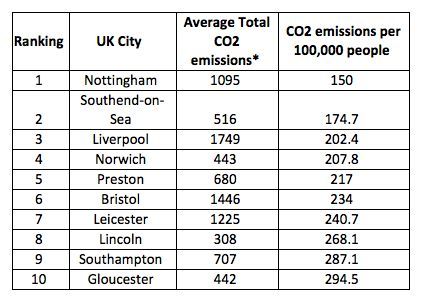
Top 10 UK Cities with the Lowest CO2 Emissions per Capita
The study’s results highlight that Nottingham ranks as the city with the lowest per capita carbon emissions, with only 150 CO2 emissions per 100,000 people. Following Nottingham are Southend-on-Sea in the Southeast (with 174.7 CO2 emissions per 100,000 people) and Liverpool (with 202.4 emissions per 100,000 people).
The 10 UK Cities with the Most CO2 Emissions per Capita
Surprisingly, the Northern cathedral city of Wakefield has the highest carbon emission rate per capita (2351.1 CO2 emissions per 100,000 people), which is more than 15 times higher than Nottingham’s. Chichester, Lichfield, and Lancaster follow on the list with 1854.4, 1849.3, and 1622 emissions per 100,000 people, respectively.

The UK Cities Relying the Most on Solar Energy
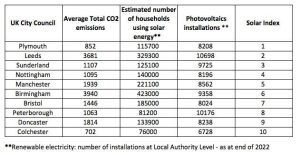
The study also examined the estimated number of households in each UK council using solar energy as their primary source of electricity, along with the number of photovoltaic installations as of the end of 2022. These findings were combined to create a Solar Index, which indicates which UK cities are the most solar-friendly based on these metrics.
The results reveal that the Southwestern city of Plymouth leads the way in reliance on solar energy, with an average annual total CO2 emission of 850, an estimated 115,700 households using solar energy, and 8,208 photovoltaic installations. Plymouth is followed closely by Leeds, and Sunderland.
The UK Cities Relying the Least on Solar Energy
The City of London ranks as the UK city with the lowest reliance on solar energy, featuring 29,983 average total CO2 emissions, an estimated 6,400 households utilizing solar-generated energy, and 48 photovoltaic installations. The capital city is followed by Lichfield and St Albans, with an estimated 46,100 and 62,000 households using solar energy, respectively.

Solar Panel Installation expert Mark McShane comments on the findings: “Cities play a crucial role in our collective efforts to combat climate change, and the data presented here underscores the significant strides being made in the adoption of solar energy. These findings demonstrate that certain UK cities, such as Plymouth and Nottingham, are leading the way in harnessing the power of the sun to reduce their carbon emissions and transition towards cleaner and more sustainable energy sources.
Nevertheless, it’s equally vital to acknowledge the varying degrees of progress among cities. For instance, the City of London, as revealed in this study, presents ample opportunities for growth in its utilization of solar energy. Amid the ongoing COP28 conference, it becomes increasingly evident that solar energy remains a cornerstone of our global initiatives to address climate change and forge a more environmentally responsible future.”