According to research from AI infrastructure provider CUDO Compute, 20% of British firms have already moved AI workloads out of the UK due to high power costs, exposing a growing disconnect between the UK’s AI sovereignty ambitions and the practical realities of infrastructure and energy.
The research, which was commissioned in partnership with Censuswide and polled over 700 senior AI decision makers in enterprises across the UK, US and Europe, highlights a growing tension shaping the UK’s AI strategy. While 46% of UK organisations say geopolitical instability is pushing them to keep AI workloads within home markets (compared to 36% overall), 43% say ‘cost and performance still outweigh sovereignty’ when it comes to deployment decisions.
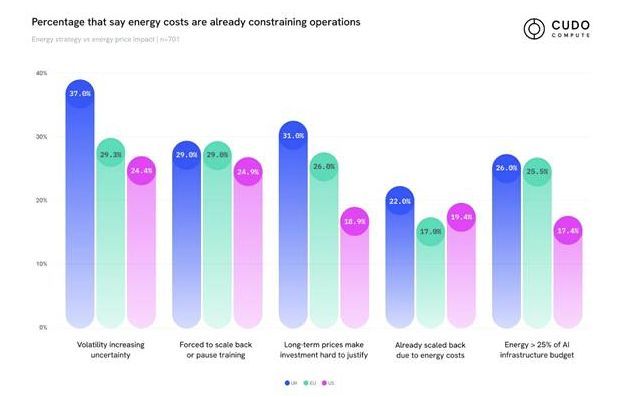
With energy costs dominating the national agenda, the impact on AI is already being felt across the UK economy. Power pricing has emerged as a critical constraint on growth, with a third (33%) of UK organisations saying energy costs are limiting their ability to scale AI operations. (Figure 1)
The pressure is even more pronounced among AI-first businesses where nearly a third (32%) say they would consider moving workloads overseas due to power costs, compared to 18% of enterprise organisations. Those building and running the most compute-intensive workloads are also the most likely to look beyond the UK when economics tighten.
When looking at which markets businesses are turning to, the US ranks as the most attractive location for new AI cluster capacity, with three quarters (72%) viewing it positively, followed by India (62%). Eastern Europe also scores highly with 58% viewing it as a positive location for AI deployment – above Western Europe (45%) and the Nordics (44%). China also ranks highly at 55%, above Latin America (40%), the Middle East (39%), Africa (38%) and APAC (29%).
But the wider macro environment cannot be ignored, as a third (32%) of UK organisations are ‘actively considering’ relocating workloads due to geopolitical pressures, and almost half (45%) say data sovereignty, regulatory compliance or national security concerns are shaping their AI deployment strategy, compared to 33% across Europe. One in three in the UK (31%) also say they are prioritising sovereign or regionally controlled compute, even if it comes at a higher cost. Organisations want to build in the UK – they just need the infrastructure with which to do so.
The research, which was commissioned to mark the launch of CUDO Compute’s Land, Power Compute Report, shows that AI infrastructure is now constrained to not just algorithms or GPU access but by land availability, power economics and grid reality – where power increasingly dictates the cost of compute.
“AI sovereignty is being hotly discussed as a priority for UK organisations, but it only works if the infrastructure exists to support it,” said Matt Hawkins, CEO of CUDO Compute. “What we are seeing is a growing tension between where businesses want to run AI and where they actually can.
AI is not abstract software. It is physical infrastructure that depends on power, land, cooling and grid access. When those constraints tighten, economics take over. If it is cheaper or easier to run workloads elsewhere, they will move, regardless of sovereignty ambitions.
For more information: https://www.cudocompute.com/
Click here for more news: https://essmag.co.uk/category/news/