The artificial intelligence (AI) era has triggered an unprecedented surge in data centre energy demand, fundamentally reshaping how power is delivered and managed. As facilities evolve to support AI, cloud computing, and digital services, the power train – the complete system that moves electricity from the grid all the way to the chip – has become one of the industry’s most critical bottlenecks and opportunities.

Giovanni Zanei, Vice President Global Large Power Converters at Vertiv
The AI-Driven Energy Challenge
AI workloads are unlike anything data centres have handled before. Powered by energy-intensive graphics processing units (GPUs) and accelerators, they consume far more electricity than traditional computing and introduce sharp, unpredictable power spikes. These transient surges can push legacy power systems beyond their limits, making flexibility and resilience essential.
To meet this demand, operators are turning to new primary power sources. Gas turbine generators, in particular, are seeing rapid adoption, especially in regions where grid capacity is limited. Although not renewable, modern gas turbines offer lower emissions than diesel generators, rapid start-up times (often under 10 minutes), and the ability to ramp output quickly – ideal for stabilising grids alongside intermittent renewables and handling AI-driven peaks.
In many markets, data centres already account for more than 10% of regional electricity load, placing enormous strain on aging grids. In some areas, new connections or expansions are delayed by years. This has accelerated adoption of on-site solutions such as battery energy storage systems (BESS) and advanced grid-interactive uninterruptible power supplies (UPS).
A key enabler in unstable grid environments is Fault Ride Through (FRT) capability in modern UPS systems. FRT allows the UPS to “ride through” voltage sags, swells, or frequency deviations without switching to battery or disconnecting – preserving battery life, improving efficiency, and maintaining seamless power delivery even as renewable integration increases fluctuations on the grid.
The Modern Power Train: From Grid to Chip
Today’s data centre power train consists of three main stages, each undergoing rapid innovation to support AI densities that routinely exceed 100 kW per rack.
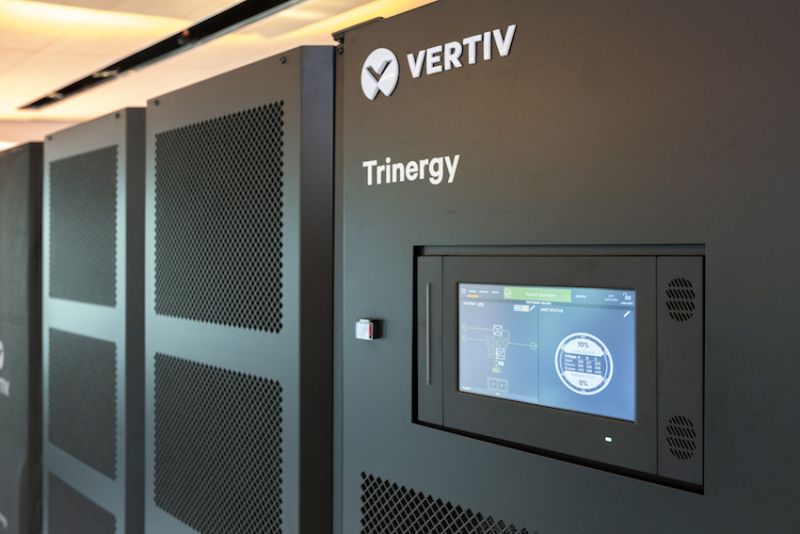
- Facility-Level Power Conversion and Distribution High-voltage utility power is stepped down, backed up, and conditioned. Modular, scalable UPS systems – often with grid-interactive features – allow operators to add capacity in small increments while occupying less floor space compared to traditional equipment. During grid peaks, these systems can discharge stored energy back to the building or grid, easing pressure on local infrastructure.
- Room- and Row-Level Distribution Raised floors are giving way to overhead busway systems that save space and offer ultimate flexibility. Plug-in units can be added or moved anywhere along the busway without shutdowns, and higher distribution voltages (415 V or 480 V) reduce current and cable sizes for high-density AI rows.
- Rack-Level Distribution Intelligent rack PDUs (power distribution units) now support extreme power densities with features such as per-outlet monitoring, hot-swappable modules, high-voltage DC options, and advanced load-balancing algorithms. These capabilities minimise cabling complexity, optimise airflow, and enable predictive maintenance in AI environments.
Designing for Tomorrow
Future-ready power trains must balance multiple priorities: higher voltage to cut losses, redundancy without wasted space, real-time visibility via electrical power management systems (EPMS), and layouts that reduce heat traps. Hyperscale operators increasingly commission fully custom designs tailored to their exact IT architecture, while colocation and enterprise facilities favour standardised, configurable platforms that speed deployment.
The Energy Storage Transformation
The shift from valve-regulated lead-acid (VRLA) to lithium-ion batteries has been transformative. Lithium-ion offers up to 4x longer life, far faster recharge, higher temperature tolerance, and a footprint up to 70% smaller – freeing valuable white space for revenue-generating IT equipment.
Battery energy storage systems (BESS) take this further. By charging during off-peak hours (or from on-site renewable sources like solar) and discharging during peaks or outages, BESS smooths demand, unlocks constrained grid capacity, and supports decarbonisation goals. In effect, they help “debottleneck” the grid, allowing new data centres to come online years sooner.
Key Takeaways
The data centre power train stands at an inflection point. AI’s insatiable appetite, grid limitations, and sustainability mandates are driving rapid innovation across UPS, distribution, and storage technologies. Gas turbines, grid-interactive UPS, open busway, intelligent rPDUs, lithium-ion batteries, and large-scale BESS are no longer optional – they are essential building blocks for reliable, efficient, high-density computing.
By adopting integrated, flexible, and forward-looking power train designs, operators can confidently scale AI workloads, ease pressure on regional grids, and help reduce their overall carbon footprint. The infrastructure that powers tomorrow’s intelligence is being built today – and it starts with moving electricity from the grid to the chip with greater efficiency and reliability than ever before.
Article written by Giovanni Zanei, Vice President Global Large Power Converters at Vertiv
For more news: https://essmag.co.uk/category/news/