As the world transitions toward renewable energy, solar power has emerged as a leading solution in reducing carbon footprints and enhancing energy independence. However, much of the existing commercial infrastructure that houses the UK’s industries and businesses was not originally designed to accommodate traditional solar panels.
Here, Ciaran Cotter, technical director at lightweight solar pioneer Solivus explains how retrofitting older commercial buildings to integrate solar technology is a crucial challenge that requires innovative approaches.

Ciaran Cotter
A quick glance at the news will, most likely, reveal that the UK’s solar capacity continues to grow at a rapid pace. According to the latest report1 from the Department of Energy Security and Net Zero (DESNZ), renewable energy accounted for more than half (50.8%) of the UK’s electricity generation for the first time in 2024. Amongst this, solar power reached a record high, increasing by 6.5% to 14.8TWh.
Notably though, domestic solar installations comprise the majority of solar volume, with commercial solar lagging far behind. According to a recent analysis less than 10% of the UK’s non-domestic buildings are utilising their available rooftop space for solar energy.2
This is a colossal wasted opportunity on multiple counts. Foremost, there is vast, unused, unobstructed roof space on our schools, warehouses, factories offering a vast, obstructed canvas for self-generation. Second, by embracing solar energy, companies can achieve substantial cost savings. In fact, by fully utilising the available rooftop space it is estimated that commercial buildings could save £35 billion, with lifetime savings reaching £703 billion. In energy generation terms that translates to 117 TWh of electricity annually.3 That’s enough to power approximately 30 million homes for a year, more than the number of households we currently have in the UK.4

So, the big question is – why is the commercial solar opportunity not been tapped?
Though there may be a myriad of reasons, such as financial barriers or policy and regulatory uncertainty, in our experience it usually comes to down to one – roof suitability and structural limitations.
Many of the commercial and industrial buildings that we have here in the UK were constructed long before solar technology became a viable energy solution, meaning they were not designed to accommodate traditional, rigid-form solar panels. A lot of these structures have roofs that are not able to handle the weight and load of solar panels, especially older buildings with existing HVAC systems taking up valuable space. It’s also common for commercial buildings to have irregularly shaped roofs with unusual layouts, curves, slopes or obstructions, bringing further other installation challenges. The result is that, in many cases, it simply isn’t possible to install traditional solar panels, without the need for steel reinforcements which can be costly and complex to install.
To place it into context, it’s estimated that up to 40% of commercial buildings cannot support the weight of traditional solar panels. The good news in 2025 is that we now have an innovative lightweight solar system which offers a fraction of the weight of standard solar, and the impact for operators and the green economy could be profound.
At Solivus, we’ve installed solar on airports, stadiums, warehouses and more. In my experience, the only regret that most commercial operators have is not going solar sooner.
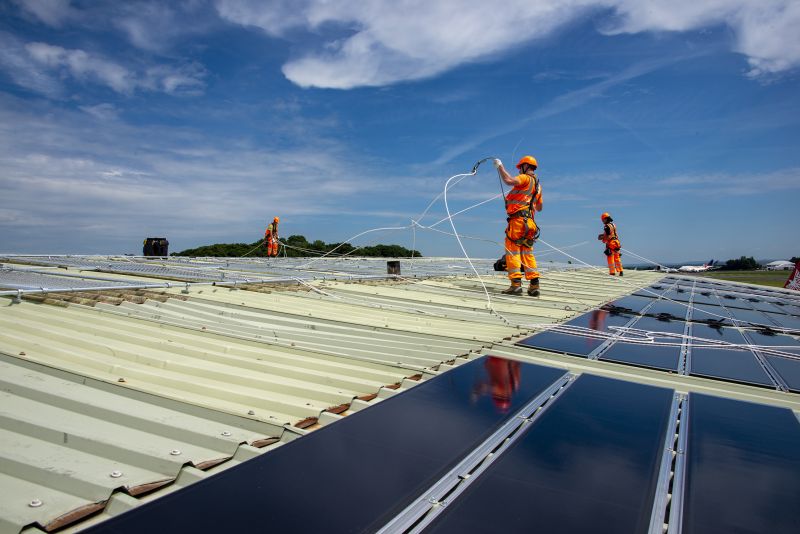
A great example of this still largely untapped opportunity can be found in our recent work with Europe’s leading private aviation destination: Farnborough Airport. As part of its strategy to achieve net zero by 2030, Farnborough Airport sought to reduce electricity and gas usage and invest in onsite renewable production. However, the iconic architectural curves of the airport building, as well as its low load capacity meant that traditional rooftop solar was not an option.
The solution to overcoming these challenges and installing the desired solar was found in our pioneering lightweight solar solution.
Now complete, the installation, which commenced works in January 2024, has seen over 4,000 lightweight solar panels installed on hangars one and two, the terminal, the control tower, and the Airport’s award winning 169 room hotel, the Aviator Hampshire.
Constituting one of the largest rooftop solar installations in the region, the works will enable up to 25% of the airport’s annual electricity needs to be met, as well as enabling its growing operational fleet of electric vehicles to be charged using self-generated electricity. With approximately 75% of solar energy generated to be used on site, the remaining 25% will be sold back to the energy supplier, thus making the financial case for solar even more attractive.
Our work with Northampton County Cricket Club (NCCC) is equally compelling. As part of its commitment to sustainability, the club sought to take advantage of the self-generation opportunity afforded by solar but there was a problem – like many sports centres and stadiums, the stadium’s wasn’t able to take the weight of traditional glass solar panels.
We were able to solve this in lightweight solar systems – which are up to 70% lighter than traditional panels yet provide an equally powerful performance, also with a 25 year lifetime warranty – in a bespoke end-to-end project constituting a total of 221 lightweight solar panels. Eighteen months since the project’s commissioning date and initial operational data reveals the installation has seen total estimated savings for NCCC of over £20,000, with an annual ROI of 10.8%. To date, the installation has saved over 15,900 kg of CO2e.
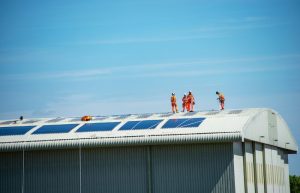
Rooftop revolution
In short, the commercial rooftop solar market is on the cusp of a revolution. This will be instrumental as challenges such as sustainability requirements, energy independence and resource management play a critical role in combating climate change and realising a low carbon economy. By reimagining how existing infrastructure integrates solar energy, businesses can help play a leading role in this exciting energy transition.
For more information please visit www.solivus.com
1 https://www.solarpowerportal.co.uk/renewables-generated-50-8-of-the-uks-electricity-in-2024/
2,3,4 https://powermarket.ai/buildings-could-save-35bn/