As conflict in the Middle East disrupts global oil supply, a University of Southampton spin-out has reported a near fourfold increase in commercial solar enquiries, signalling a shift in how UK businesses are approaching energy security.
Absolar, based at Southampton Science Park, says the surge reflects a growing focus on resilience rather than sustainability alone, with organisations increasingly treating energy as a core infrastructure decision.
Energy security, once largely confined to government policy and international summits, is now being felt directly by businesses through rising costs and operational risk. The latest data from the Office for National Statistics shows inflation rose to 3.3% in March, driven in part by energy prices, with fuel costs seeing their sharpest monthly increase in more than three years.
The renewed pressure follows the UK’s energy price crisis in 2022–2023, triggered by Russia’s invasion of Ukraine, which exposed the vulnerability of businesses to volatile global energy markets. Analysts warn that further geopolitical instability could sustain elevated prices into 2026.
“What’s becoming clear is that solar is no longer viewed purely as a sustainability measure,” said Dr Phil Wu, Absolar CEO. “It is increasingly a strategic infrastructure decision, helping organisations reduce exposure to volatile grid prices and maintain operational continuity.”
According to Absolar, the nature of enquiries has shifted significantly in recent months. Businesses are no longer focused primarily on carbon targets, but on backup power, cost control and independence from the grid.
Battery storage is playing a central role in that transition. When paired with solar PV systems, it allows organisations to store surplus energy, use it during peak price periods and maintain operations during outages an increasingly important consideration for sectors such as data centres, logistics, manufacturing and research facilities.
“Battery storage adds a layer of control,” Wu said. “It enables businesses to manage when and how they use energy, which is particularly valuable for sites where uptime is critical.”
Despite rising demand, adoption remains low. Analysis based on Ordnance Survey data suggests fewer than 4% of UK buildings have solar installations, with the vast majority concentrated in the domestic sector. That leaves a significant opportunity for commercial property owners. Large volumes of roof space remain unused, despite sharp declines in technology costs over the past decade and improving returns on investment.
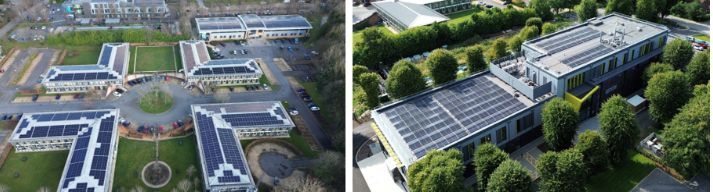
One organisation moving ahead of the trend is Southampton Science Park, which has become the first science park in the UK to reach one megawatt (MW) of installed solar capacity. The project, delivered in partnership with Absolar, spans ten buildings and includes 2,546 solar panels.
The installation is expected to prevent around 220 tonnes of carbon emissions annually and has already generated 1.8 gigawatt hours of electricity over three years.
“The installation provides our tenant companies with access to cleaner, more stable energy,” said Stuart Perry, Operations Director at Southampton Science Park. “Reaching one megawatt of solar capacity is a significant milestone for us.”
Historically, one of the main barriers to commercial solar adoption has been the complexity of feasibility assessments, particularly across large property portfolios. Absolar has sought to remove this barrier with their proprietary technology using geospatial AI and LiDAR scanning to assess the solar potential of any commercial building in under 60 seconds. The tool named ORBIT which Absolar launched last month delivers a full commercial solar feasibility assessment, including projected costs, savings, payback period and carbon impact in under a minute for any commercial building in the UK, with no site visit required. “The potential is huge,” Wu says. “We are only at the beginning of what’s possible.”
The Institute for Government has recently identified energy resilience as an increasing priority for policymakers in light of ongoing geopolitical tensions. For businesses, however, the response looks like it is already underway. “Organisations are recognising that waiting for systemic solutions is not enough,” Wu said. “They are taking more direct control of their energy supply.”
As volatility in global energy markets continues, companies investing in on-site generation and storage are likely to gain a growing advantage in cost stability and operational resilience. “Solar is no longer a green gesture. It is a resilience asset. And for commercial property owners, the question is no longer whether to act, it is how quickly they can move.” concludes Dr Wu.