Developing a uniquely comprehensive testing programme for advanced gas turbine filtration systems puts Parker Hannifin in a position to create even more advanced filtration systems for the future. By Timothy Adeniyi Ajayi, Business Unit Director, Filtration & Energy Solutions Division, Parker Hannifin Manufacturing
Advanced gas turbines are widely acknowledged as the pinnacle of precision engineering, but maintaining their supreme efficiency requires the highest performance of critical elements such as the air inlet filtration system. Achieving top-line efficiencies of 60% or more from a gas turbine demands huge investment in research & development across diverse fields like metallurgy and fluid dynamics, as well as thorough testing and analysis. And, like advanced gas turbines, the performance of the air inlet filtration system does not come easily either. It is embedded in decades of experience, extensive R&D, and a comprehensive testing programme to ensure that high performance can be maintained in any number of diverse operating environments.
An example of this commitment to testing comes from Parker Hannifin’s Clearcurrent Assure cartridge filters, which were developed specifically for advanced gas turbines. Although top-tier filters will all typically meet common industry standards such as those established by the ISO or Saudi Aramco – the Saudi Aramco specifications are an industry-leading standard for example – Parker Hannifin has gone much further, investing double-digit millions in developing the industry’s most wide-ranging and detailed testing programme and putting its filters on a quantifiable performance footing. For instance, the use of durable hydrophobic and oleophobic filtration media helps to resist the ingress of troublesome contaminants like salt water and oils. Such liquids can stick to turbine internals but also exacerbate problems associated with other contaminants, combining with dust to form a mud that may block the filter or prompt changes to salt particles by liquifying them and making them far more challenging. Testing hydrophobic and oleophobic characteristics to ensure sustained performance is therefore key to good filter design. However, many of these specific tests used to explore these capabilities are unique to Parker Hannifin. For example, the hydrophobic testing programme was designed purposely within Parker for their products. Similarly, there is no standard for mist testing and as a result, Parker Hannifin developed its system for measuring performance and used that to guide filer design. In this case, the mist test is a comparative programme that explores the effect of mist on filters over eight hours. If the differential pressure changes by more than 1,000 Pa over this test window this is indicative of a problem that needs to be addressed.
Developing a comprehensive testing programme
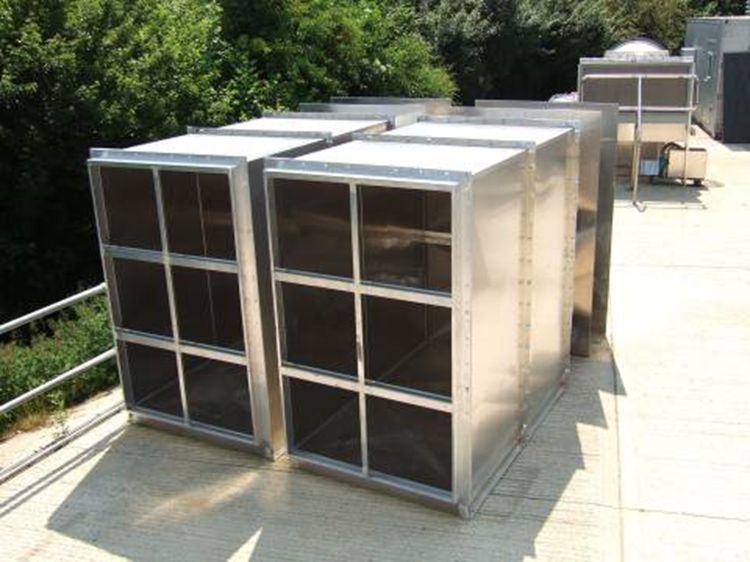
Developing the Clearcurrent Assure filters for the global H-class turbine fleet required determining the performance of the filter when exposed to different kinds of conditions both in a controlled environment and in real-world installations. Among the most critical elements for the tests is contaminant rejection in a range of environments, such as those typically found in the Middle East, Europe, and North America and in conditions such as low ambient temperatures and snow or rain, ensuring that the filters still perform and achieve their primary function of dust rejection. Wind tunnels are used to test filters under all kinds of moisture conditions such as high humidity, mist, salt fog, rain, and monsoon but an equally important element is real-world testing and Parker developed a mobile test rig to support this important function.
Mobile test rigs fitted with multiple filter types can be installed at or near sites where real contaminants are present, such as hydrocarbons, salt spray, fog, and heavy dust. This real-world approach means the filters are exposed to the most challenging environmental parameters that can be found to determine how the filtration system performs. Critical parameters such as pressure loss across the system are recorded through remote monitoring over extended periods. Alongside pressure differentials, the mobile test rigs record multiple additional parameters such as airflow, temperature, and relative humidity as well as functional set-up like the pulse system, filter types and so forth. These rigs generate millions of data points every day and this extremely valuable data allows engineers to gather a profound understanding of how environmental factors affect performance and can thus modify filter design accordingly. These mobile test rigs can work alongside existing installations, ensuring there is no disruption to day-to-day operations while the design of the filtration system is assessed to ensure it delivers efficient protection for advanced gas turbines at the desired location, wherever that is. Mobile test rigs have been deployed in the desert in Riyadh, the coastal desert in Dammam, cold coastal regions like Maine and temperate locations such as Missouri.
Testing also allows Parker to explore filter performance under the most extreme conditions. For example, testing in low temperature icy conditions determined that both the choice of filtration media and the construction of the filtration element and its structure, shape, and mesh support can affect filter performance when ice is present. The rigorous testing regime explored different types of ice formation such as glaze ice and rime ice. On a well-designed outer mesh, the size, shape, gauge and finish will allow rime ice to create a honeycomb-like structure as it forms. That allows air to continue to flow but also collects moisture, preventing ice from forming in the filter media itself. Smooth powder coating on the mesh also supports ice removal using standard pulse cleaning systems. The geometry of the filter can also affect performance low temperature conditions, round filters can allow the ice to form in a stronger circular form, making it harder to remove.
Alongside field testing, Parker partnered with a Canadian university to support the ice testing programme, running filters in environments at temperatures as low as -40oC. Indeed, these tests proved that at very low temperatures a lack of moisture in the air stopped further ice from forming and that ice already formed would start to disappear due to the process of sublimation.
Testing to extremes
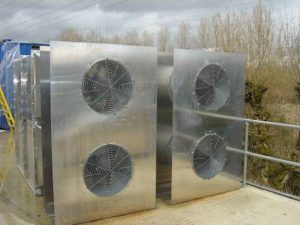
Alongside a test programme to ensure exceptional performance under any number of environmental conditions, the physical characteristics of the filter system are also thoroughly tested. These include an acoustic test unique to Parker, but also robust measures to break the filter by exposing that system to extremes far beyond those anticipated during actual deployment and operations.
Both new and used filters are subject to a programme of thermal, vibration and shock testing to get the different elements to fail, expand and contract or shake loose. For example, a vibration table is used to test filters across and range of frequencies and amplitudes for periods of up to two hours based on readings from accelerometers. Parker Hannifin also exposes its filters to extremes of pulsing system use, simulating pulsing 36,000 times continuously to see whether the filters break or fall apart. Whatever happens to that product in the field, even if it is used for far longer than recommended the chances of pulsing that many times is effectively zero. Multiple diagnostic tools are deployed to determine the impact of these tests such as UV fluorescent die, CT scans, filter cut ups, and filters with transparent frames are used to identify any leak paths that develop as a result.
Another test unique to Parker is the long-term test rig (LTTR) where the filters are exposed to all sorts of weather conditions under a testing programme that could last for 12 to 24 months. This is among the most effective and informative of all the real-time testing data that is produced and by exposing its products to these extremes Parker Hannifin has the empirical data to prove their performance and that they are robust, reliable, and efficient over the full lifetime and more.
Perhaps more importantly though, Parker Hannifin’s ground-breaking and unique testing programme does far more than show how its advanced filters react under the most perilous real-world conditions. By developing its test programme to support H-class advanced gas turbines Parker has also laid the groundwork for future filtration system advances too. Developing assets and equipment such as the mobile testing rig which was designed specifically for the H-class filtration system has expanded in-house testing capabilities immeasurably. This comprehensive testing system will thus build on Parker Hannifin’s strong commitment to research and development and inform engineers developing future filtration systems, yielding benefits and dividends for the next generations of gas turbines and far beyond.