By Eryn Devola, Head of Sustainability, Siemens Digital Industries
Throughout the years, sustainability has been a challenging topic for companies as it constantly shifts in and out of organizational and political focus. While there have been periods of intense progress, there have also been times when industries struggle to adapt to new regulations and regional differences. One thing that has become clear to us, however, is that sustainability is a driver for growth and profitability.
We have seen first-hand how businesses that prioritize sustainability are positioning themselves for long-term success. With pressing challenges like climate change, evolving geopolitical regulations and increasing consumer demand for eco-friendly products, organizations must adopt sustainable practices to not only remain relevant but also to truly thrive.
With this in mind, let’s take a look at the trends, innovations and forward-thinking companies shaping the future of sustainability.
Circularity: The new standard
Industrial waste is at an all-time high and only 7.2 percent of materials used worldwide were recycled in 2023. This presents a huge opportunity for organizations to save both costs and resources by embracing circularity. The Circularity Gap Report highlights that companies can reduce CO₂ emissions by over 39 percent by focusing on recovering and reusing resources throughout the entire product lifecycle, including within supply chains.
Circularity also helps address resource scarcity by ensuring the availability of essential materials. A circular economy operates on a framework of “R-strategies,” which guide circular design and manufacturing to maximize resource use and minimize waste.
These “R-strategies” include:
• Reducing
• Repairing
• Refurbishing
• Remanufacturing
• Recycling
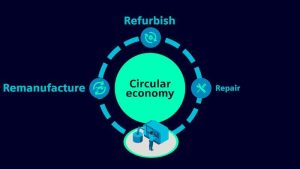
This image represents the circular economy, a sustainable model that minimises waste, maximises resource efficiency and enables cost savings
Transitioning from a linear economy to a circular economy starts with design as research shows that 80 percent of a product’s environmental impact is determined in the design phase. The digital twin — a digital representation of a physical asset or process based on powerful physics-based simulation, is a crucial tool in creating smarter, more efficient machines, products and processes. It allows engineers to design sustainability from the start, instead of trying to add it on later.
The Digital Twin helps define and optimize products and production systems, thus significantly reducing the need for physical prototypes before investing in physical assets and contributing to saving valuable resources. Creating a digital twin and leveraging tools like design and simulation software enables companies to embed circularity into every stage of the product lifecycle—from design and manufacturing to use and through end-of-life. The digital twin can also be used to understand cause and effect in the supply chain. By creating a virtual replica of real-world networks and processes, it enables users to simulate disruptions and changes in advance, evaluate their impact using real data, and make more informed decisions with transparency.
By leveraging lifecycle assessments, simulating R-strategies and connecting designs to supply chains, businesses can optimize resources and reduce waste. Digital technologies like the digital twin, artificial intelligence (AI) and IT/OT convergence also can improve production efficiency, with automation and predictive maintenance extending machine life, reducing downtime, and minimizing resource use.
Once products are in use, tools like asset management software work to ensure optimal resource efficiency and enable informed maintenance. Additionally, as innovations like the battery passport which functions as a digital record for individual batteries by documenting their entire lifecycle become more widespread, reuse and recycling will be further enhanced.
Circularity also tracks a product to its end-of-life. Using advanced recycling technologies, supported by automation, companies can reclaim old materials for future use. Circular alternatives like biodegradable plastics benefit from flexible production systems that adapt to new processes, driving the zero-waste economy forward. Implementing circularity is a long-term solution that empowers businesses to achieve greater results with fewer resources, which can help protect the environment, as well as the bottom line.
Fürth and Spinnova are models for progress
Siemens’ electronics plant in Fürth, Germany – who recently received the Sustainability Lighthouse award from the World Economic Forum for being a leader in the field of energy efficiency, CO2 reduction and resource conservation — demonstrates how sustainable outcomes equate to a more profitable business. It has experienced cost efficient benefits including:
• 64 percent energy saving per throughput
• 72 percent reduction in greenhouse gas emissions per throughput
• 47 percent less waste per throughput
• 145 percent increase in production throughput
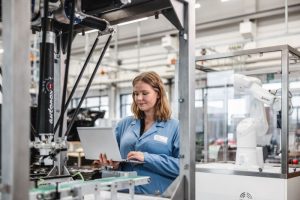
With the help of artificial intelligence and a circularity strategy, the Fürth plant has embraced an innovation to make sustainable operations a top priority. (Image credit: Getty Images)
These achievements are a direct result of their focus on a circular economy. By tracking its products throughout their lifecycle, Fürth uses spare parts and repairs to extend the lifecycle of products to avoid emissions that would otherwise be generated during production, scrapping and recycling. Through a long-life repair service, the plant offers an extended service on selected products. There are already over 300 long-life repair cases in the beginning of 2025 and that number is expected to increase to 2000 by 2026.
Additionally, by building on its substantial energy savings, Fürth is striving to achieve CO2 neutrality by 2026. While the target may seem bold, the plant’s dedication to sustainable practices and circularity provides a clear path to turning this vision into reality.
Like the Fürth plant, textile company, Spinnova is using circular models to redefine sustainability in the textile industry. The fashion industry generates over 90 million tons of waste per year and consumes even more water. That is why Spinnova’s mission is to make the textiles industry a sustainable one.
Spinnova’s technology makes it possible for raw material producers, fiber producers and others in the industry to produce fibers from a variety of cellulosic raw materials through a mechanical process that mimics how spiders spin their webs. This one-of-a-kind production process creates materials that look and feel similar to cotton and linen. Using Siemens technology to enable their innovation and design, Spinnova has managed to make a sustainable impact on a historically wasteful industry.
Optimizing sustainability with AI
Artificial intelligence (AI) is another digital tool that has the potential to further enable circularity as well as overall sustainability efforts. Although AI has been a widely discussed topic across industries and consumers, its potential for sustainability is just beginning to be uncovered. It will, however, require strategic implantation and scalability, which is only possible with industrial-grade AI. This classification is used only for AI that meets the levels of quality, security and reliability required to tackle the requirements and standards of even the most demanding environments.
AI’s advantage lies in its ability to process large amounts of data and identify hidden patterns. Not only does this power help companies accelerate their digital transformation by identifying inefficiencies to lower emissions, but it also enables circularity within the Digital Enterprise.
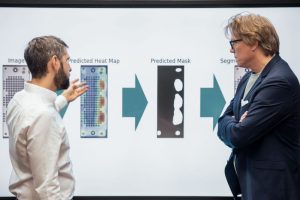
The Erlangen factory uses the digital twin to optimize machines, operations and processes to make them more energy efficient. (Image credit: Siemens)
But what does this look like in a real-world scenario? As a sustainable Digital Enterprise, Siemens’ electronics factory in Erlangen, Germany has been using industrial AI to collect, connect and understand data to accelerate sustainability—and the benefits have not gone unnoticed. For example, the factory has seen improvements such as:
• Reducing its energy consumption by 25 percent, and its net carbon footprint by 50 percent
• Targeted improvements to production efficiency have helped reduce the energy used to produce each product by 50 percent.
• Production hall ventilation power consumption is down by 70 percent
Additionally, Erlangen employs robotics to handle their printed circuit board (PCB) components with incredible accuracy. With the increased precision of the now automated fitting process, Erlangen has been able to reduce wasted material and energy significantly, making the factory more efficient. Since the smart robotics no longer require extra pre-sorted parts, the plastic inlays that were once required to organize sorted parts are not necessary. The result is the elimination of thousands of plastic pieces that ultimately end up as waste. These environmental and cost savings would not be possible without AI.
Efficiency meets responsibility
The future of sustainability is one of opportunity and transformation. As circularity and AI become essential to success, businesses can move beyond compliance to generate real value through cutting costs, driving efficiency and reducing waste. Companies and factories can turn to pioneers like Siemens factories or customers like Spinnova to see how sustainability is more than a responsibility but a profitable strategy. With new and ongoing innovations and advancements, sustainability soon will become inseparable from profitability and overall success.