High-density AI clusters are rewriting the rules of power delivery. When individual racks draw more than 100 kW and entire halls consume tens of continuous megawatts, the limiting factor is no longer compute silicon alone. It is the electrical pathway that converts grid-scale energy into usable power for servers, cooling and critical systems.
At the centre of that pathway sit transformers, devices once treated as routine infrastructure that now decide whether hyperscale growth remains technically and economically feasible.
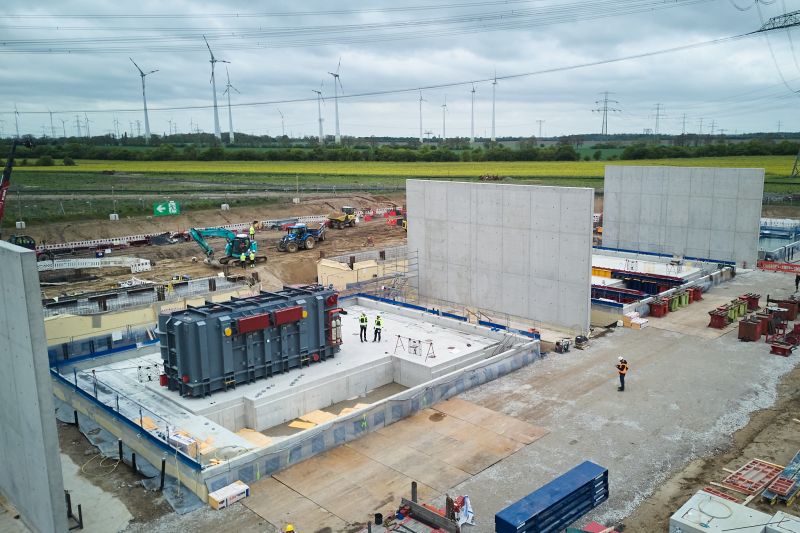
VIRTUS Data Centres has made this shift concrete at its Wustermark Campus, situated a short distance west of Berlin. The site is equipped with two 185 MVA super-grid transformers, among the largest units yet placed inside a European data-centre campus. These machines will take supply directly from the 50Hertz 380 kV transmission network, giving the facility an opening connected capacity of 300 MVA and a designed expansion path to 500 MVA. Conventional diesel generation is still offered, yet the electrical design also supports a complete zero-generator operating mode. More than five-nines statistical availability, underpinned by 100 % certified renewable energy, renders that mode both resilient and sustainable.
The strategic value extends beyond raw megawatts. By interconnecting at transmission voltage rather than relying on the local distribution network, the campus avoids adding load to circuits that serve nearby businesses and households. The arrangement simultaneously improves Germany’s ability to compete for large-scale AI investment focused on the Berlin region.

The physics that makes capacity possible
Transformers rely on electromagnetic induction. Alternating current flowing through a primary winding produces a varying magnetic field within a laminated iron core. That field induces a proportional voltage in the secondary winding. The ratio of turns between the two windings determines whether voltage is raised for efficient bulk transmission or lowered for safe utilisation.
Because resistive losses increase with the square of current, moving power at high voltage (and therefore low current) yields large efficiency gains. Ordinary distribution transformers typically reduce voltage from the 30–110 kV range. Super-grid units operate at an order of magnitude higher, accepting 380 kV or above straight from the transmission system and delivering medium-voltage output around 30 kV. Synthetic insulating oil provides both dielectric strength and cooling, allowing continuous operation under variable load profiles and service lives measured in decades, often more than 50 years.
Inside a data centre these transformers form the primary interface between the external grid and the entire internal electrical hierarchy i.e. mechanical plant, uninterruptible power supplies (UPSs), server halls and emerging high-voltage DC architectures such as 800 V solid-state conversion. Every percentage point of inefficiency appears as heat that must be removed, inflating cooling demand and lowering overall facility performance. At AI-scale densities, even small improvements in transformer efficiency translate into measurable reductions in energy consumption and associated carbon intensity.
Why earlier designs fall short
Forecasts indicate that global data-centre electricity demand could treble by 2030. Training and inference fleets already require continuous multi-tens-of-megawatt supplies. Electrical architectures sized for previous generations of cloud computing lack both the absolute capacity and the voltage stability now demanded. Super-grid transformers address the shortfall by eliminating intermediate conversion stages, increasing total throughput, providing tighter automated voltage regulation and strengthening overall resilience. The higher primary voltage also reduces the operational necessity of standby generation which is an environmental advantage as well as a cost one.
Grid strength that makes diesel optional
Diesel generators remain a familiar contingency measure, yet they introduce carbon burdens across manufacture and operation, fuel-supply logistics, ongoing maintenance and local air-quality effects. Wustermark’s direct tie to a robust, meshed 380 kV network delivers high voltage stiffness and inherent uptime. Combined with the 2N internal architecture, this grid-level resilience converts standby generation from a mandatory requirement into a discretionary option.
Compounding returns across cost, carbon and certainty
Each incremental gain in transformer efficiency multiplies across hundreds of megawatts. Reduced losses lower waste heat, shrink the required cooling plant and cut water consumption. European efficiency directives and national net-zero commitments are already pushing operators to minimise diesel reliance. A pathway that eliminates generators while simultaneously lowering grid charges creates reinforcing benefits of cost and sustainability.
At the strategic level, secure power is synonymous with deployment certainty. Hyperscalers committing multi-billion-euro AI campuses cannot afford uncertainty over their most fundamental input. Super-grid transformers, paired with long-term renewable power-purchase agreements and, where useful, on-site generation or storage, provide predictable capacity and accelerated time-to-compute.
As demand continues to outpace conventional grid reinforcement, operators are discovering that passive consumption is no longer sufficient. High-performance transformers function as the critical interface that renders multi-source energy practical, efficient and dependable. Over the coming decade, leading facilities are likely to evolve from pure loads into integrated energy hubs.

Mike Golding
Author: Mike Golding, SVP Design & Build at VIRTUS Data Centres
For more news: News Archives – Energy Sustainability Solutions