A faster, easier and more cost-effective technology is set to change the way surveyors quantify the thermal performance of both old and new buildings, with Westminster Abbey in London among the latest heritage properties to take advantage. At the heart of the innovative new Heat3D system co-developed by Build Test Solutions (BTS) is a FLIR ONE Pro thermal imaging camera.
Heat3D was co-developed by BTS to address the time and cost of performing a survey, as well as the need to measure heat loss through the entire wall section, not isolated points. It follows ISO 9869-2, which covers the in-situ measurement of the thermal resistance and thermal transmittance of building elements. Part 2 specifically relates to the use of infrared technology.
Although building surveyors have taken advantage of FLIR infrared thermal cameras for many years, primarily for inspection purposes, with Heat3D BTS spotted a potential new use case for this innovative technology. By pairing a FLIR ONE Pro with other bespoke hardware and a proprietary mobile app, it would be possible not only to infer temperature across the wall surface but the actual rate of heat transfer through the wall.
The Westminster Abbey estate comprises a diverse range of buildings that are currently undergoing energy efficiency improvements to reduce carbon impact and ensure resilience for future generations. The Grade I listed Deanery, for example, parts of which date back to the 13th century, stood out for its high energy consumption. With its thick masonry walls, timber panelling and original metal-framed windows, it was a good starting point for a data-driven assessment.
To understand the building’s thermal performance and conduct a detailed assessment, Westminster Abbey appointed multi-disciplinary property and construction consultant Keegans, which invested in Heat3D technology from BTS to measure the U-value of the main building’s brick walls, as well as the stone-walled extension.
The results were surprising. The wall U-values were much lower [better] than assumed. For example, the predicted U-value for the main wall (rendered solid brick) was 1.7 W/m2K. The actual measured value was just 0.8 W/m2K, some 53% better than expected. Similarly, the predicted value for the 13th century fair-faced stone wall of the extension was 2 W/m2K, while the actual value was 0.9 W/m2K, a difference of 55%.
Beyond measure
By capturing more accurate measurements of U-values (and air permeability), surveyors can provide clients with more precise estimates of annual energy costs. In the case of the Deanery at Westminster Abbey, the calibrated model based on actual measurements provided a 16% more precise value for annual energy costs, equating to a financial difference in predicted savings of more than £1,000. This is just for one building. Westminster Abbey now plans to apply similar testing across its estate.
Crucially, the insight enabled Westminster Abbey to be confident that investing in upgrades such as secondary glazing, better heating controls and targeted draught-proofing would prove a cost-effective yet sufficient option compared with installing internal insulation, which the measurements confirmed were unnecessary.
How does it work?
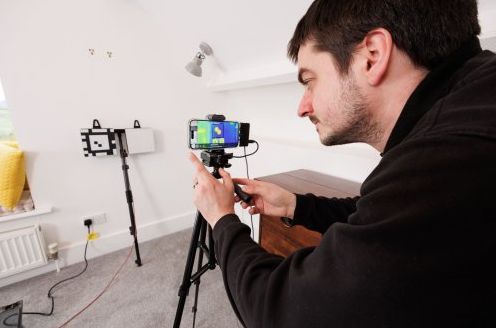
Heat3D calculates U-values using bespoke hardware and an iOS app. A mobile device such as an iPhone or iPad is mounted on a tripod with the portable FLIR ONE Pro camera attached and pointing at the wall from a distance of around 2 m.
To maximise the precision of the system’s absolute temperature readings, two calibration targets are suspended from a monopod leaning against the wall within shot of the camera. One is a (matt) black body temperature target that incorporates a Bluetooth sensor accurate to 0.1°C. It is sized sufficiently to represent a large quantity of pixels that the camera can detect. The second is a radiative temperature target – an isotropic reflector – which is representative of the radiative temperature that the wall surface might receivefrom elsewhere in the room.
The FLIR ONE Pro takes an infrared image every minute for an hour. Using these measurements, the appcalculates the heat transfer across the whole internal surface of external walls. It creates a 3D heat transfer map that not only enables heat loss quantification but also the identification of thermal bridges or defects, prompting subsequent action.
“With this low-cost, quick and non-invasive method of measuring the heat flow and U-values of building elements, surveyors can more than halve the cost of their surveys,” reveals Luke Smith. “It’s easy to complete a survey in one site visit, whereas the heat-flux method requires at least two visits over two weeks.It’s also worth pointing out that the price of Heat3D is around 20% less than the heat-flux plate system we offer.”
The potential for this new technology is truly vast. Far from the preserve of heritage properties, Heat3D is also ideal for new-build properties, checking whether the home meets the thermal performance specified by the builder. The Heat3D infrared thermography kit and associated training is available to purchase from BTS, which also offers post-sales service and calibration.
For more information visit www.teledyneflir.com or follow @flir.
For more energy management stories, click here.