By Rohit Sharma, Global HSE and Sustainability Manager, ABB’s Process Industries division

Sustainability is now inseparable from business resilience. Disruptions in energy supply, climate risk and workforce expectations continue to reshape industrial operations around the globe. As such, companies are increasingly focused on their environmental, social and economic impact.
There’s certainly no shortage of good intentions when it comes to the transition to more sustainable business operations. In fact, the latest Net Zero Stocktake Report found that the number of companies with net zero targets increased by 23 percent year-on-year in 2024.
However, the gaps between intention and outcome remain significant. For example, our global research of over 400 mining leaders showed that while two-thirds were confident of meeting their 2030 decarbonization targets, nearly a third remain behind schedule. Mining leaders pointed to familiar obstacles: capital investment requirements, infrastructure gaps, and commodity price volatility. It’s clear that progress, while underway, is uneven.
Real progress demands measurable action, cultural alignment and a willingness to treat sustainability as a driver of business value. When sustainability is embedded into risk management, motivation and performance, it becomes a catalyst for resilience and a source of long-term reward. To achieve this, however, it must show up in the numbers, in the culture and in how we lead.
So, how can companies shift from good intentions to tangible improvements?
Rethinking Risk
Today, businesses must rethink how they define and evaluate risk. In today’s world, risk is also cultural, reputational and environmental. Sustainability should therefore be treated as a core business outcome, not just a side project.
Yet, metrics alone aren’t enough if they’re disconnected from how decisions are made and how people behave day to day. That is why change must come from the top. When ABB started linking senior leader incentive plans to emissions reduction, it helped accelerate results. In fact, after setting a clear Scope 1 and 2 baseline in 2019 and targeting an 80 percent reduction by 2030, we’ve already achieved 78 percent. This is because measurement, discipline and accountability were aligned to meet company sustainability ambitions where ‘walk the talk’ is driving the real progress.
To deliver consistent outcomes, businesses need a culture in which challenges surface early, accountability is shared and teams are empowered to make sustainable decisions every day.
Making Progress Real Through People
No sustainability strategy, no matter how ambitious, succeeds without people behind it who can deliver consistently under pressure. The real test is making progress sustainable.
The most effective way to drive transformation is by creating belief and engaging the root level of the organization. Not just asking teams to meet targets but enabling them to shape them. When people understand how their actions contribute to a measurable outcome, they’re more likely to act with purpose.
At the same time, leaders need to create environments where sustainable thinking is normalized, where teams are supported to challenge old assumptions and experiment with better ways of working. This mindset is great for engagement and will also be vital for attracting the next generation of talent, with many young workers looking for a purpose they can see and the chance to contribute to something bigger than profit.
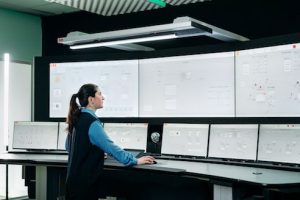
ABB Ability™ System 800xA® will integrate utilities into three control hubs, enabling centralized monitoring and management
The Ecosystem Challenge
Even the most committed businesses can’t deliver sustainable outcomes alone. The challenge now is less about ambition and more about alignment. While companies move forward with bold goals, they often run into barriers. Meanwhile, governments introduce regulation without offering practical incentives and consumers hesitate at green premiums. This misalignment slows down progress and undermines impact.
To deliver sustainability at scale, the whole ecosystem needs to pull in the same direction; Policymakers need to reward low-carbon innovation; businesses need to lower barriers to sustainable choices and technology partners must provide the connective thread that helps industries turn ambition into action. Above all, the right partnerships make it possible for whole industries to scale solutions and sustain momentum.
Long-Term Progress Is a Systems Play
It’s tempting to look to policymakers or visionary leaders to drive change, but the reality is more grounded. Real progress comes when supply chains align, leadership teams stay the course, industry can visualize the scalability and sustainability becomes part of how decisions are made, not just what gets reported at the end of the year.
To effectively manage both sustainability requirements and potential opportunities, companies should adopt a value-focused sustainability strategy. This involves prioritizing initiatives that not only support environmental and social goals but also deliver financial benefits, such as increasing shareholder value through improved funding access, safeguarding revenues, minimizing operational costs, and reducing risks.
Organizations that make this shift toward transparency, accountability and measurable impact stand best positioned to remain relevant, competitive and trusted in a world that’s rapidly demanding more.
For more sustainability stories, please visit: https://essmag.co.uk/category/sustainable-solutions/