Three in five (64%) UK car buyers are unaware of the government’s electric vehicle grant, according to new research from Carwow, raising concerns that a lack of awareness could slow the UK’s progress towards its zero-emission targets.
When the EV grant launched, drivers responded quickly. September, traditionally a key month for new car purchases due to the new registration plate, saw consumer interest on Carwow peak. Leads for grant-eligible EVs reached 28.8% of all electric vehicle leads on Carwow, up from 23% in March 2025 before the grant was announced. However, that uplift didn’t last, and by December, the share of leads for grant-eligible models had fallen to just 17%.
To understand the drop-off, Carwow surveyed 3,959 in-market car buyers after the scheme’s launch. Almost two-thirds (64%) said they were unaware of the grant. Among those who did know about it, nearly three-quarters (73%) said they would be more likely to choose an EV if all eligible models received the full £3,750 discount. Currently, 46 models qualify for the grant, but just eight receive the maximum £3,750 support. That complexity may be adding to confusion for buyers already unsure about making the switch.
Steady growth in EV sales
Carwow’s survey found that price remains a major sticking point. Almost a quarter (23%) of drivers say EVs are still too expensive. When asked what would persuade them to switch, drivers pointed to:
- Larger purchase grants (38%)
- Free or discounted public charging (31%)
- Exemption from congestion charges or clean air zones (31%)
In response to concerns around charging access and affordability, the Government has recently extended its home EV charger grant until March 2027, increasing support from £350 to £500 towards installation. The scheme now applies to renters, flat owners and households without driveways, widening access to subsidised charging.
Regional differences in EV adoption:
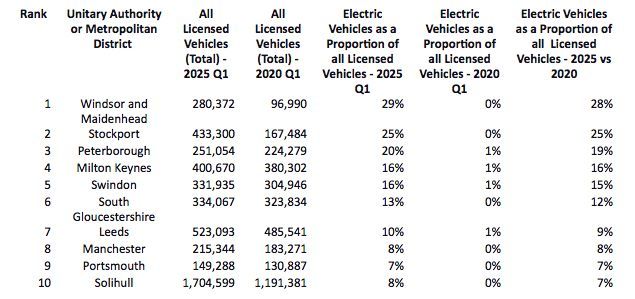
Carwow also delved into public government data to see which parts of the UK are leading the way in EV adoption, compared to the total funding each area has received**.
The top-ranking areas can be seen in the image.
Windsor and Maidenhead had the highest growth, with 28% of all newly licensed vehicles being electric in 2025. Other top areas include Stockport and Peterborough, with each gaining a 25% and 19% growth, respectively. These areas have seen significant growth in EVs thanks to funding from the Local Electric Vehicle Infrastructure (LEVI) program, which has supported the installation of over 2,500 charging points, particularly in London.
In contrast, the North of England and the Midlands have struggled to adopt electric vehicles at the same rate. Areas like North Lincolnshire and York have less than 1% of vehicles registered as electric, showing a regional divide. The lack of investment in charging points and infrastructure in these areas is a key factor.
To help address this, the government has launched a new phase of the LEVI fund, providing £381 million to install more public charging points and help local councils plan for the future, especially as the 2030 ban on petrol and diesel vehicles approaches.
Learn more: https://www.carwow.co.uk/#gref
For more EV news: https://essmag.co.uk/category/energy-efficient-transport/