AI clusters now routinely push rack densities from tens and often hundreds of kW’s per rack, while training and inference cycles create rapid, dynamic load swings. Established approaches that treat power delivery and thermal management as isolated silos are no longer viable.
One solution lies in a unified, end-to-end thermal-power ecosystem. By tightly coupling advanced liquid and air cooling technologies with high temperature optimised chillers and heat rejection systems, including centralised, intelligent controls, data centre operators can achieve consistent performance, superior energy efficiency, and fault-tolerant operation tailored to AI’s unique demands.
Data centre operators should link the entire thermal chain – from on‑rack heat capture to plant‑side heat rejection – under a single, data‑driven control strategy so the system reacts coherently to workload dynamics.

Direct-to-Chip Liquid Cooling: Precision Heat Removal at Scale
Direct-to-chip liquid cooling has become the cornerstone for high-density AI deployments. Modern coolant distribution units (CDUs) deliver precise, scalable heat removal directly to processors, closely tracking real-time compute demands.
Recent CDU advancements support capacities of 70 kW, 100 kW, and up to 2300 kW in in-rack or in-row configurations. These systems accommodate both liquid-to-air and liquid-to-liquid loops, making them suitable for retrofits and new builds alike.
An emerging best practice pairs CDUs with uninterruptible power supply (UPS) systems. This integration allows uninterrupted cooling during power disruptions, safeguarding operational continuity even when the grid falters.
Hybrid Cooling: Flexible, Retrofit-Friendly Solutions
Hybrid approaches bridge the gap for transitional set ups. Rear-door heat exchangers (RDHx) offer retrofit-friendly waste heat removal before it enters the room. This reduces the reliance on perimeter cooling and stabilising temperatures in hybrid loads. In-row cooling units provide granular, targeted heat capture for residual loads, with capacities like 70 kW liquid-to-air or 10–50 kW air-to-air options featuring variable compressors, Electronically Commutated (EC) fans, and integrated intelligence for real-time coordination.
Plant-Side Innovations: Maximising Efficiency and Reducing Carbon Footprints
With future operating temperatures still evolving, AI cooling needs may span wide density and temperature ranges, making it challenging to commit to a fixed chilled water setpoint.
In such a dynamic scenario, new efficiencies emerge through design choices that prioritise flexibility while Plant-side innovations can help to further reduce carbon footprints. By limiting the reliance on compressor based cooling and adopting high-temperature-capable solutions, facilities can operate with elevated leaving water temperatures, on the primary circuit, up to 40°C, unlocking extensive free cooling even in warmer climates or under highly variable operating conditions.
This adaptability allows supply water temperatures to rise by 12–16K for AI infrastructure, delivering consistent annual cooling energy savings in favourable conditions and optimised space reduction compared to conventional designs. Low-global warming potential (GWP) refrigerants align with regulations like EU F-Gas, while warmer fluids (35–45°C) facilitate heat reuse, transforming waste into resources and lowering CO₂e emissions.
Choices in chiller technology depend on the data centre’s thermal requirements.
- Trim cooling prioritises elevated temperatures to maximise free cooling and minimise compressor runtime – ideal for high-density AI to address dynamic conditions.
- Free cooling screw technology cut energy use while maintaining performance with mechanical and free cooling efficient operation at any ambient temperatures
- Centrifugal technologies provide a stable, efficient backbone for extreme or fluctuating loads preserving more power for AI workloads.

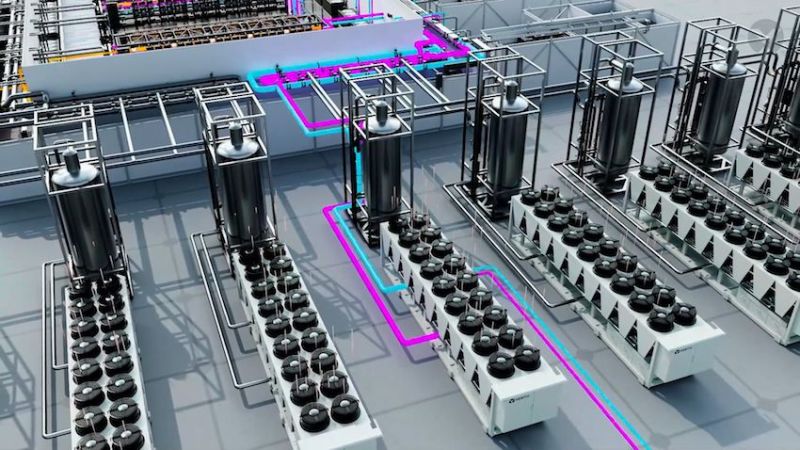
The full thermal chain solution – the purple and blue pipes connects from end to end
Intelligent Controls: The Nervous System of the AI Data Centre
A multi-tier controls layer can bring this entire ecosystem together – unit-level intelligence for self-healing and protection, supervisory orchestration for zone harmonisation, and plant management leveraging machine learning and digital twins to predict loads, detect anomalies, and optimise staging. This connects power draw to thermal response in real time, enabling load-aware cooling, fault-tolerant failover, and a single-pane view for diagnostics.
Modern AI data centres require more than additional cooling capacity – they demand smarter, tightly coupled thermal-power systems. A connected ecosystem spanning chip-level heat capture, hybrid heat rejection, advanced air delivery, and multi-tier intelligent controls is purpose-built to anticipate, coordinate, and adapt.
The outcome is infrastructure that remains efficient at elevated temperatures, stable at extreme densities, and resilient under dynamic loads – ready for the demands of true AI factories.
Author: George Hannah – vice president, Thermal Systems and Advanced Development at Vertiv

For more news: https://essmag.co.uk/category/news/