Colm Joy, Chief Technical Officer, Cleanova, explains why filtration is key to successful carbon capture, storage and utilisation.
Decarbonising our energy supply is key to mitigating climate change, but what happens to the captured carbon dioxide (CO2) is equally important. Whether you choose carbon capture and storage (CCS) or utilisation (CCUS), filtration technology is vital for success.
Filtration performs three functions: it removes contaminants to achieve the desired final product quality, protects processing equipment, and enhances operational efficiency. Correctly applied, filtration maintains carbon capture system efficiency and delivers the CO2 to downstream processes with minimal contamination.
Filtration in carbon capture
CCUS projects primarily focus on capturing CO₂ emissions from point sources. Chemical absorption is the most mature technology for post-combustion capture and is commonly deployed in industries that burn hydrocarbons to produce energy. It uses solvents such as amines to selectively absorb CO₂ from the flue gas. Closed-loop heat regeneration cycles then separate the captured CO₂ from the solvents so it can be compressed for transportation or storage.
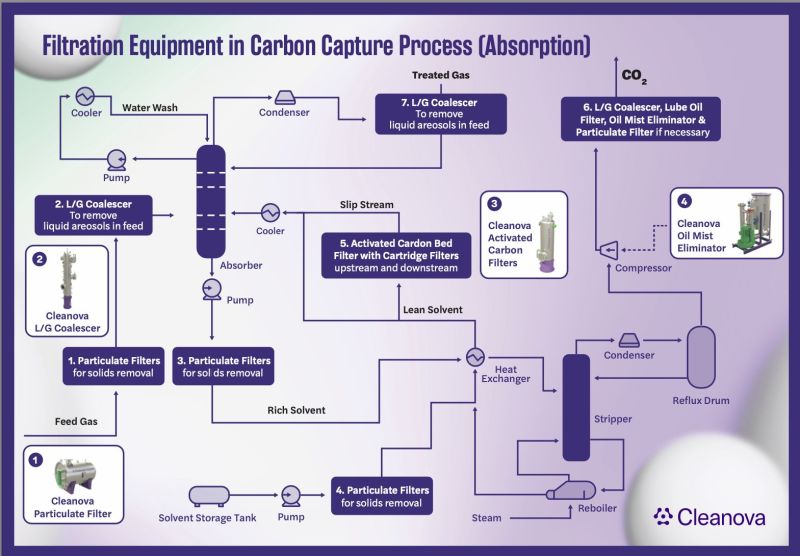
Any contamination reaching the top of the absorber column will directly impact CO2 quality and may lead to inefficient CO2 capture. Figure 1 illustrates the application of filtration in a solvent absorption system using a combination of:
– gas filters to reduce flue gas contaminants
– liquid particulate filters to maintain solvent quality and reduce absorber fouling, foaming and solvent degradation
– activated carbon filtration to remove residual organics and hydrocarbons.
Carbon dioxide can also be separated from the fuel before combustion occurs. The pre-combustion capture method is commonly used in integrated gasification combined cycle (IGCC) plants, where fossil fuels are converted into syngas. Filtration is required to remove impurities such as sulfur compounds, particulates and moisture from the syngas before CO₂ separation.
A third method is oxy-combustion, in which fossil fuels are burned in an environment of pure oxygen. This process relies on an air separation unit (ASU), to generate the pure oxygen required. Filters remove impurities from the incoming air, protecting the ASU and ensuring efficient oxygen production.
Transportation and storage
Captured CO2 is typically dehydrated and compressed to high pressure for transportation and storage. This is commonly known as the ‘Supercritical’ or ‘Dense Phase’ state. Filtration is essential for efficiency and safety during this process.
Contaminants such as water, lube oil, oxygen and hydrogen sulphide in the CO₂ can threaten pipeline integrity by causing corrosion or pipeline blockages. Solid corrosion products and pipe scale can also be carried downstream, fouling critical equipment such as control valves, metering stations, and high-pressure injection pumps. This increases maintenance costs and can involve equipment replacement or unscheduled downtime. Solid contaminants can also plug permeable storage reservoir pore structures, requiring increased energy for CO₂ injection and limiting the amount of available reservoir storage capacity.
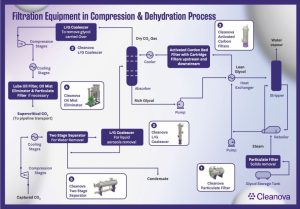
Figure 2 illustrates where filtration should be applied during the supercritical phase. Substantial care must be taken over the choice of filter materials, filter sizing and filtration rating
Advances in CCUS filtration
CCUS is developing rapidly. The challenge is to leverage the benefits of proven technologies like filtration to meet CCUS requirements. One example of success is Cleanova’s UNIQ-MAX filter technology. It addresses the issues that arise in absorption-based CCUS systems. With a market-leading solid removal capacity per unit area, these filters are configurable across a wide range of filtration efficiencies (1 – 100µ) and physical solvent types. This allows CCUS operators to use their solvent of choice (e.g. MEA/DEA, SelexolTM, or Purisol) in pre-combustion carbon capture systems. UNIQ-MAX filters are equally effective during high-pressure supercritical CO2 injection, where low particle concentrations are critical to efficient gas sequestration in depleted rock formations.
CCUS filtration outlook
Better filtration equipment alone will not solve the challenges of industrial-scale decarbonisation. No ‘standard’ CCUS system design currently exists and each application will have unique process challenges. End-users, CCUS system designers and filtration experts must collaborate in a new way to deliver optimal results. Cleanova C-CLEAN2 is one solution. This innovative approach facilitates early and direct access to market-leading filtration products and a global pool of engineering and process expertise. It provides tailored filtration solutions designed for each carbon capture process, based on the chosen method, load quantities, type of contaminants, CO2 concentration, pressure, and temperature.
Driving down costs, optimising uptime, and delivering high-quality products are common aims in any industrial application. The successful adaptation of existing filtration technologies to meet the specific requirements of CCUS operations is an ongoing process, and early collaboration is crucial to the success of our decarbonisation journey.
This article is based on the whitepaper “Carbon capture, utilisation and storage: a filtration perspective”, which is free to download here: https://www.cleanova.com/ccuswhitepaper/
References
1. https://unfccc.int/about-us/unfccc-archives/the-unfccc-archival-exhibition/the-paris-aghttps://www.cleanova.com/wp-content/uploads/2024/06/Cleanova-High-Capacity-Filtration-Bro_y24_final.pdf