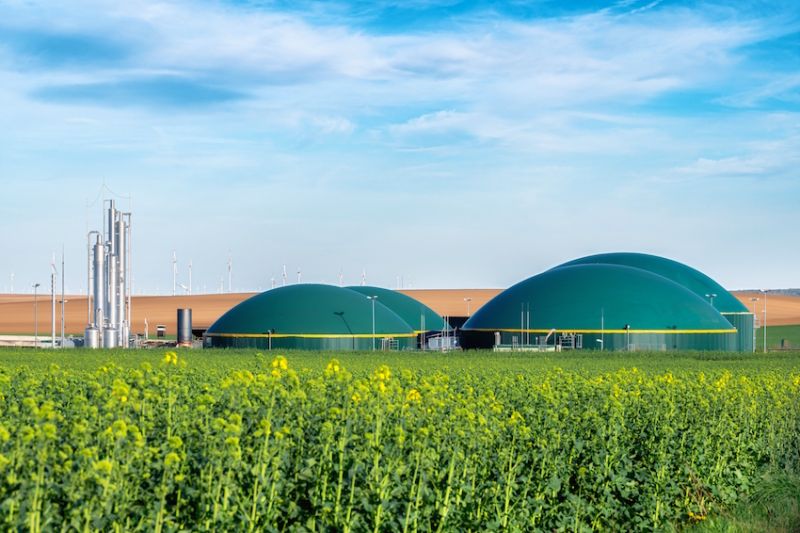
Global biogas production is expected to reach 142 billion m3 by 2026 and is currently a major focus for companies thanks to the potential of green hydrogen and the ability of biogas to deliver reduced greenhouse gas emissions. Sabine Artuso, product manager special gases with Donaldson’s Industrial Gases segment, highlights five areas where biogas producers can optimise efficiency and drive growth in their operations.

Sabine Artuso
Global biogas production has seen a consistent upward trend as countries increasingly adopt renewable energy sources to meet climate goals and reduce dependence on fossil fuels.
In the growing green energy segment, wind and solar power tend to attract many of the headlines, but it is worth remembering that energy generated from biomass is currently one of the most important – and fastest growing – areas within the segment. Some renewable sources like solar and wind are intermittent. Biomass can provide a more consistent energy supply, and it has unique characteristics that set it apart from other renewable sources.
Numerous organizations are exploring new opportunities in biogas production, ranging from major gas producers and agricultural operations to wastewater treatment plants and government agencies. The development of green hydrogen is fueling a lot of the growth, but it is important to remember that the demand is still relatively limited, given its high production cost as compared to the less environmentally-friendly grey hydrogen. This is why biogas remains such a vital sector: it provides a way to process and convert excess green gas into syngas (bi-reforming of methane), which can then be sold back into the gas market.
Biogas is created by taking a form of biomass (landfill, agricultural waste, slurry from water treatment plants, etc.) and putting it through a digester – a large container used to decompose material. The resulting gases from this process are then purified, filtered and separated to extract the biomethane which can then be injected back into the local gas supply for use by households and businesses. It can be a productive and lucrative process for many plant owners. Not only does it deliver biogas (methane) for sale back into the gas network, but it also offers opportunities to separate other useful components, such as in-demand carbon dioxide or biochar (carbon-rich material) which can be used as a fertilizer.
Biogas production offers multiple opportunities for emissions reductions; for example, through harnessing organic waste and using it to produce energy efficiently or by reducing dependency on less environmentally-friendly methods of energy production such as fossil fuels.
As companies look to reduce their environmental burden and deliver solutions that meet growing needs for energy and gas, it is easy to understand the growing appeal for biogas production. Here are five key areas where plant owners can take advantage of rising interest in the biogas production segment and focus their attention on getting optimal efficiency from their operations.
1. Be flexible
Each production facility is unique, and the biogas it produces can vary depending on the type of waste being processed. While the majority of biogas is made up of CO₂ and biomethane (which is ultimately what is injected into the gas network), there can also be traces of nitrogen, oxygen, or hydrogen sulphide. Having a plant that can deal with changing inputs and that offers flexible production or capture capabilities will ultimately reap rewards. This approach ensures designs are as effective as possible while keeping waste to an absolute minimum.
2. Get the size right
Europe stands as the world’s largest biogas market, boasting over 1,200 production facilities. Globally, the biogas sector is projected to achieve a compound annual growth rate (CAGR) exceeding 4.5% between 2019 and 2027. In addition to the need for flexibility, it is important that companies get their sizing right to cope with current and future capacity needs. This is particularly relevant for water removal, as inputs to the biogas digestor often have high water content. An optimally-sized filter will support effective water removal and high production rates. If the filter is full of water, however, gas cannot easily pass through. A production plant can outgrow its equipment; if production levels are not as expected, a new filtration system may be needed.
3. Go for quality

An example of a Donaldson ARBG biogas dehydration air dryer
Plant owners need production equipment that ticks multiple boxes. Filters should be designed to endure challenging production environments, resist corrosive gases, and allow for easy replacement of elements. Dryers must be energy efficient and able to accommodate variations in air flow. Filtration equipment must remove impurities but also offer in-built protection from them. Drying equipment must reduce humidity and moisture to ensure high-quality production. All of this must fit inside an optimised set-up focused on profitability with minimal cleaning and downtime risks. Ultimately, if a set-up delivers biogas faster, cleaner, and with better quality, then it is designed for productivity.
4. Design to standards
While policies and regulations vary from country to country, all are centred around a common framework defining quality standards, procedures, traceability, and compliance. In the future, quality standards for biogas production will likely become more stringent, so it makes sense to plan ahead. Companies should pay particular attention to the EU’s ATEX directives which harmonise safety rules for equipment in potentially explosive atmospheres. At Donaldson, we are seeing more customers specifying ATEX standards not only for compliance but to ensure the highest levels of quality and to help future-proof their facilities.
5. Maximizing Performance through Proactive Care
Regular maintenance is the cornerstone of ensuring optimal performance and longevity for biogas production facilities. By adopting a proactive approach to maintenance and partnering with trusted manufacturers like Donaldson, plant operators can minimize downtime, enhance productivity, and maintain the highest quality standards. A well-maintained facility not only secures operational efficiency but also supports long-term profitability, making maintenance an investment in the success and sustainability of biogas operations.
Efficiency wins
Biogas production is one of the best examples of truly circular business operations. It is a dynamic area where there is demand for increased production and higher quality with simpler and cleaner production.
With the exciting growth opportunities in volume and quality, the ultimate winners in the biogas arena will be those who can reach the highest levels of efficiency in production.