For years, the advice given to households worried about energy bills has essentially been the same: use less, writes Matt Stockdale, founder of The 22:23 Community Interest Company.
Turn down the thermostat. Switch things off. Buy more efficient appliances. Reduce consumption where you can. There is nothing wrong with that advice. But as electricity tariffs become more sophisticated, I think we need to add another question: not just how much electricity are we using, but when are we buying it?
That distinction could become increasingly important. Electricity can be considerably cheaper at certain times. With a suitable time-of-use tariff, households can buy electricity cheaply overnight and use it later when prices are higher.
The difficulty, of course, is that family life doesn’t conveniently happen at 2am. We cook dinner in the evening. We use washing machines, televisions, computers and appliances when we’re awake. People working from home use electricity throughout the day.
A home battery which stores electricity offers one way around that problem. It can charge from the grid during cheaper overnight periods and store that electricity until the household needs it. And one of the biggest misconceptions I encounter is that you need solar panels to have a battery. You don’t. A battery can simply be charged from the grid.
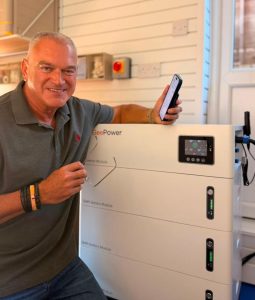
Matt Stockdale with installed system
I have been doing exactly that at my own four-bedroom family home. During my latest 31-day billing period, 95.4% of the electricity we took from the grid was purchased off-peak at 6.9p per kWh. Our grid electricity cost was £52.36 before VAT, including charging an electric vehicle.
Based on our previous costs, I estimate that changing how we buy and use electricity is saving us around £1,500 a year.
But that figure needs an enormous caveat: my house isn’t everybody’s house.
Battery economics depend on how much electricity a household uses, when it uses it, the tariffs available, the size and cost of the battery and how effectively it can shift consumption from expensive to cheaper periods.
Someone with substantial daytime electricity demand may have a very different calculation from a low-use household. If the potential annual saving is relatively small, spending thousands of pounds on a battery may make little financial sense.
That is why consumers considering battery storage should start with their electricity usage and tariff, not with the battery.
How much electricity do you actually use? When do you use it? What does your current tariff charge at different times? How much of your expensive electricity could realistically be replaced with cheaper stored electricity? And, crucially, how long would the resulting savings take to repay the upfront investment?
We need more transparency around those questions and fewer sweeping claims about what households can save.
There is also a bigger question here.
If one household charges a battery overnight and uses that stored electricity during peak periods, it makes virtually no difference to the electricity grid.
But what happens if hundreds of thousands, or eventually millions, of households do it?
Could domestic batteries become a significant source of flexible storage, shifting some household demand away from periods when the grid is under greatest pressure? I think that question deserves much greater attention.
Unfortunately, there is an obvious obstacle to wider adoption: you need money to save money. Battery storage, solar panels, heat pumps and many other technologies capable of reducing household running costs require substantial upfront investment.
Households with capital can invest today to reduce what they pay tomorrow. Households struggling most with energy costs may be unable to afford the technology that could help reduce those costs for years.
That is the problem I became interested in after seeing what battery storage was doing to my own electricity bill, and ultimately why I founded The 22:23 Community Interest Company.
We use collective purchasing and supply home battery systems at cost, without a conventional retail profit margin. That significantly lowers the financial barriers to accessing these types of technology. And the savings I am seeing means I will recoup that investment within 2 years, rather than within 10+ years which is often the issue with solar.
I’m not arguing that batteries are the answer to all household energy costs, or that they should replace solar, insulation, heat pumps or other measures. Energy efficiency and generation both have vital roles.
But we need to explore different ways of making energy-saving technology financially accessible rather than assuming the existing retail model is the only option.
That’s why I am making my own bills and usage data available for scrutiny. I’d rather people examine the numbers than simply accept a headline saving.
The energy affordability debate will understandably continue to focus on prices, price caps and support for households in difficulty.
But perhaps we need to broaden it. We shouldn’t only ask how we can help people pay for expensive electricity or persuade them to use less of it.
We should also ask how we enable more households to buy electricity when it is cheapest, store it and use it when they actually need it.
If existing technology can help suitable households take greater control of their long-term energy costs, then making that technology accessible deserves to be a much bigger part of the energy affordability conversation.
Learn more About The 22:23 Community Interest Company