In industry, sustainability is the word of the day, featured in boardroom conversations & corporate annual reports. But for manufacturers, promises are only as credible as the operations behind them, writes Nicole Berney, Health, Safety & Environmental Manager and Sustainability Lead, ABB.
Nicole Berney
Pledging net-zero targets is easy. Delivering them – on a factory floor where production targets don’t pause for sustainability goals – is where the real work begins. But there’s a misconception that doing so comes at the expense of cost efficiency. In reality, the two go hand in hand. When done right, energy efficiency and decarbonization reduce total cost of ownership over time. That’s the case we make to our customers, and it’s one we can stand behind – because we’ve lived it ourselves.
Our philosophy is simple: we are committed to decarbonizing faster than the industry norm – starting in our own operations, and taking that same expertise to help our customers run leaner and cleaner too.
Turning commitment into impact
For manufacturers, the most immediate and controllable emissions sit in what are known as Scope 1 and 2 categories. Scope 1 covers direct emissions from sources a company owns or controls – think on-site fuel combustion, gas-fired heating, company-owned vehicles or refrigerant leaks from HVACR systems. Scope 2 covers indirect emissions from purchased electricity, district heating, steam, or cooling a company purchases and consumes. Together, they are the baseline of any credible industrial decarbonization strategy – and the area where manufacturers have the most agency to change.
So what are we doing to ensure we lead by example? Our work falls broadly into two pillars:
Decarbonisation: eliminating the carbon sources themselves
- Drive Products sites have reduced Scope 1 & 2 GHG emissions 71% since 2019.
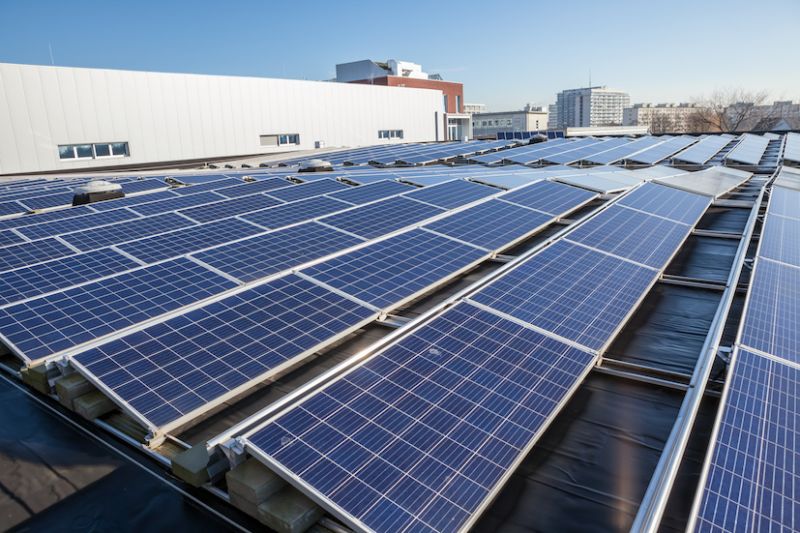
- We’ve transitioned all ABB Drive Products factories to green electricity, through rooftop solar panels and power purchasing agreements that channel investment into new wind, solar, and hydropower infrastructure.
- We’re electrifying how our factories are heated, moving away from fossil fuel dependency and towards systems that recover energy. At our Hornberg site in Germany, a new heat pump completely removes the site’s oil dependency – while at our Helsinki Drives factory, heat pumps capture and reuse thermal energy that would otherwise be lost. In 2023, the Helsinki heat pumps saved ~2650 MWh in consumption of district heating. HVACR overhauls have also reduced refrigerant leakages.
- Our New Berlin facility in US was designed as a zero-emission building from the ground up – geothermal HVACR, rooftop solar, all-LED lighting, and no natural gas connection. The same principles are now being built into a new facility in Nanjing, China.
- Decarbonization doesn’t stop at the factory gates. We’re electrifying our vehicle fleet too – currently at 54% fully electric, with a target to meet EV100 by 2030. When people can see that the organisation they work for is genuinely committed to sustainability – not just in its products, but in how it heats its buildings, runs its vehicles, and powers its operations – it changes how they feel about the work they do. That sense of purpose has real impact: our New Berlin facility has been named a top workplace in Milwaukee for three years running. Sustainability has become one of our strongest talent propositions, drawing in people who share that commitment and giving them a reason to stay.
Energy efficiency: using less energy to do the same work
With production volumes at some ABB Drive Products factories growing by as much as 40%, the task now is to produce more without proportionally increasing energy usage – and without sacrificing product quality or reliability. We approach this at two levels. At the production process level: we manufacture variable speed drives – these are the devices that control the speed and torque of electric motors in everything from pumps and fans to conveyors and compressors. But testing them is typically energy-intensive. Shorter test cycles and choke loading methods now deliver the same thorough validation with significantly less energy. At the factory level, building management systems and on-demand compressed air ensure energy is used only where and when it is needed.
The work we do at Drive Products is part of a broader Group-wide effort. At ABB Group level, that collective commitment has added up to a 79% reduction in Scope 1 and 2 greenhouse gas emissions against a 2019 baseline.
Living proof
The most distinctive part of our story is that we run our own facilities on the same drives and control systems that we design and manufacture for our customers. This means every efficiency claim we make to a customer is grounded in live, auditable results from our own production environment – not modelled projections, but real-world outcomes we’ve already validated ourselves. In an industry where sustainability claims are increasingly scrutinized, that distinction matters.
The most valuable lessons have not come from reports or projections, but from applying these solutions in our own operations and measuring the results. That experience gives us confidence that energy efficiency and decarbonization can go hand in hand with productivity and growth. Yet sustainability is never finished. The expectations, technologies, and opportunities continue to evolve – and so must we. The challenge is not simply to meet today’s standard, but to help define tomorrow’s.
ABB Group | Helping industries outrun – leaner and cleaner | ABB