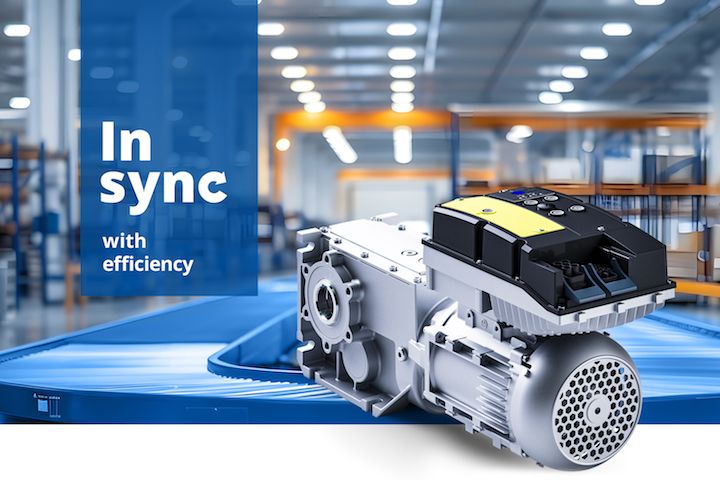
Lenze has introduced a new and compact IE5/IE7 motor drive system that meets the growing demand for energy efficient and sustainable solutions.
The drive system, which performs without sensors even in dynamic applications, consists of the m550/m650 motor, the g500 gearboxes and the newest generation of variable frequency drives, the i550 and i650.
According to the company, the first synchronous motor is as easy to use as an asynchronous motor and, thanks to its innovative design, it achieves energy efficiency classes IE5 and IE7. Furthermore, motor losses can be reduced by up to 60%, significantly lowering energy requirements and CO2 emissions, and its 300% overload torque accelerates the motor from standstill to full load, a benefit for the beverage industry, the textile industry and intralogistics, for example.
In fact the solution has already been tested in the intralogistics sector, as Klaus Dierkes, product manager Electromechanics at Lenze, explains: “Our customers are primarily interested in lower energy costs and reducing their carbon footprint. This is a very big issue, especially in logistics, and we can deliver this with the m550.”
The new synchronous motor m550 is available in the power range 0.25 – 11 kW, with the m650 for more dynamic applications in 0.75 – 22 kW. Both can be seamlessly combined with helical, angular or bevel gearboxes from the Lenze modular system.
Design
During the design phase, the first test customers worked with Lenze’s new System Designer, resulting in a precisely dimensioned drive solution and an energy- efficient machine concept. Dierkes commented: “Efficiency and usabilty are crucial for our customers. One must only enter one parameter to set the motor data on the variable frequency drive. There is no encoder, therefore less wiring, no adjustments and fewer components.”
A further benefit is the sensorless feedback – no encoder, no expensive feedback system, no expensive cables. Plus, mounting and installation are quick and safe, contributing to the reliability of the system.
If the motor is controlled with the decentralised variable frequency drives i550 or i650 motec, there is even less need for hardware, as brake resistors are not required. The regenerative unit integrated in the motec feeds any braking energy back into the mains; and the i500 cabinet frequency drives can also exchange excess energy via the DC network, making it available to other axes.
So, as the company explains, the system makes life easier for the user, scores highly in terms of energy efficiency and offers the potential for servo solutions.