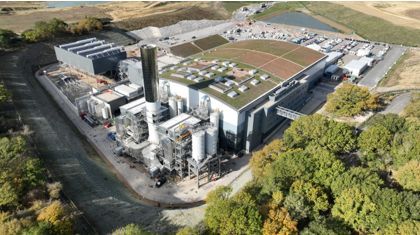
Indaver’s Rivenhall Integrated Waste Management Facility (IWMF) in Essex is now accepting and processing waste and exporting electricity to the grid, as the plant ramps up towards full operation.
The Rivenhall facility is Indaver’s largest-ever Energy-from-Waste project and represents a significant investment in sustainable waste management, energy security and circular economy infrastructure, for the region. The facility will process up to 595,000 tonnes of non-recyclable household and commercial waste each year, diverting material away from landfill, while generating enough electricity to power approximately 125,700 homes.
The project marks the culmination of a 4½-year construction programme, that began in 2021 and involved up to 850 people on site, contributing more than three million working hours during construction. The total investment amounts to 680 million euros or 589 million GBP.
Energy from waste
The facility forms an important part of the UK’s transition towards a more resource-efficient and lower-carbon future. Waste that cannot be recycled is transformed into valuable energy, reducing reliance on landfill while contributing to local energy resilience. The project reflects Indaver’s wider ambition to recover both materials and energy from waste, while helping the UK become more self-sufficient and independent from imported resources and fossil fuels.
John Tatton, General Manager of Rivenhall IWMF, said: “The opening of the waste to energy element of Rivenhall IWMF culminates the first part of exciting times ahead for Indaver. Myself and my team are really proud to be part of Indaver’s success and are looking forward to the challenge of operating this fantastic facility.”
Kristien Schoonjans, Group Engineering Director at Indaver, said: “The successful construction of this Energy-from-Waste facility reflects strong project governance and close collaboration between Indaver and Kanadevia Inova, bringing a complex EPC project through design, construction and commissioning into a fully operational facility”.
Rivenhall also builds on Indaver’s decades of experience in sustainable waste management and energy recovery. Across Europe, Indaver owns and operates multiple Energy-from-Waste facilities and continues to invest in technologies that maximise the recovery of both materials and energy from residual waste streams. By combining proven operational expertise with ongoing innovation in resource recovery, Indaver helps communities and industries extract greater value from waste, reduce environmental impact and advance the transition towards a circular economy.
Only the beginning of the story
Seamus Flynn, Director Municipal Solid Waste Services for Ireland and UK at Indaver, said: “We’ve now built a plant where we treat waste and produce energy. For Indaver, this is only the start of the story. We want to look at how we best use the electricity, the heat, the carbon and the ash from the facility.”
Plans are already progressing for a major greenhouse development adjacent to the site. The proposed project would utilise heat, electricity and CO₂ generated by the facility to produce food locally, creating a practical example of industrial symbiosis and circular economy thinking in action.
The greenhouse project has planning permission for 40 hectares of low-carbon greenhouses, which could source approximately 90% of their heat and 100% of their electricity and CO₂ requirements, from the Rivenhall facility. The development is expected to significantly reduce carbon emissions compared with conventional gas-heated greenhouses while supporting domestic food production and reducing reliance on imported produce.
In addition, Indaver is exploring opportunities to recover even more value from the facility’s bottom ash, including metals and critical raw materials, that can be returned to society.
As Rivenhall moves into full operations, the facility stands as a tangible example of the circular economy in action: transforming non-recyclable waste into energy, creating local jobs, supporting future food production, recovering valuable materials and preserving both natural and historic assets for future generations.