A recent article published in the Mail on Sunday regarding health concerns linked to blue-rich LED street lighting has reignited a vital conversation about the intersection of public health, environmental responsibility, and urban infrastructure.
As a leading innovator in lighting technology, Tridonic welcomes this scrutiny – and believes it’s time to move beyond compromise. Energy efficiency should never come at the expense of human well-being or ecological balance.
The article rightly highlights the risks associated with high-intensity, cool-toned LED lighting, particularly its impact on melatonin production, sleep disruption, and potential links to hormone-sensitive cancers. Medical experts and environmental researchers have been raising red flags about blue-rich LED lighting for more than a decade. Yet as the UK nears five million LED street lights, it’s clear that rollout has raced ahead while caution has lagged behind.
Tridonic’s Multichannel OTD Driver was developed precisely to address this challenge. It represents a new generation of outdoor lighting control – one that doesn’t force cities to choose between sustainability and safety. By enabling dynamic, tunable lighting, the Multichannel OTD allows operators to adjust colour temperature throughout the night. Cooler tones can be used during peak hours for visibility and security, while warmer tones – less disruptive to circadian rhythms and wildlife – can take over during quieter periods.
The ability to shift spectral output in real time is a powerful tool. It means councils no longer need to rely on fixed-output luminaires that emit blue-rich light regardless of context. Instead, lighting can be responsive – adapting to traffic patterns, pedestrian activity, and ambient conditions. Integrated sensors and intelligent dimming profiles further enhance efficiency, ensuring that light is only delivered when and where it’s needed.
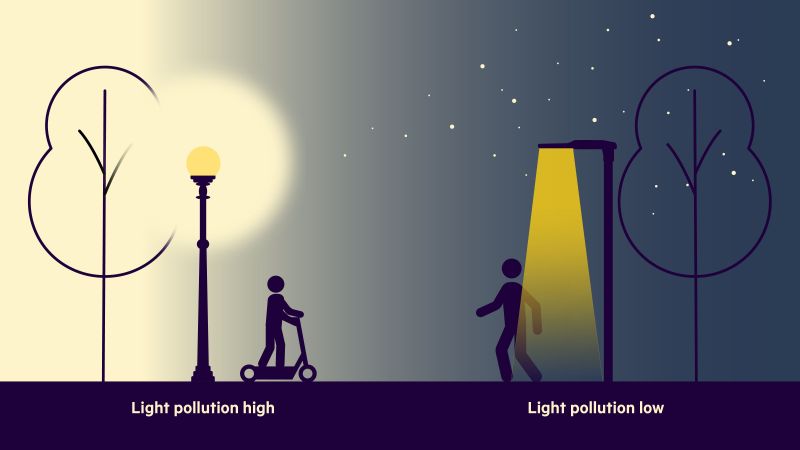
Importantly, this approach also supports dark sky principles. The Multichannel OTD system is engineered for precise beam control and minimal upward light output, reducing skyglow and preserving nocturnal environments. In an era of rising concern over biodiversity loss and ecological disruption, this is important.
The Multichannel OTD’s performance has been recognised with both an Energy Saving Award and a Gold Build Back Better Award, affirming its role in advancing sustainable, health-conscious urban lighting. These accolades reflect not just technical excellence, but a broader commitment to responsible innovation.
Technology can only take us so far; as recent coverage has shown, councils have often chased cost savings without fully considering the health impact of their lighting choices, and it’s time for that mindset to change. Tridonic urges local authorities, urban planners and policymakers to embrace adaptive lighting strategies that reflect the complexity of modern cities, along with the needs of the people who live in them.
Lighting shapes how we experience public space, how we sleep, and how we feel. As we move toward net zero goals and smarter cities, we must ensure that our lighting systems are not just efficient, but humane.
The shift is already underway, and the tools to make it happen are ready to go. With solutions like the Multichannel OTD Driver, the focus isn’t only on efficiency – it’s on improving everyday life.
Author: Richard Strode, Managing Director, Tridonic UK
For more Lighting news: https://essmag.co.uk/category/lighting/