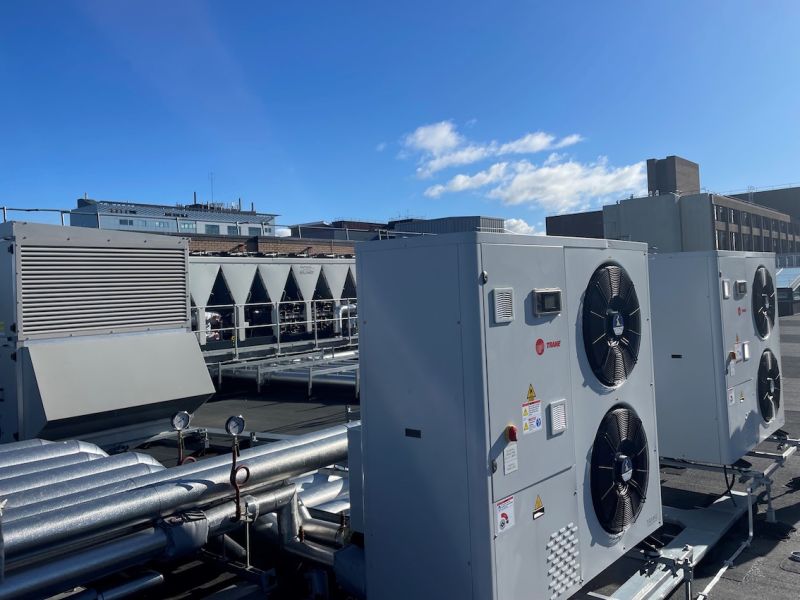
Decision-makers assessing lower global warming potential (GWP) heat pumps must weigh efficiency, refrigerant choice, installation practicality and lifecycle cost. According to Lee Ballard, regional technical sales manager, Trane UK, a useful approach is to assess heat pumps as year-round thermal assets.

The transition of the UK’s commercial and public building stock away from fossil fuel heating is no longer a distant regulatory target; it is an active operational challenge.
For facilities, building managers and estates teams, the pressure to decarbonise is paired with managing escalating operating costs, ensuring compliance, and future-proofing high-value assets.
For building owners, estates teams, consultants and contractors, the challenge is no longer simply whether to electrify heat, but how to make heating and cooling decisions that remain resilient over the long term.
That is particularly true in applications below 350 kW, where decision-makers assessing lower global warming potential (GWP) heat pumps must weigh efficiency, refrigerant choice, installation practicality and lifecycle cost. Reducing the conversation to upfront capital cost alone, or treating a heat pump as a like-for-like heating replacement, risks missing the bigger picture. A more useful approach is to assess heat pumps as year-round thermal assets.

Moving beyond separate heating and cooling silos
The UK building sector has traditionally treated heating and cooling as two separate silos: one system designed to provide cooling, and another dedicated to heating. In this setup, excess heat from cooling processes is routinely vented to the atmosphere. This creates an absurdity still common in many buildings today: a chiller rejects heat on one side of a plant room, while a boiler or separate heater is simultaneously burning fossil fuels to create new heat on the other. By looking at cooling and heating from the perspective of a thermal management system, we can turn this inefficiency around.
Managing heating and cooling together, allows buildings to capture thermal energy that would normally be wasted, and use it for comfort heating, domestic hot water, or other building processes depending on a facility’s operational needs. This matters because many commercial buildings do not have a simple, single-mode load profile. Schools, healthcare estates, offices, warehousing and industrial comfort applications all experience changing patterns of occupancy, internal gains and seasonal demand. Some require substantial winter heating. Others have meaningful cooling loads for much of the year. Many need both at different times or even simultaneously in different zones.
When we evaluate heat pumps as part of a wider thermal management system, the design conversation shifts to the annual operating profile: how the building uses energy across the year, at part load and peak load, during occupied and unoccupied periods, and across both heating and cooling demand.
A thermal management system, leveraging intelligent building controls and AI-powered energy optimisation, allows these components to function as a single, coordinated asset, delivering heating and cooling more efficiently and cost-effectively. There is no need to pay twice for the same thermal energy.
While some may assume that integrated thermal management will be too complex or cost-prohibitive to implement, these heat-pump-based systems can operate up to 400% more efficiently than traditional boiler-and-chiller setups. By recovering heat that is already paid for, they deliver substantial reductions in both carbon emissions and operating costs.
When long-term maintenance savings, compliance protection, and carbon reduction goals are factored into the Total Cost of Ownership (TCO), the financial case becomes highly compelling. Operational reliability and sustainability work hand-in-hand, and the incremental cost of installing an integrated system can often be recovered in just a few years.
For contractors, consultants and building owners, this creates a more practical basis for assessing what will work safely, effectively and economically.
Navigating the Refrigerant Transition
As the market transitions toward lower global warming potential (GWP) heating and cooling technologies, stakeholders need practical guidance, not a debate framed around a single technology alone.
The key question is not which refrigerant wins in theory. It is which solution is best suited to the application, the building constraints, the operating profile and the long-term strategy for the asset.
There is no ‘one-size-fits-all’ refrigerant; instead, we must remain refrigerant-agnostic, evaluating options by thermal performance, safety, regulatory trajectory, installation implications, maintenance requirements and lifecycle value.
For commercial applications below 350 kW, R290, a natural refrigerant with a GWP of zero, is a highly compelling option. It has excellent thermodynamic properties, enabling heat pumps to deliver outlet temperatures of 70˚C or more. In cooling mode, R290’s high-efficiency performance further strengthens the year-round business case.
Safety comes first
For contractors, consultants, building owners and end users alike, safety is not a secondary issue: it is fundamental to specification, installation and operation.
In the case of R290, the conversation must move beyond assumptions and focus on facts, standards, testing and practical implementation guidance. For all its thermodynamic and environmental benefits, R290 is classified as an A3 highly flammable refrigerant. At the same time, R290 systems are factory-sealed monoblocs, with safety designed in:
- Hermetically sealed circuits: minimising potential leak paths through rigorous factory manufacturing and testing.
- Ventilation and dilution: ensuring that any minor leak is immediately diluted by natural airflow below the lower flammability limit (LFL).
- Encapsulated electrical components: utilising ATEX-rated or intrinsically safe electrical enclosures to prevent ignition sources near potential leak points.
For contractors and installers, the shift to R290 requires upskilling, but not a revolution in working practices. Because systems are factory-sealed, the installer does not handle raw refrigerant on-site during standard installation. This simplifies installation, reduces on-site labour risks, and provides specification confidence to consultants.
Designing for Sector-Specific Realities
As a building’s operational profile is heavily dictated by its sector, thermal system design must reflect that reality.
- Healthcare – Estates teams in the NHS and private healthcare face a continuous, 24/7 demand for space heating, high-temperature domestic hot water, and critical cooling for diagnostics and ward comfort. Reliability is paramount. The ability of an R290 heat pump to deliver consistent, high-temperature water without supplementary heaters is a major operational advantage, while its high cooling efficiency supports critical summer infrastructure.
- Education – Schools and university campuses have highly seasonal occupancy and energy profiles. They require high heating capacities in winter but have low occupancy in peak summer. However, they still require domestic hot water year-round and comfort cooling for IT suites or lecture halls. Understanding this low-load summer profile prevents oversizing equipment, ensuring the heat pump operates within its optimal efficiency band during term times.
- Commercial Offices and Public Estates – These environments experience highly dynamic, occupancy-driven load changes. High solar gains and internal heat load mean cooling is often required even during spring and autumn. In these scenarios, a heat pump capable of highly efficient cooling and seamless control integration can leverage the ambient shoulder months to deliver exceptional seasonal efficiency.
Future-proofing means thinking in systems
For decision-makers, futureproofing is not just about buying equipment that meets today’s requirements. It is about making choices that remain resilient as regulations evolve, energy costs fluctuate and decarbonisation pressures increase.
Navigating this path requires a balanced, refrigerant-agnostic approach that prioritises practical application, safety, and long-term regulatory resilience. For commercial and public estates below 350 kW, refrigerants like R290 offer a clear, compliant, and highly efficient path forward, enabling organisations to invest with confidence in a future-ready built environment. In many cases, the greatest gains come not from viewing technologies in isolation, but from joining up the thermal strategy across the building.
Stakeholders should ask not only how a unit performs in isolation, but how it will function within the wider building environment over time. Will it integrate effectively with existing plant and controls? Can it support both heating and cooling needs efficiently? Is it suitable for the realities of retrofit?
As heat pump adoption grows, the market needs a more informed, practical conversation that helps building owners, consultants, specifiers, contractors and estates teams assess options with confidence. It should reflect real operating conditions rather than nominal assumptions, and frame heat pumps as part of a wider thermal management strategy, not merely as a heating replacement.
That is the basis for more resilient heating and cooling decisions, and for a more future-ready built environment.
Learn more https://trane.eu/uk/