Scope 3 emissions are often the largest part of an organisation’s footprint, and they are usually the hardest to measure well. This blog focuses on Category 1: purchased goods and services. Complex supply chains, inconsistent data, and varying supplier maturity make purchased goods and services particularly challenging to report.
So, where to start: supplier carbon footprints, product-specific cradle-to-gate data, or a structured supplier carbon audit? The answer depends on your reporting goals, required accuracy, and where improved data will add the most value.
Why average data has limits
Traditionally, Scope 3 emissions for purchased goods and services have been calculated using industry averages, secondary datasets, or spend-based emission factors. This remains a practical starting point, especially when supplier-specific data is limited. The GHG Protocol recognises these approaches as valid methods, particularly in the early stages of reporting or where better data is not yet available.
However, average-based calculations can only ever tell part of the story. No two suppliers operate in the same way. Processes vary, energy sources differ, operational boundaries are not always consistent, and emissions intensity can differ significantly between products that appear similar on paper. These differences are often lost in average-based calculations, masking the true supply chain footprint.
As reporting matures, stakeholders expect more transparent and decision-useful metrics, with improved data focused on material and high-impact areas.
Supplier carbon footprints: a practical starting point
In many cases, organisations begin by asking suppliers for high-level emissions disclosures or carbon footprints, usually aligned with the GHG Protocol. These reflect the supplier organisation’s emissions over a reporting period, often across Scope 1, Scope 2 and sometimes parts of Scope 3. They provide a useful view of a supplier’s overall emissions profile and maturity, and they are often easier to obtain than more granular product data.
Used in this way, supplier carbon footprints can play a valuable role in Scope 3 reporting. They help organisations engage suppliers early, provide indicative data where none previously existed, and support initial prioritisation by highlighting possible emissions hotspots across the supply chain. For many organisations, they are a pragmatic way to build early coverage and momentum.
However, a supplier carbon footprint is not the same as product-specific emissions data. A corporate-level footprint tells you about the supplier as a business but it does not tell you the emissions associated with the specific product or service.
Boundaries, assumptions and allocation methods can differ between suppliers, reducing comparability and confidence when the data is used for detailed decision-making.
Supplier footprints are not the same as product-specific cradle-to-gate emissions
This distinction matters. Under the GHG Protocol supplier-specific method for purchased goods and services, the most specific input is product-level cradle-to-gate greenhouse gas data. In other words, the data should relate to the actual good or service being purchased, not simply to the supplier’s organisation-wide footprint.
Product-specific cradle-to-gate emissions usually cover the emissions associated with a particular product up to the point it leaves the supplier’s gate. This can include raw material extraction, processing, manufacturing, energy use, waste from production, and upstream transport within the production supply chain before purchase. Transport from the tier-one supplier to the reporting company is generally considered separately under Category 4: upstream transportation and distribution, where applicable. Product-specific cradle-to-gate data is far more directly linked to what is actually being bought, making it more useful for Category 1 calculations, hotspot analysis and procurement decisions.
Both data types have value: supplier footprints provide context on maturity and broad emissions profile, while product-specific cradle-to-gate data supports more precise emissions analysis.
As a result, supplier carbon footprints are best viewed as a first step to build an initial Scope 3 emissions picture but, on their own are often insufficient for robust reporting, target setting or investment decisions.
Supplier carbon audits: a structured route to better data
A supplier carbon audit is not a formal GHG Protocol calculation method, but a useful way to describe a structured process for collecting and validating supplier-specific emissions data. It focuses on activity data, product-level detail and calculation transparency, rather than proxy data or high-level disclosures.
This is as much about supplier engagement as carbon accounting, involving structured data collection on materials, energy, production and transport.
Data is reviewed for internal consistency, transparency and methodological fit. This includes checking system boundaries, inclusions, supplier response comparisons against expected activity levels, and resolving gaps or anomalies through follow-up discussion. The aim is not a false sense of precision, but more robust and defensible reporting.
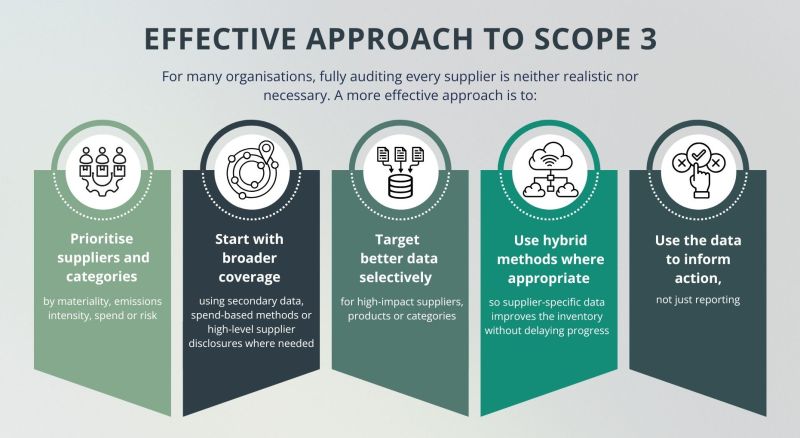
Building on this, organisations often move towards supplier-specific and hybrid methods recognised by the GHG Protocol, using product-level cradle-to-gate data for key purchases and secondary data to address remaining gaps. For most, this blended approach is more practical and scalable than aiming for complete data from the outset.
Compared with standard supplier carbon footprints alone, this structured approach delivers stronger insight, better alignment with reporting practices, and a clearer view of true emissions hotspots. Crucially, it creates a more credible foundation for supplier engagement and decarbonisation planning.
What’s the trade-off?
More detailed supplier data collection requires time and sustained engagement, making it harder to scale across complex supply chains. Organisations therefore prioritise effort where emissions are likely to be highest.
When do you need which?
Organisations are more likely to rely on supplier carbon footprints in early-stage Scope 3 reporting, where broad directional insight is needed or supplier capability is limited. In these cases, high-level disclosures offer a practical way to build initial visibility without creating disproportionate burden.
Organisations tend to move towards product-specific cradle-to-gate data and more structured supplier reviews when individual suppliers represent a material share of Category 1 emissions, when the data needs to stand up to greater scrutiny, or when procurement decisions and reduction strategies depend on it.
The goal is not to apply the most detailed method everywhere, but to use the right level of data quality for the purpose at hand.
Final thought: it’s about fit for purpose
Scope 3 is not about defaulting to the most detailed methodology everywhere. It is about using data that is fit for purpose, transparent enough for decision-making and proportionate to the materiality of the emissions involved, with a clear understanding of how Scope 3 factors and categories are defined in practice.
High-level supplier footprints provide context. Product-specific cradle-to-gate data offers stronger Category 1 evidence, while structured supplier reviews build confidence where it matters most.
The organisations that succeed focus less on volume and more on building a structured approach, improving data quality over time, and targeting effort where it delivers the greatest impact.