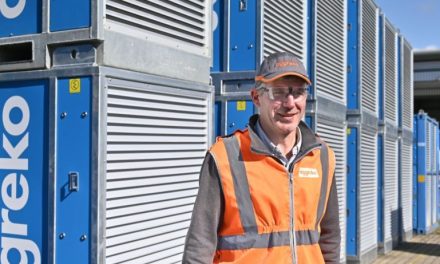
By Simon Alderson, CEO of infrastructure security specialist, First Response Group
Criminal activity targeting UK energy infrastructure can have serious national implications, placing crucial emphasis on rigorous, year-round monitoring and security. Facilities classified as ‘critical national infrastructure’ (CNI) are essential for society’s continuous functioning; their disruption has far-reaching effects. These include facilities not simply related to energy, but also water, transportation, health, and telecommunications.
Practically, crime in these areas can severely impact trains, public transport, highways, and telecommunications, even disrupting emergency services. CNI also includes banking, nuclear facilities, food distribution, and data centres, whose disruption would affect millions. The Centre for the Protection of National Infrastructure (CPNI) considers national infrastructure core targets for foreign intelligence services, often aimed at espionage for economic, political, military, or commercial advantage.
Even in times of comparative peace, hostile states, cyber criminals, and terrorists regularly target infrastructure, seeking to test resilience, engage in espionage, or extort. While CNI security is primarily managed by the government, MOD, and police, many facilities fall under independent security companies’ daily oversight. This includes railway and highway construction sites, ports, and distribution centres, whose disruption has strategic effects. Protecting assets in these facilities is crucial, as they are costly and attract both professional and opportunistic criminals. Crime affecting infrastructure can indirectly impact schools, hospitals, and public events, highlighting the widespread consequences of security breaches.
Collaboration with the government is essential. Agencies provide central government, regulators, and infrastructure operators with crucial guidance on risks and mitigation. For instance, the Centre for the Protection of National Infrastructure (CPNI) delivers protective security advice across the UK’s critical infrastructure, working closely with independent security firms and government agencies to minimise vulnerabilities to terrorism, espionage, and other national threats.
As technology advances and criminals grow increasingly sophisticated, staying ahead in both physical and digital security is paramount. Crime targeting infrastructure demands continuous threat assessment and evolving security practices.
Over the years, First Response Group (FRG) has become a trusted name in infrastructure security, safeguarding assets from ports and data centres to rail, including projects like Crossrail and HS2, as well as highways and water supplies. As part of the National Infrastructure Crime Prevention Partnership, FRG unites with UK industry leaders and government agencies – including police – to secure vital infrastructure. Together, they provide strategic direction, share intelligence, and uphold best practices in security.
A typical construction site is land where building or engineering work occurs, but infrastructure projects like highways, bridges, Crossrail, or new power stations bring unique challenges. The scale alone can be daunting; for example, the HS2 site spans 140 miles, requiring complex logistics and careful planning to secure vast areas.
In a different sector, the £20 million upgrade at Chalton’s Water Recycling Centre posed similar issues. Managed by the Anglian Water @one Alliance, the first task was to secure the 1.7-mile perimeter against trespassers, who posed health and safety risks. Limited power at the site made supporting CCTV systems a challenge, compounded by high volumes of modular deliveries that risked disrupting the nearby town. Over the project’s 52-week lifecycle, FRG implemented CCTV coverage, 24/7 monitoring, and audiovisual alarms. Trespassing remains a major issue on large sites with many contractors, demanding robust systems and full audit trails to manage site access. The security of these sites goes beyond crime prevention, extending to health and safety measures to protect workers and visitors alike.
The government, through the Department for Energy Security and Net Zero, plays a pivotal role in overseeing security measures and collaborating with industry stakeholders. Areas of focus include cybersecurity, physical security, supply chain resilience and climate change adaptation of more than 2,000 UK electricity generating stations and offshore and onshore gas production sites, plants, pipelines and storage facilities. The transition to a low carbon economy will continue to evolve the energy sector, presenting new challenges and opportunities.
While some infrastructure has long been part of the UK, newer developments like data centres (recently classified as Critical National Infrastructure) and solar farms bring new security challenges. Cyber security remains a pressing issue, with ransomware the leading threat, as noted in the NCSC 2023 review. The Ukraine conflict has heightened risks from state actors aiming to disrupt critical services. Although critical sites have resilience measures, recent events show vulnerabilities, and the public remains at risk from these evolving threats.