A parked electric car could soon power your hotel room, thanks to researchers at the University of Salford. This forms part of a Horizon Europe and UKRI-funded project focusing on the tourism accommodation sector, a key industry on the Isle of Wight.
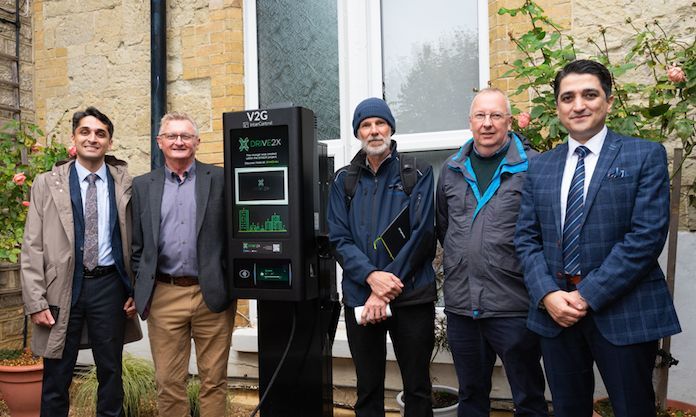
Working closely with a community interest company on the Isle of Wight, Future Isle of Wight CIC, and a range of other international partners, the team at the University of Salford has been involved in the launch of a state-of-the-art bi-directional EV charger at a pilot hotel in Shanklin. The charger, part of the international DriVe2X project, allows EVs not only to charge from the electricity grid but also to return stored energy to the building when demand is high.
The system is managed by smart charging algorithm developed at Salford, which calculates the best times for cars to charge, or discharge, based on energy prices, building needs, and driver preferences. This reduces costs, lowers emissions, and makes the most of renewable energy such as solar panel.
Professor Vahid Vahidinasab, Chair in Sustainability at Salford Business School, the University of Salford, said: “Electric vehicles can be more than just transport. They can store clean energy, share it when needed and help homes and businesses save money. Our goal is to make that practical and accessible for everyone.”
Vincent Wedlock-Ward, MBE, Director and Founder of Future Isle of Wight CIC, said: “Partnering with Professor Vahidinasab of the University of Salford on the DriVe2X project has been transformative for our community. By trialling bi-directional EV charging in tourism accommodation as a key business sector, we are helping businesses cut energy costs during peak seasons, strengthening the Island’s energy resilience, and creating new opportunities for green jobs and skills development and also demonstrating how smart, sustainable innovation can be scaled to benefit local economies across the UK.”
The Isle of Wight pilot aligns with the UK Government’s Clean Power 2030 plan and Ofgem’s Clean Flexibility Roadmap, which highlight the role of citizen-led flexible energy solutions, including smart EV charging and V2G, in building a reliable and affordable energy system.
Salford’s work demonstrates how data-driven innovation can support both business operations and sustainability goals, helping communities thrive while cutting emissions.
Learn more: https://www.salford.ac.uk/
For more news, click here.